
The Hunt of the Unicorn, Notes on Symbolism and Color Palette.
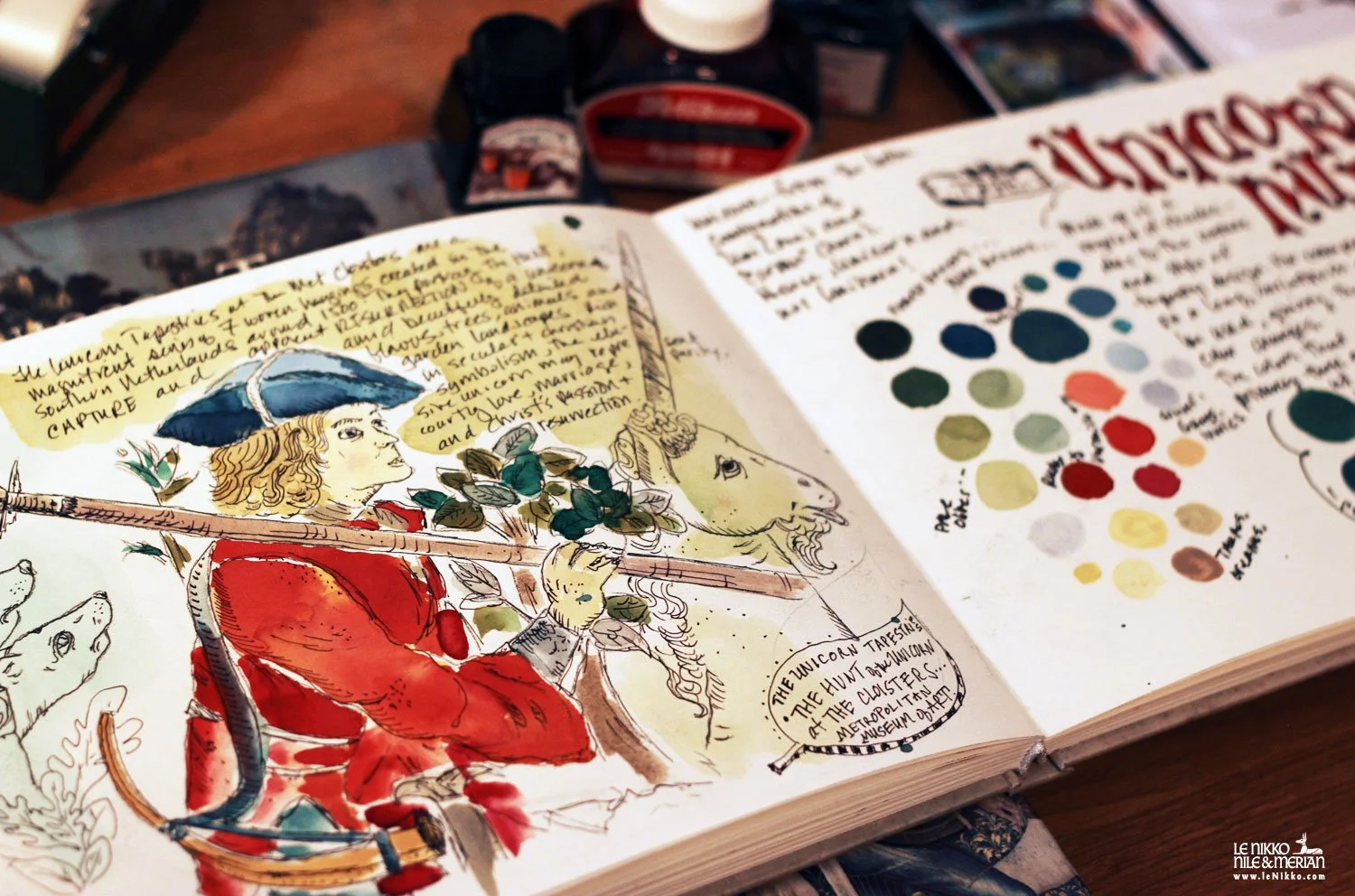
My sketchbook with The Unicorn Tapestries color palette.
Like ‘The Lady and the Unicorn’ tapestries found at the Cluny Museum in Paris, ‘The Unicorn Tapestries,’ or the ‘Hunt of the Unicorn,’ are a series of beautifully woven panels, rich in color. But whereas the Cluny series is predominately red, The Unicorn Tapestries that reside at The Met Cloisters in NYC includes a much more verdant palette.
About the Unicorn Tapestries…
Woven from luxurious wool, silk, silver and gilded threads, the series of seven panels depict a hunt for the unicorn, an elusive and magical creature.
Highly symbolic with intricate detail, the Unicorn Tapestries are a magnificent series of seven woven hangings created in Brussels around 1500. They portray the hunt, capture, and apparent resurrection of a unicorn amid extraordinarily detailed flowers, trees, animals, and garden landscapes. Rich in both secular and Christian symbolism, the elusive unicorn may represent courtly love, marriage, purity, and Christ’s Passion and resurrection.
Though noted that they were woven in Brussels, they were most likely designed in Paris, according to the museum. There’s also some debate on the order of the panels, but I believe this is the sequence as shown at The Met Cloisters.
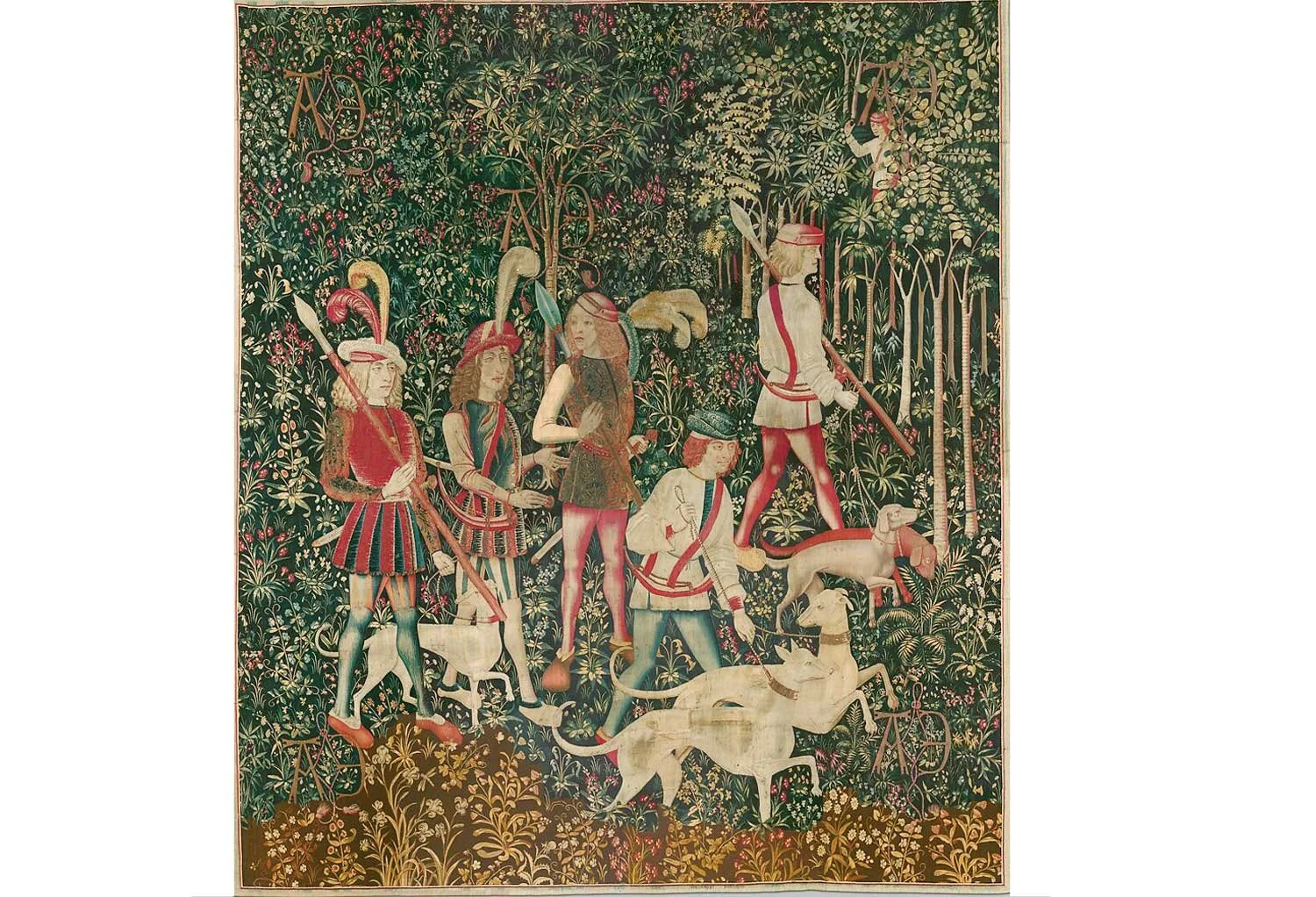
The Hunters Enter the Woods, at the Cloisters, Met Museum
The Hunters Enter the Woods…
In The Hunters Enter the Woods, a richly dressed company of noblemen, huntsmen and hounds gathers beneath the trees at the beginning of the quest. The unicorn itself has not yet appeared, giving the scene an expectant air as the hunters confer and prepare to follow its trail. Woven around 1495–1505, the tapestry introduces the aristocratic world of the hunt while surrounding its figures with the extraordinarily detailed flowers, trees and animals that distinguish the entire series.
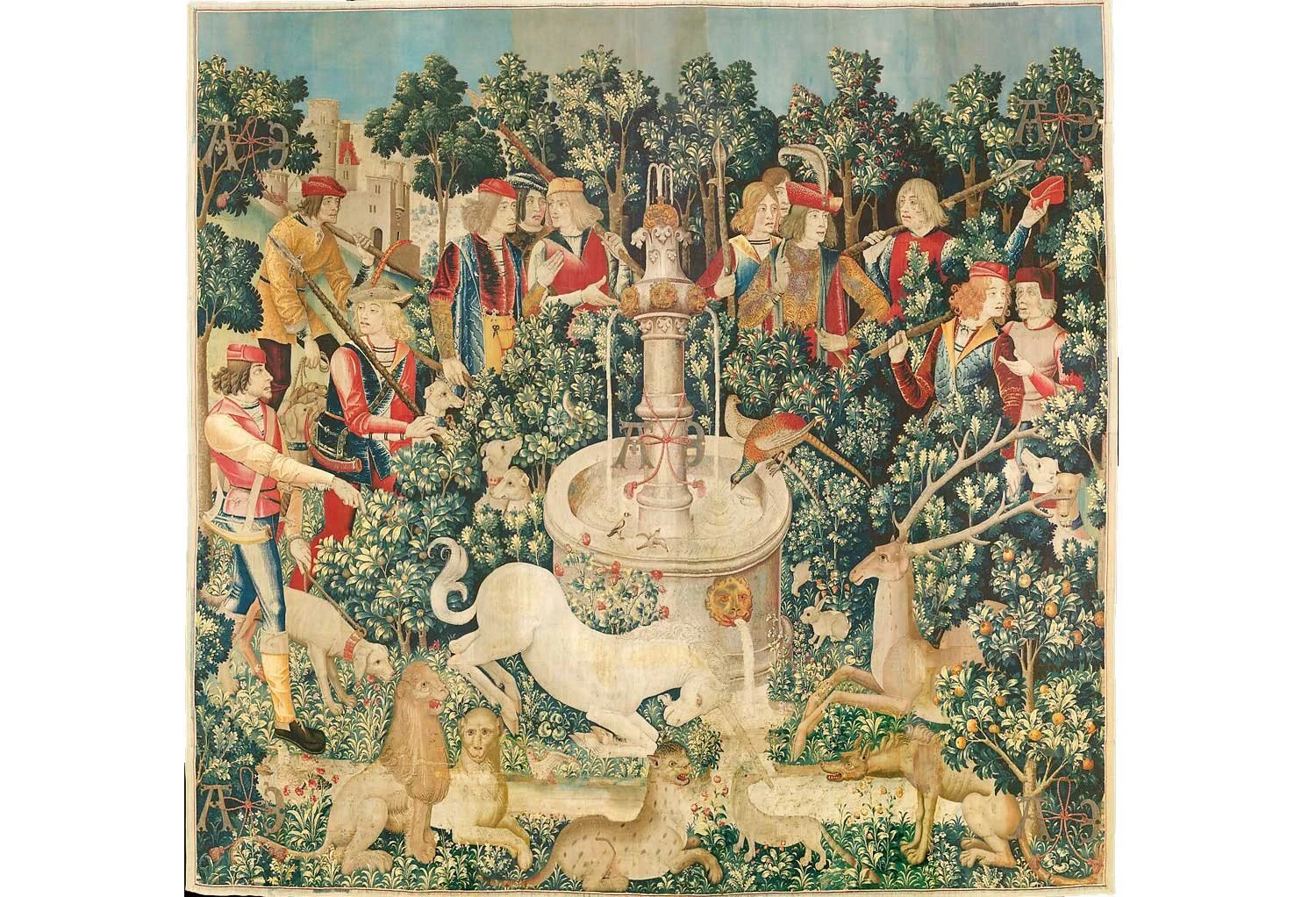
The Unicorn Purifies Water by touching his magical horn into the stream.
The Unicorn Purifies the Water…
In The Unicorn Purifies Water, also traditionally called The Unicorn Is Found, the unicorn kneels beside a fountain and dips its horn into the flowing water. According to medieval legend, a serpent had poisoned the stream, but the unicorn’s horn possessed the miraculous power to cleanse it so that the gathered animals could safely drink. The scene may also carry Christian meaning, with the purifying unicorn representing Christ, while the fountain and abundant plants suggest spiritual renewal, healing and the restoration of life.
In this panel, the Unicorn purifies a stream which is blanked not only animals, but plants which were known in the Medieval era to be antidotes to poisoning - sage, pot marigolds, and orange etc.
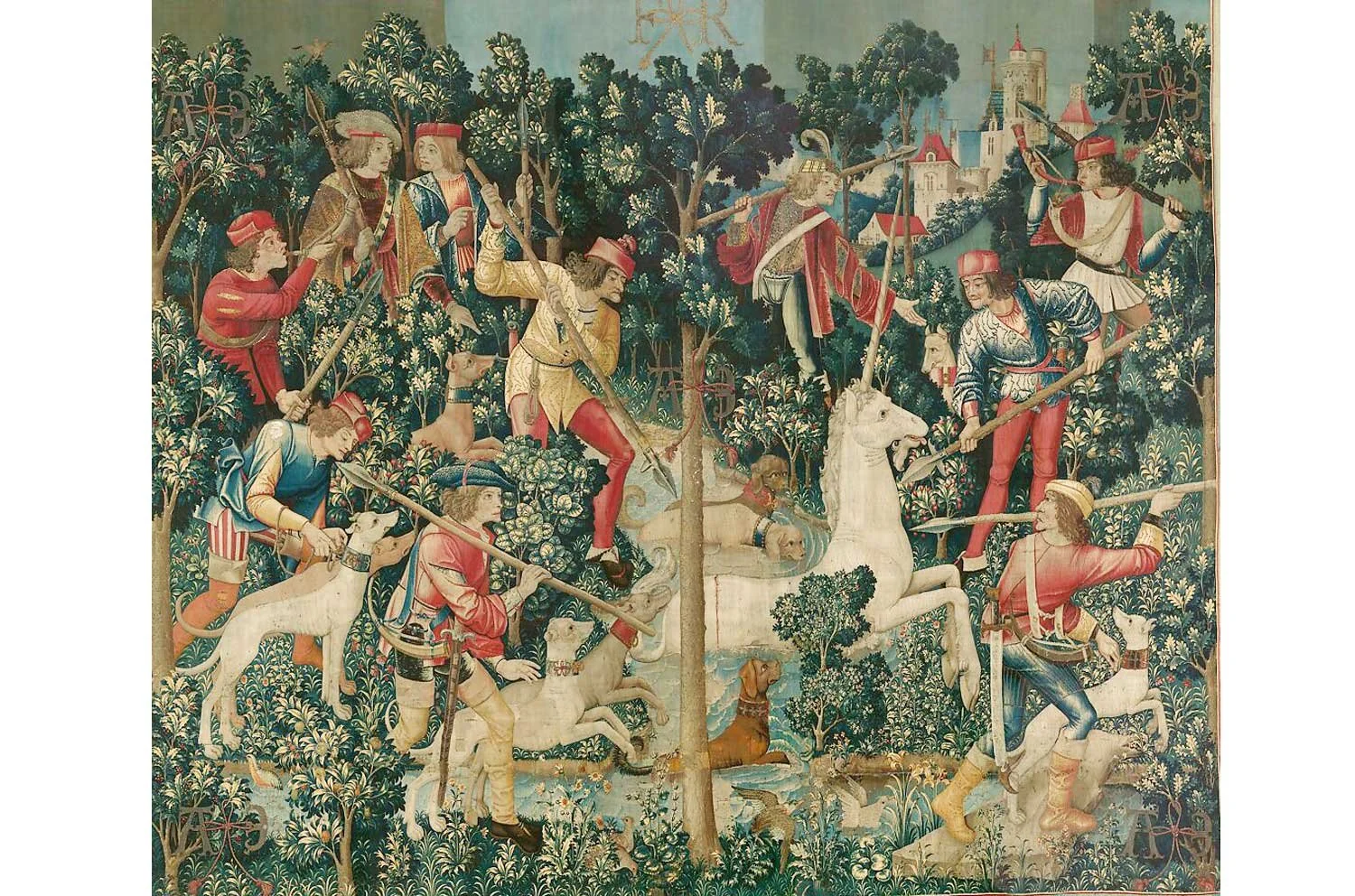
The Unicorn Crosses a Stream
The Unicorn Crosses a Stream…
The peaceful discovery gives way to violence in The Unicorn Crosses a Stream, formerly known as The Unicorn Is Attacked. The unicorn leaps across the water as hunters, hounds and converging lances surround it, creating one of the most energetic compositions in the series. Although greatly outnumbered, the animal remains powerful and elusive, embodying both the untamed beloved pursued in medieval courtly poetry and, in a Christian interpretation, Christ pursued by his enemies.
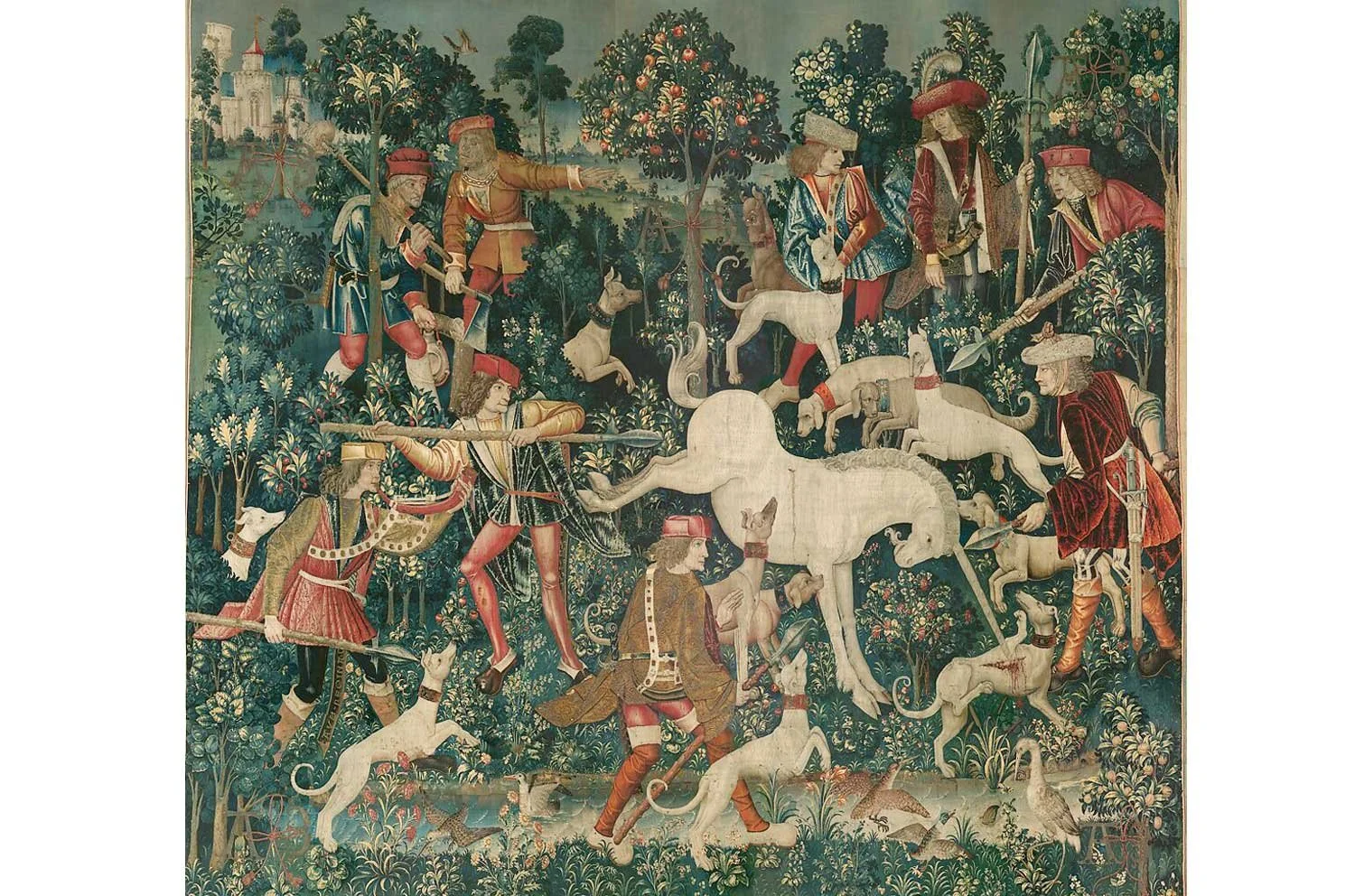
The Unicorn Defends Itself
The Unicorn Defends Himself…
In The Unicorn Defends Himself, the wounded creature turns fiercely upon its attackers. Held at bay by three hunters with raised lances, the unicorn lashes out at one of the hounds with startling force, demonstrating that it cannot be conquered through strength alone. The tapestry combines brutality with remarkable beauty: the violent action unfolds amid flowering plants, birds and woodland animals, making the unicorn’s struggle appear at once earthly, legendary and symbolic.
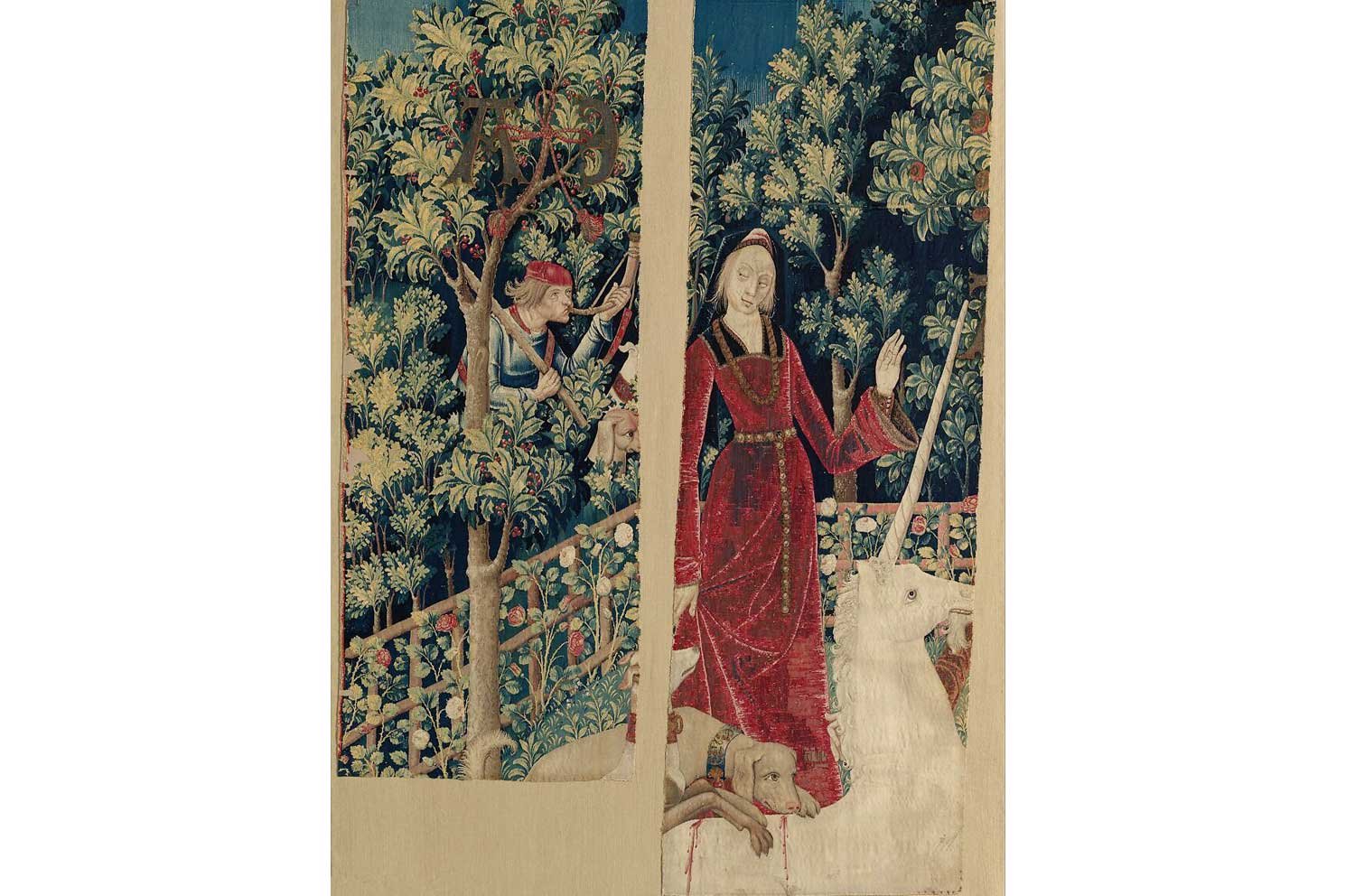
The Unicorn Surrender to a Maiden
The Unicorn Surrenders to the Maiden…
Only two fragments survive from The Unicorn Surrenders to a Maiden, sometimes called The Mystic Capture of the Unicorn. According to medieval bestiaries, a unicorn could never be taken by hunters but would become gentle in the presence of a virgin, resting trustingly beside her. Here the maiden sits within an enclosed garden, a traditional symbol of purity, while her hand tenderly touches the unicorn’s mane and approaching hounds prepare to seize it. The scene could be understood as a courtly allegory of love or as a Christian image of Christ’s Incarnation through the Virgin Mary.
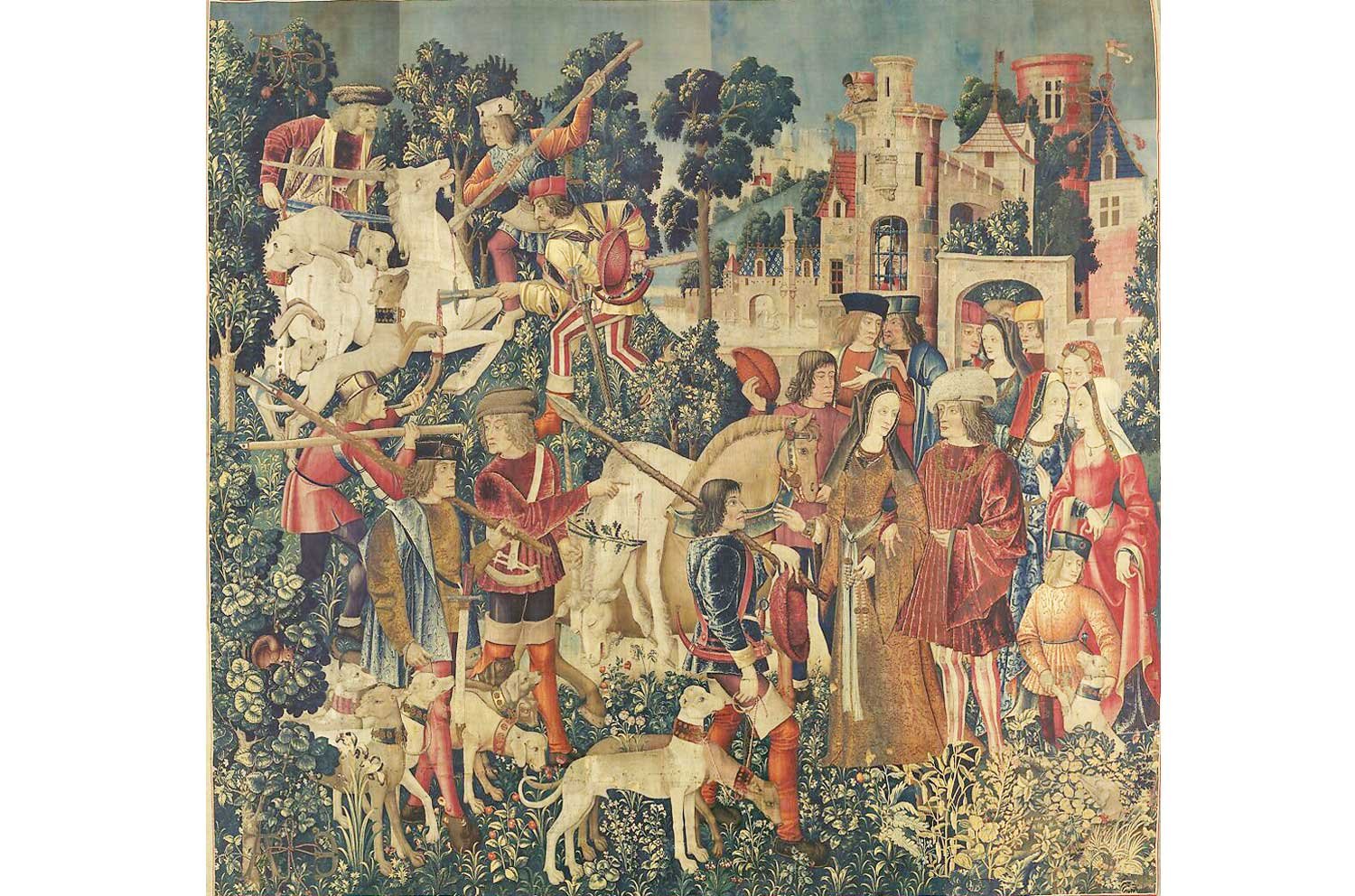
The Hunters Return to the Castle
The Hunters Return to the Castle…
In The Hunters Return to the Castle, the hunt reaches its tragic conclusion. At the upper left, the unicorn is killed by the hunters; below, its lifeless body is carried across the saddle of a horse and presented to a noble lord and lady before their castle. Details recalling Christ’s crown of thorns and pierced body have encouraged the tapestry’s interpretation as an image of the Passion, while its courtly setting may also connect it with marriage, fidelity and the symbolic capture of a beloved.
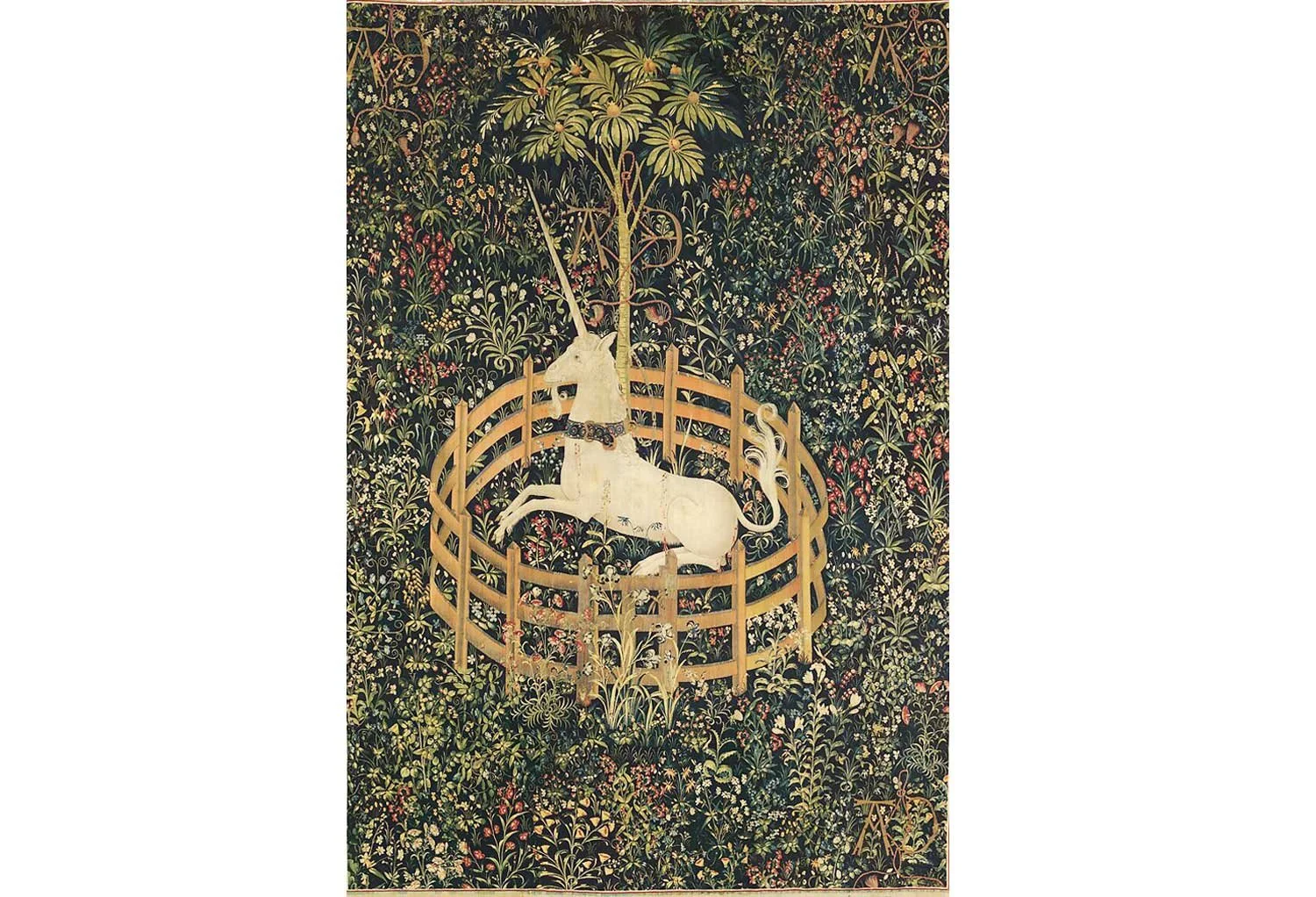
The Unicorn Rests in a Garden. Interestingly, the museum says it’s possible this panel was created separately and not meant to be part of the series, though it does match in tone and artistic style. At the Cloisters, this panel is the last in the series.
The Unicorn Rests in a Garden…
The most famous of the series, The Unicorn Rests in a Garden, often called The Unicorn in Captivity, shows the creature alive again, peacefully seated within a low circular fence. A golden chain fastens its jeweled collar to a pomegranate tree, yet the chain appears delicate and the fence could easily be crossed, suggesting that the unicorn remains willingly rather than forcibly confined. The ripe pomegranates symbolize fertility, marriage and abundance, while the resurrected animal may represent the risen Christ. Scholars believe this tapestry may have been created as an independent celebration of a lover happily bound to the beloved, rather than as the original final scene of the hunt.

The Unicorn Hunt color palette in my sketchbook.
The Unicorn Tapestries Color Palette…
The palette of the Unicorn Tapestries is made extensive by use of woven shading. What I mean is, there appears to be more colors than there actually are due to the excellent and amazing skills that produced these panels. Subtle shading with varying threads tricks the eye into seeing extended tones.
That said, the palette is obviously full of greens and rich jewel hues.
I’ve attempted to create a palette for my sketchbook, and the colors include ones that are produced by this shading.
Blues, greens, shades of red, including vermillion and pinkish tones, creams and browns. But the play of green against its complimentary color red are the stars of this tapestry set.
Ending With a Mystery, A & E…
The intertwined A and E, more properly called a cipher or monogram, remain one of the great mysteries of the Unicorn Tapestries. They may represent the initials of a married couple, the first and last letters of one person’s name, or even words from a family motto. One earlier theory identified the letters with Anne of Brittany, proposing that the tapestries celebrated her 1499 marriage to Louis XII of France, but later scholars found insufficient evidence for this attribution. Other interpretations, including “Adam and Eve,” are also speculative.
We likewise do not know with certainty who commissioned the tapestries. They were probably designed in Paris and woven in the Southern Netherlands around 1495–1505 for a very wealthy aristocratic patron—possibly to commemorate a marriage. Their first definite appearance in history comes much later, in a 1680 inventory belonging to François VI de La Rochefoucauld. Although the La Rochefoucauld family owned them for generations, the tiny surviving coat of arms on one hunter’s dog does not match that family’s arms, and the A and E cannot be convincingly connected to them. Therefore, the safest answer is that both the meaning of A and E and the identity of the original patron remain unknown.