
Symbolism In Owls, Antiquity to Renaissance
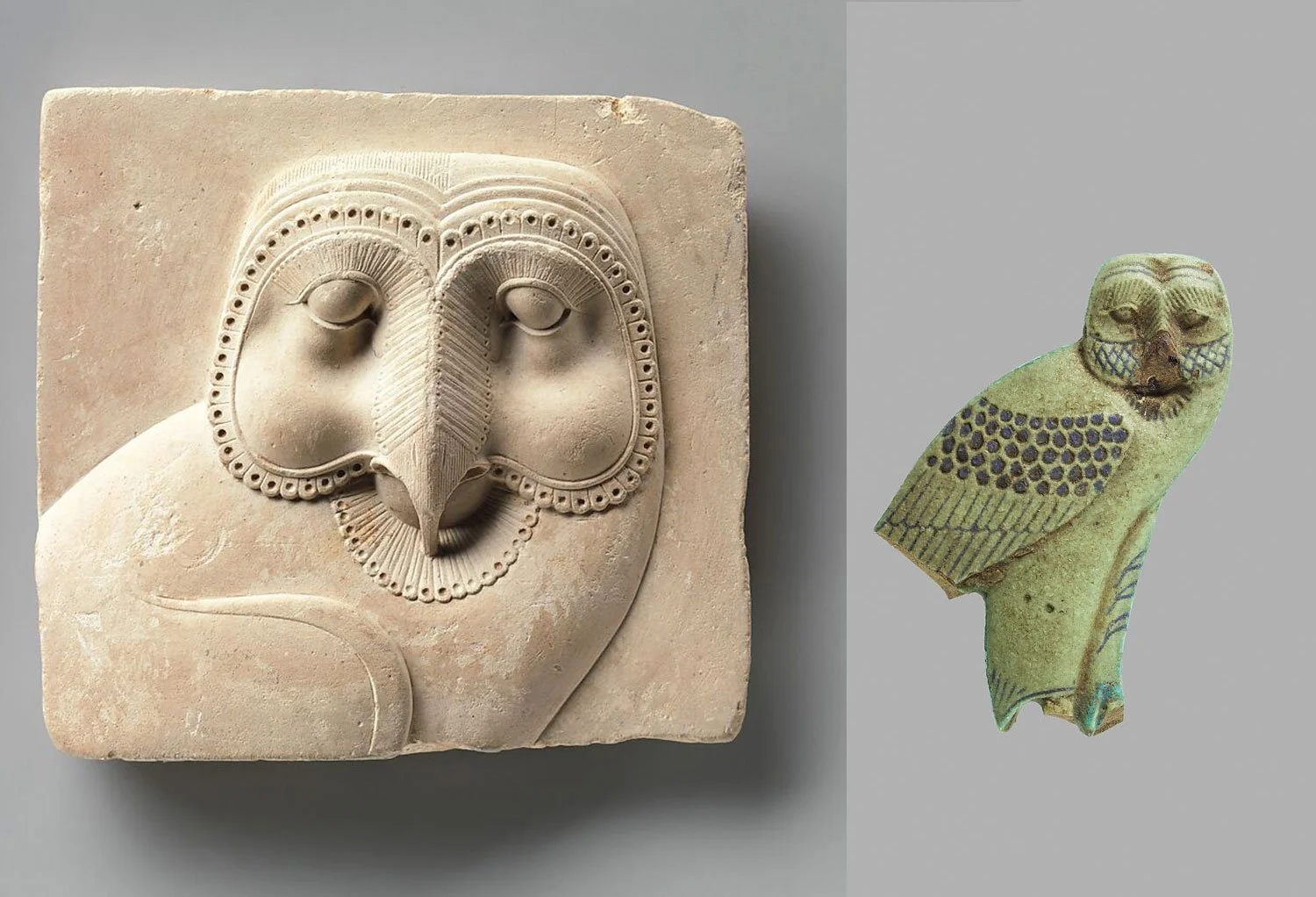
Hieroglyphic owl faces, in relief and faience, both from the Met Museum, Ptolemaic period, Egypt.
Owls have always intrigued me. Most of all because I’ve never actually seen one in the wild, only in captivity at zoos or one time in Edinburgh on the street with his trainer. I am a very early 3 am-ish riser, and every morning for a long time I listened for what I thought was an owl calling. It turned out it was the coo of a Mourning Dove! How disappointing, not that I have anything against the dove, I just really wanted it to be an owl.
Anyway, owls have, like Dachshunds, a unique shape for their species and it’s my opinion that it’s one of the reasons they have become iconic. That, and the fact that they are creatures of the night which instantly gives them an aura of mystique. And who wouldn’t want that?
The Owl Through History: Wisdom, Night and the Unseen
Few creatures have carried such contradictory meanings through history as the owl. It has been revered as the companion of a goddess, feared as a messenger of death, painted beside mysterious deities, carved into amulets, stamped upon coins and placed in the margins of illuminated manuscripts. Its symbolism has never belonged to wisdom alone. Because the owl sees and hunts in darkness, hears what human beings cannot and calls into the night with an eerily human voice, ancient and early modern cultures repeatedly placed it at the threshold between the familiar world and the unknown.
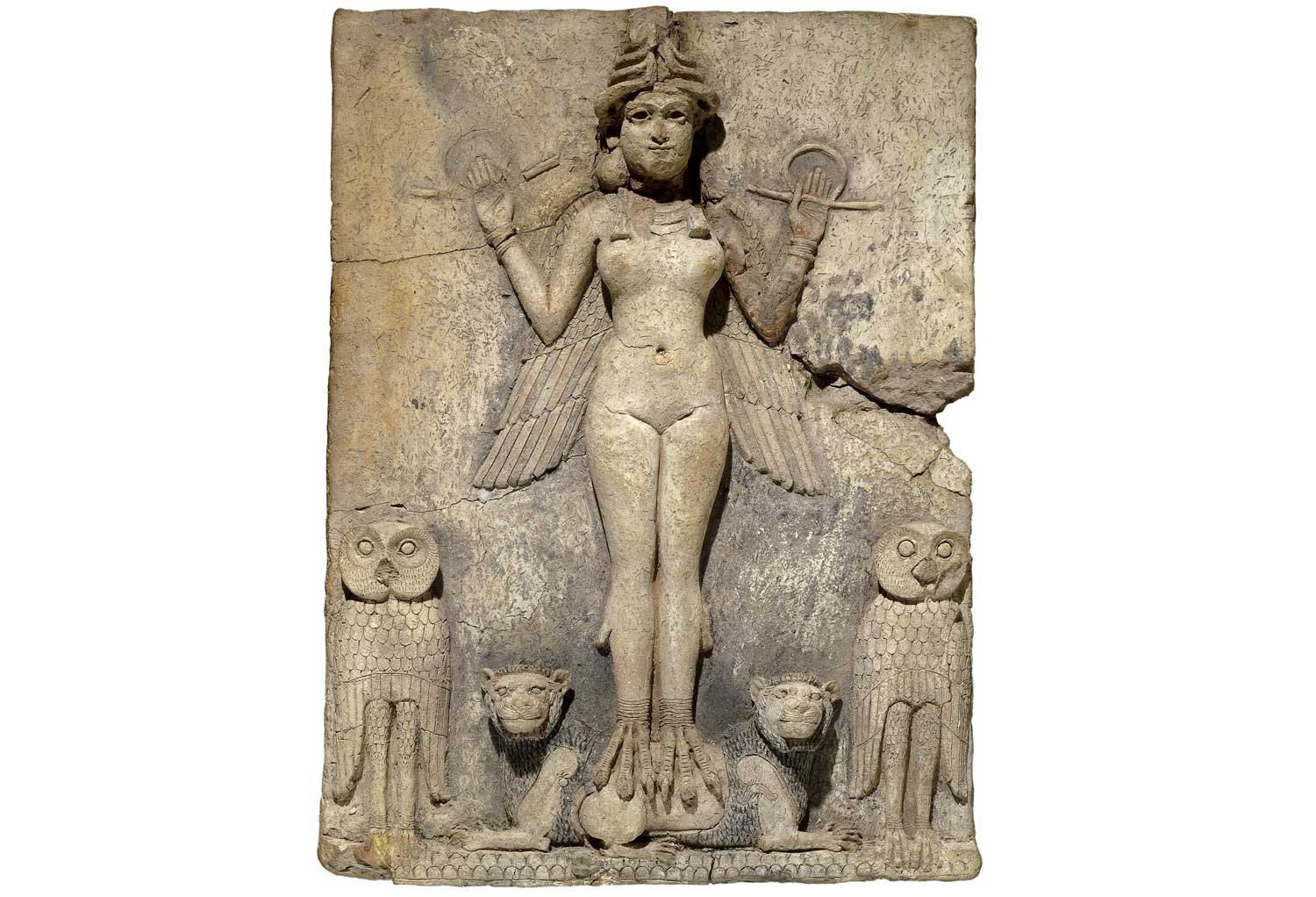
Queen of the Night Relief, © The Trustees of the British Museum
The Owl in the Ancient Near East
In the ancient Near East, the owl’s meaning was closely tied to the qualities people observed in the living bird: its nocturnal habits, haunting cry, silent flight and preference for ruins or lonely places. Unlike the owl of Athena in Greece, however, the Near Eastern owl did not possess one clear and universal identity. Its appearances suggest a creature of darkness, wild places and supernatural power, but its precise significance could change according to place and period.
The most arresting example is the Old Babylonian terracotta plaque now called the Queen of the Night Relief, made in southern Mesopotamia around 1800–1750 BCE. It depicts a winged, divine female figure with birdlike talons, standing upon lions and flanked by two large owls. The plaque’s original background was black, strengthening its atmosphere of night and the underworld. The identity of the central figure remains uncertain: scholars have proposed Ishtar or Inanna, goddess of love and war; Ereshkigal, queen of the underworld; and, less convincingly, the demoness Lilith. The owls cannot therefore be assigned a single definite meaning. They may signal night, death, the underworld or the goddess’s ability to cross boundaries between worlds. What the relief conveys with certainty is not the familiar modern idea of bookish wisdom, but a formidable, mysterious power belonging to darkness and the divine.
The owl also appears in the biblical landscapes of the ancient Near East. Hebrew prophetic poetry places owl-like night birds among ruined cities, deserted palaces and wildernesses. Exact species are often difficult to identify because ancient bird names do not correspond neatly with modern zoology and translations vary. Nevertheless, the image is consistent: a night bird nesting in abandoned places became a living sign of desolation after human life had vanished. Its cry intensified the atmosphere of loneliness, judgment and mourning.
Thus, in Mesopotamian and Levantine traditions, the owl often occupied a boundary. It belonged to night rather than day, ruins rather than cultivated settlements, and realms that lay beyond ordinary sight. It was not necessarily evil, but it was rarely ordinary.
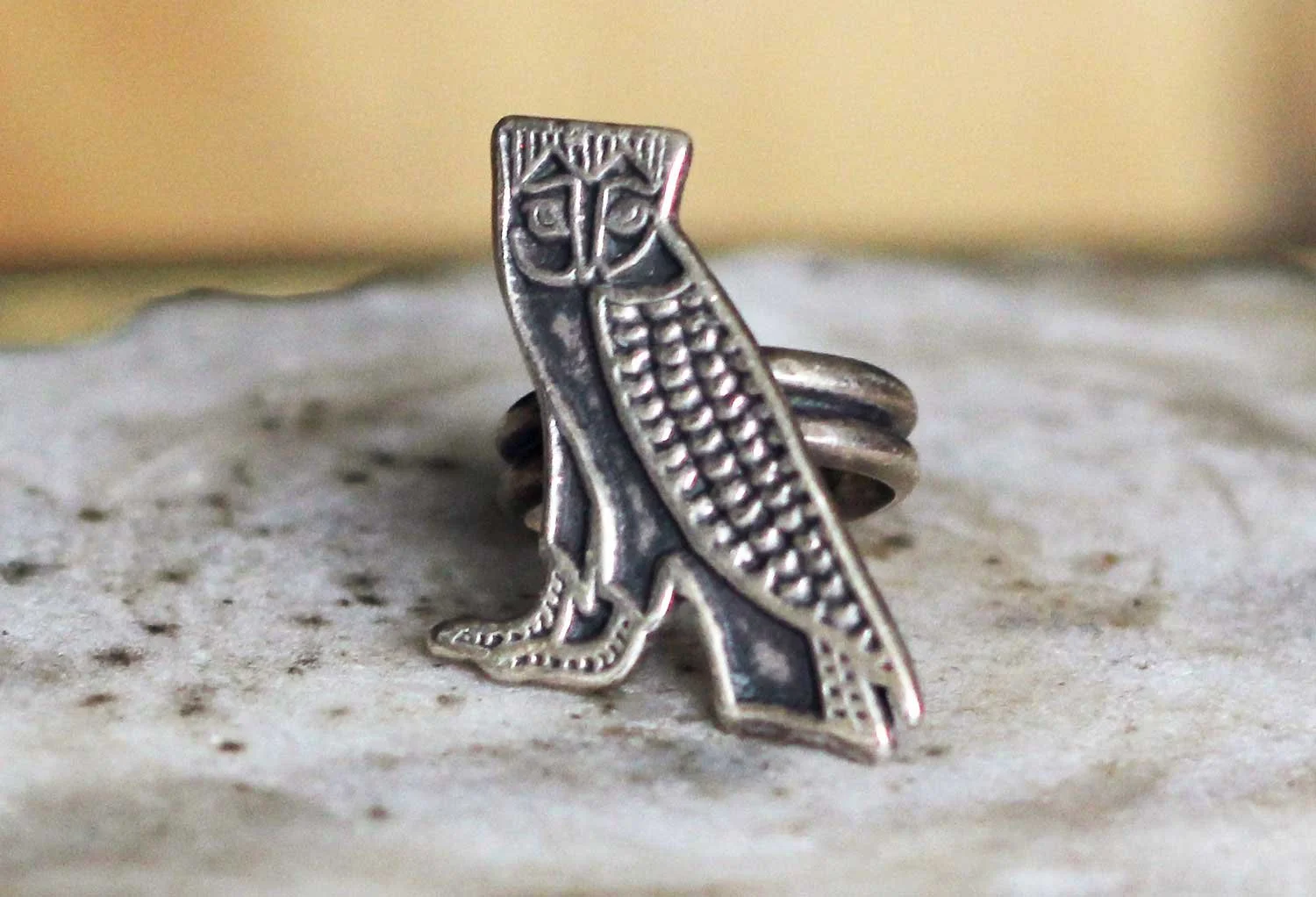
The Ancient Egyptian owl hieroglyph made into a ring.
The Owl in Ancient Egypt
Owls were familiar inhabitants of ancient Egypt, and Egyptian artists observed them with remarkable care. The owl hieroglyph, usually identified with a barn owl, although its form may combine characteristics of more than one species, was drawn frontally, with its round face and large eyes turned directly toward the viewer (body in profile). Most Egyptian birds were shown in profile, making this unwavering gaze especially striking.
The hieroglyph was one of the most frequently used signs in Egyptian writing. It represented the consonantal sound m and could also function in common words and prepositions. This is important because the sign was primarily linguistic: an owl appearing in an inscription did not automatically add a secret symbolic meaning to the text. Its prevalence nevertheless made the bird a recognizable part of Egypt’s visual culture from the earliest dynasties onward.
Egyptian ideas about the living owl seem to have gathered around its powers of sight and its mournful nocturnal voice. It could be understood as a keen-sighted hunter, able to perceive and move through darkness, but it also acquired associations with lamentation, death and the mysterious hours of night. Such meanings were natural in a culture that imagined the nightly passage of the sun through the underworld as a dangerous journey followed by rebirth at dawn.
The owl never became the defining emblem of an Egyptian deity in the way that the falcon belonged to Horus or the ibis to Thoth. Nor is there strong evidence that ancient Egyptians regarded it principally as a symbol of wisdom. Its significance was subtler: it was a creature that could inhabit darkness without being blinded by it. When owl-shaped amulets and small images occur, they may have drawn upon the bird’s alertness and protective watchfulness, although their individual purpose is not always recoverable. The Egyptian owl is therefore best understood not through a single fixed definition, but through a constellation of ideas—sight, night, lamentation and the unseen world.
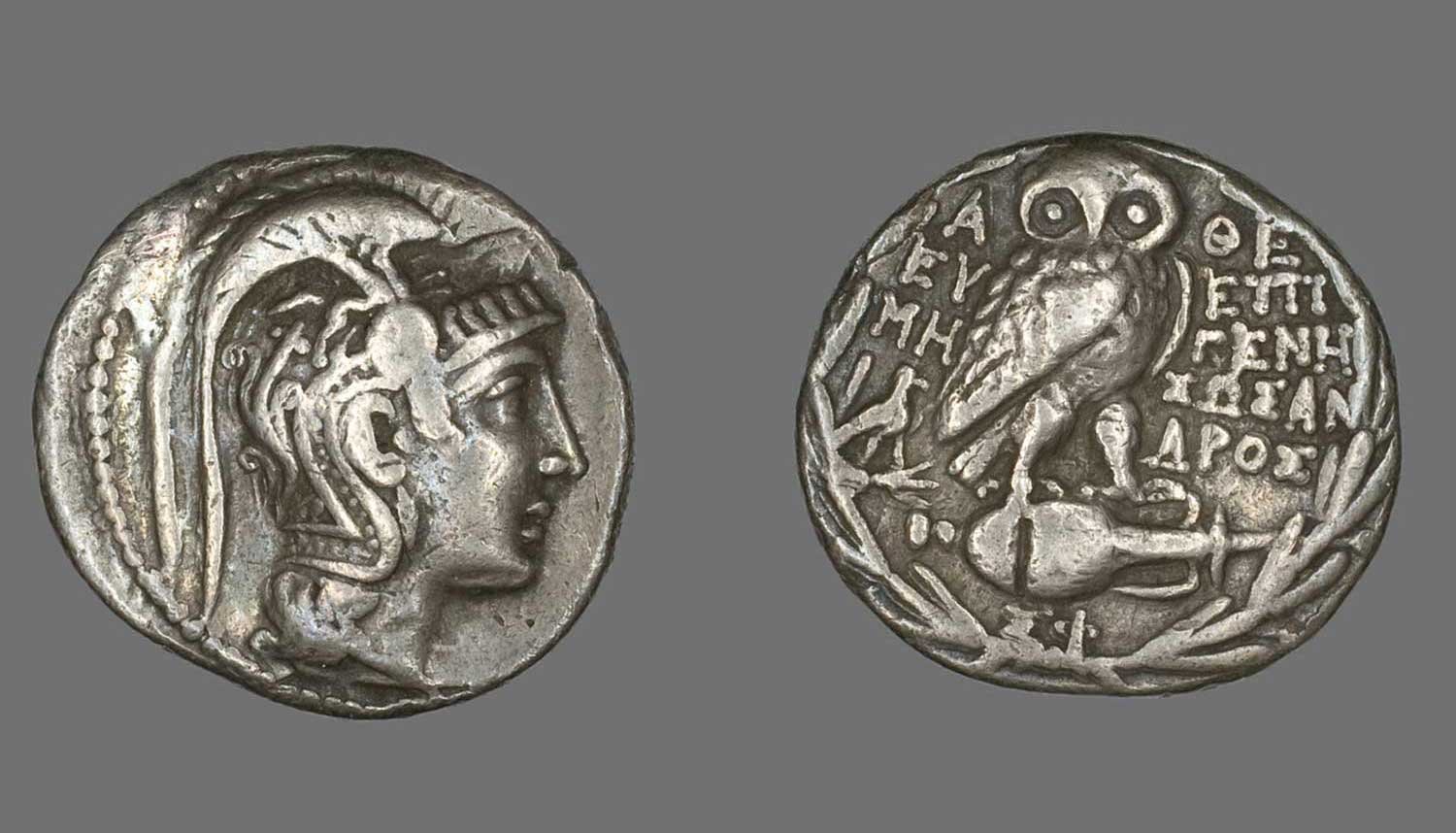
Tetradrachm (Coin) Depicting the Goddess Athena, Art Institute of Chicago
Greece: The Owl of Athena
It was in ancient Greece, and especially in Athens, that the owl acquired its most enduring association with wisdom. The little owl (Athene noctua) became sacred to Athena, goddess of wisdom, strategic warfare, skilled craftsmanship and the disciplined life of the city. Athena’s intelligence was practical rather than merely scholarly: she was the patroness of weavers, builders, artisans, statesmen and commanders. Her owl came to represent the same clear, watchful judgment.
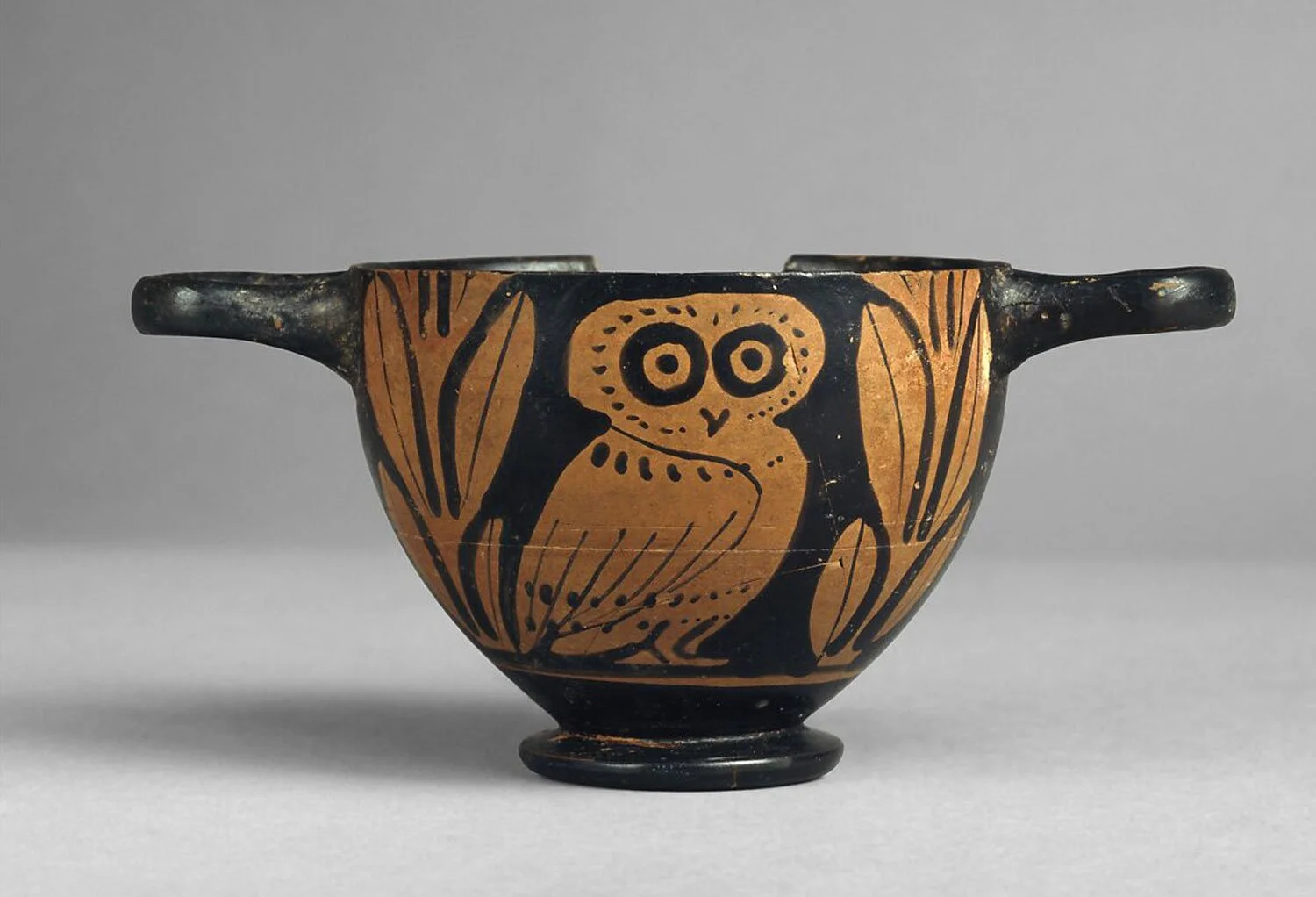
Ancient Greek skyphos (deep drinking cup) with Athenian owl. 5th c, BCE, Met Museum.
Why the owl became Athena’s bird is not known with certainty. Its ability to see in darkness offered an obvious metaphor for insight—the power to perceive what others miss. Little owls were also common around the rocky Acropolis and the buildings of Athens. Whatever the origin, the relationship became inseparable from Athenian identity. On the city’s famous silver tetradrachms, Athena’s helmeted head appeared on one side and the owl, accompanied by an olive sprig and the letters of Athens, on the other. These coins traveled throughout the Mediterranean, making the owl not only a religious emblem but also an international symbol of Athenian power, prosperity and civic pride.
The Greek owl therefore carried several related meanings: intelligence, vigilance, skilled counsel and divine favor. Its nocturnal vision did not make it sinister; rather, it suggested a mind capable of penetrating darkness.
Rome: Minerva, Prophecy and Omen
The Romans identified Athena with Minerva, goddess of wisdom, learning, medicine and the arts, and the owl remained her companion. In Roman art and later European allegory, an owl beside an armed or helmeted woman usually identifies the figure as Minerva or as Wisdom personified.
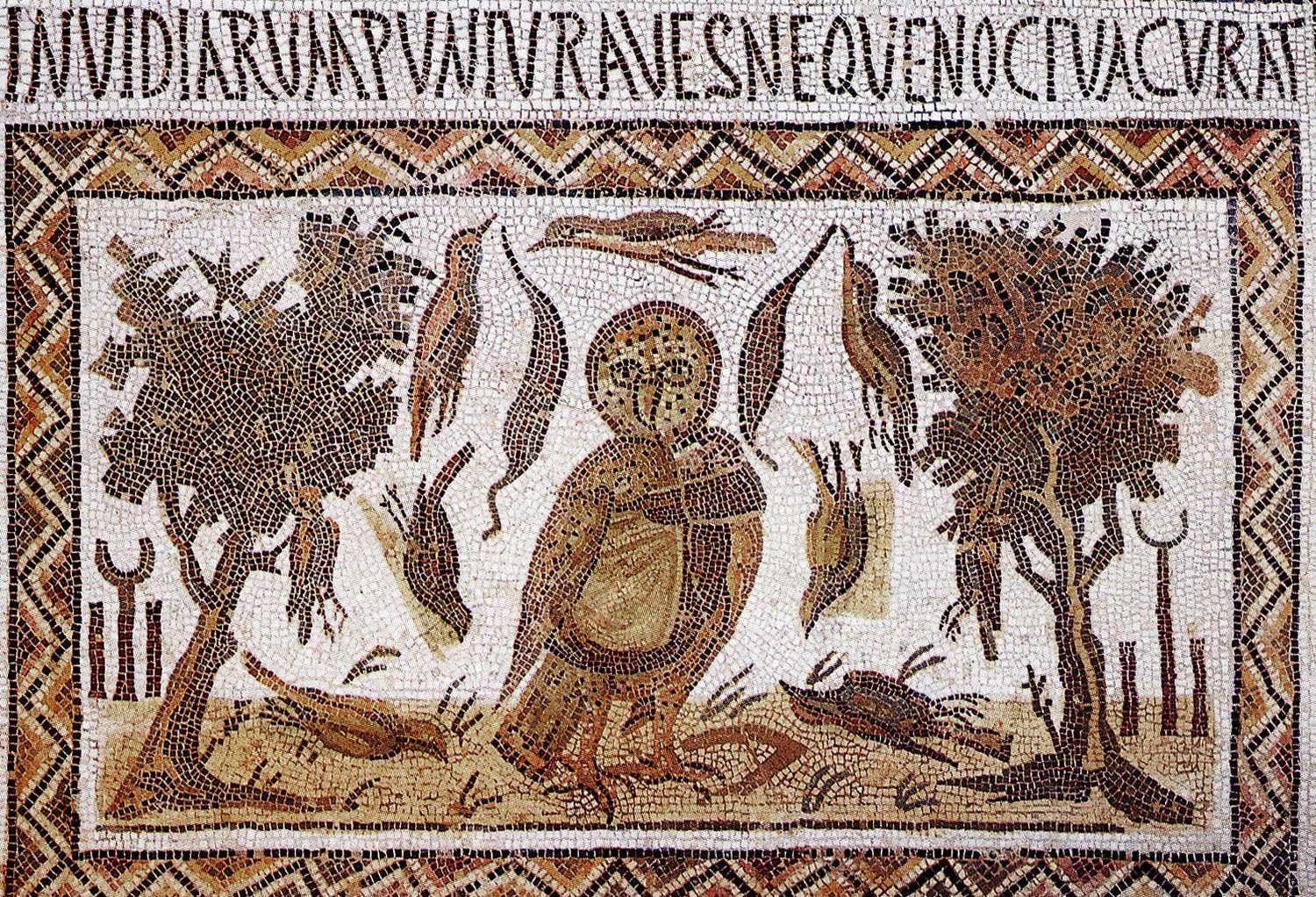
Ancient Roman mosaic now at the El Jem Museum in Tunisia. The Latin translation reads,
“The birds burst with envy, but the owl does not care.” Photo: wikipedia by Pascal Radigue.
Yet Roman culture also preserved a more ominous understanding of the bird. Romans paid close attention to unusual animal behavior and cries as possible messages from the gods. Because owls flew at night, frequented tombs and ruins and called with unsettling voices, their appearance in a city or at a moment of crisis could be interpreted as a warning of death or disaster. Roman literature connects owls with cemeteries, ill fortune and threatening prophecy.
These two meanings did not cancel one another. The owl could belong to Minerva and still be a bird of omen. Both interpretations arose from the same extraordinary ability: it perceived and announced things hidden from ordinary human senses.
The Medieval Owl: Darkness, Solitude and Contradiction
Medieval Europe inherited classical stories about Minerva, biblical images of desolate places and living folklore surrounding nocturnal birds. The result was an unusually changeable symbol. In bestiaries—books that presented animals as moral and religious lessons—the owl’s love of darkness was often interpreted negatively. It could represent the sinner who avoids the light of truth, ignorance that rejects divine illumination or a soul dwelling amid spiritual ruin.
Some medieval Christian writers also used the owl as an anti-Jewish allegory, claiming that it represented those who rejected the light of Christ. This was not a neutral zoological belief but part of the period’s polemical and prejudicial imagery, and it should be recognized today as evidence of medieval antisemitism rather than repeated as a timeless meaning of the bird.
Yet the owl could also receive a positive interpretation. The thirteenth-century Aberdeen Bestiary, for example, explains that the night owl may signify Christ entering the darkness of the sinful world to save it. It could also represent a righteous or contemplative person who avoids worldly praise, keeps watch while others sleep and lives quietly among the metaphorical ruins of earthly life. In this reading, the owl’s solitude became humility, its wakefulness became spiritual vigilance and its darkness became a place in which light was most needed.
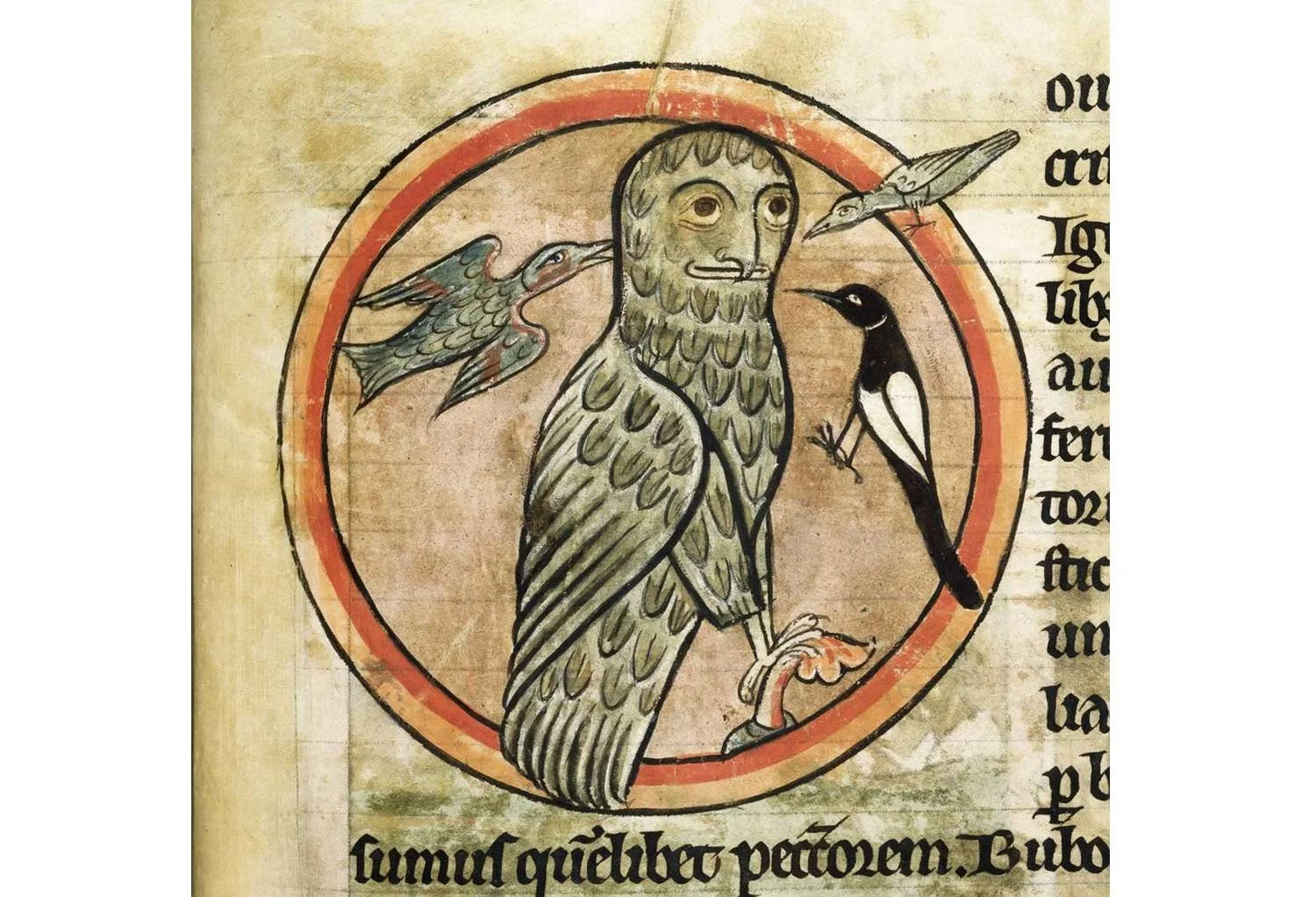
From a bestiary in the British Library, showing an owl being attacked by small birds.
Medieval images sometimes show an owl surrounded and attacked by smaller birds. This scene came from actual behavior. Day birds often mob a discovered owl because they recognize them as night predators but artists and writers turned it into allegory. Depending upon the context, the besieged owl might represent a sinner exposed to righteous condemnation, Christ persecuted by the world or a wise person mocked by fools. As so often with medieval animals, the moral did not reside in the creature alone; it emerged from the story told around it.
The Renaissance and Early Modern Owl
During the Renaissance, renewed enthusiasm for Greece and Rome restored the owl’s classical relationship with Athena-Minerva. Humanists, artists and printers used it as an emblem of wisdom, prudent counsel, learned study and the ability to distinguish truth from error. The owl appeared beside personifications of Wisdom and Learning, in decorative schemes inspired by antiquity and in the new emblem books that combined a motto, a symbolic image and an explanatory verse.
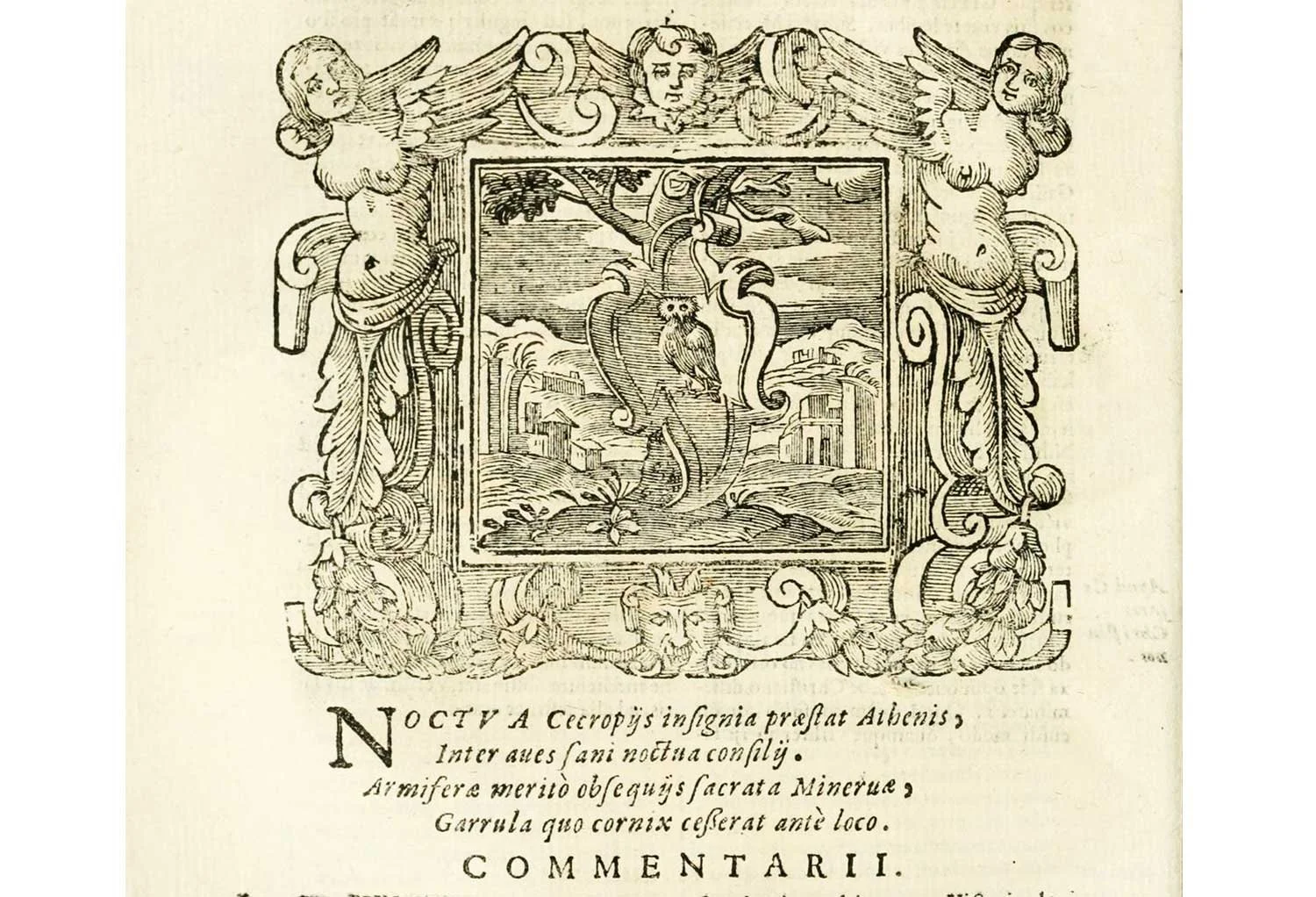
From Andrea Alciato’s Emblemata.
The Emblemata…
The translation, according to Google translate and my reading of the letters:
By night, the owl, Minerva's bird, flies forth from Cecropian Athens, bearing the emblems of the goddess; it takes the place where the chattering crow had previously yielded that bird sacred to Minerva, the patroness of arms.
Andrea Alciato’s enormously influential sixteenth-century Emblemata used the owl in several ways. In one emblem it stands for Athens and wise counsel; in another, an owl associated with Minerva suggests that the prudent person should avoid idle talk. Elsewhere, the spectacle of other birds mobbing an owl became an image of the ignorant attacking the learned. These interpretations suited the humanist ideal of the scholar: observant, disciplined, discreet and sometimes isolated by knowledge.
Older meanings did not disappear. Renaissance and early modern owls continued to haunt tombs, ruins, witchcraft imagery and scenes of night. Their cries could still be taken as omens, and their shadowed habitats linked them with melancholy, secrecy and death. The age therefore preserved the owl’s double nature. It might perch beside Minerva as the clear-eyed companion of reason, or watch from a dead tree as a sign that the visible world had given way to mystery.
A Creature That Sees Beyond the Light
Across the ancient Near East, Egypt and Europe, the owl’s symbolism grew from a simple natural wonder: it flourished where human sight failed. To the peoples of Mesopotamia, it could accompany a mysterious power of night or the underworld. In Egyptian culture, it became both an ever-present written sign and a keen-eyed, mournful inhabitant of darkness. Greece placed it beside Athena and transformed its night vision into wisdom; Rome added the language of omen. Medieval Christianity interpreted its darkness as both sin and sacred solitude, while Renaissance humanists reclaimed it as an emblem of prudent learning without surrendering its older associations with ruins and death.
The owl has endured because it refuses a single meaning. It is wise and uncanny, watchful and solitary, protective and foreboding. Perched between daylight and darkness, it became the perfect historical emblem for knowledge itself—not knowledge that lives safely in the sun, but knowledge willing to look into what cannot yet be seen.