
Centaurs, In a Nutshell
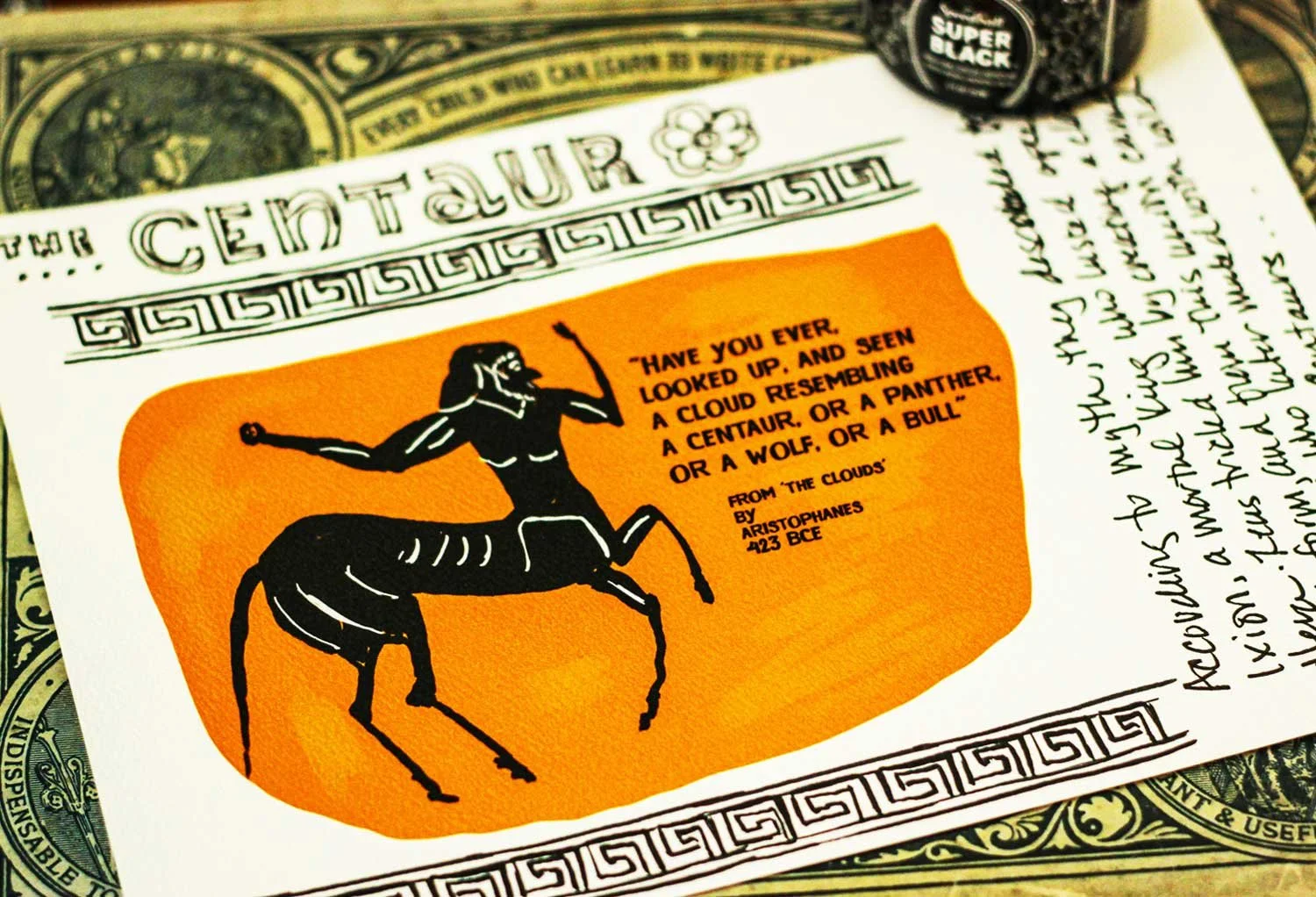
From my sketchbook, Centaur illustration based on an ancient Greek vase.
I have always loved mythological creatures or things, based on horses. Centaurs, Pegasus, the Trojan Horse, all come to mind. I like their images in ancient art, they’re often quite stylized and that’s why they look so at home in modern architecture.
Of these, the Centaur is one of the most well represented throughout history, in terms of art. And if you read on, you’ll discover more about the Centaur and how it was perceived through time.
Origins in Mythology
Centaurs are half-human, half-horse beings from Greek mythology. They appear first in early Greek art and poetry, often representing the tension between civilization and wildness.
Birth Story: According to myth, they descended from Ixion, a mortal king who lusted after Hera. Zeus tricked him by creating a cloud in Hera’s form, and from this union came Centauros, who later mated with wild mares, producing the race of centaurs.
Symbolism: Centaurs embody duality, human intelligence combined with animal instinct. In myths, they often symbolize uncontrolled passions (drunkenness, lust, violence), but a few stand out for their wisdom and restraint.
Famous Centaurs
Not all centaurs were alike, some were rowdy and destructive; others were noble teachers.
Chiron: The most famous, known for wisdom and healing. Unlike other centaurs, Chiron was civilized and kind. He taught many heroes such as Achilles, Asclepius, Hercules, and Jason. He is sometimes said to be immortal, but after being wounded by Hercules’ poisoned arrow, he gave up his immortality and was placed among the stars as Sagittarius (sometimes associated with Centaurus).
Nessus: Known for his darker role. He tried to abduct Deianira, wife of Hercules. Hercules killed him with a poisoned arrow, but Nessus tricked Deianira into keeping some of his tainted blood, leading to Hercules’ death.
Pholus: A gentler centaur, friend to Hercules, but accidentally killed after opening a jar of sacred wine that incited the wild centaurs.
Eurytion: Involved in the notorious battle of the Lapiths and centaurs at the wedding of Pirithous, where drunken centaurs tried to abduct the bridesmaids, sparking a violent conflict.
Depictions Through the Ages
Ancient Greece
Archaic and Classical art: Centaurs were often shown in vase paintings and temple sculpture (like the Parthenon metopes) battling humans, symbolizing chaos versus order.
Philosophical texts: They were used metaphorically for the struggle between rational thought and instinct.
Roman Era
Romans inherited Greek views but also portrayed centaurs in decorative mosaics and sarcophagi, often in bacchic (wine-filled, Dionysian) scenes.
Medieval Period
Centaurs appear in bestiaries and manuscripts, often Christianized as symbols of sin, lust, and the dangers of the flesh.
They also entered astrology and were associated with Sagittarius.
Renaissance
Rediscovered in classical texts and art, centaurs became popular subjects in painting and sculpture, often embodying both wildness and the possibility of higher learning. Michelangelo carved a relief sculpture titled, Battle of the Centaurs (although it’s hard to actually spot the Centaurs in the tangle of bodies).
18th–19th Centuries
Romantic and Neoclassical artists revived them, sometimes as pastoral figures or allegories of the untamed natural world.
In literature, centaurs appear in poetry (like in Keats and later Tennyson) as mysterious, liminal beings.
20th–21st Centuries
In modern fantasy and pop culture, centaurs appear as complex characters:
C.S. Lewis’s Narnia books depict them as noble astrologers and warriors.
Harry Potter presents them as wise, mysterious forest-dwellers with their own culture.
Fantasy art and games often use them as archetypes of wild but honorable beings.
Enduring Symbolism
Across time, centaurs have always represented the duality of human nature:
The wild, instinctual side that resists control.
The wise, noble side that can guide heroes and civilizations.
They remain one of mythology’s richest figures precisely because they embody that tension, half man, half beast, caught between two worlds.