
Ancient Artisan Stonework
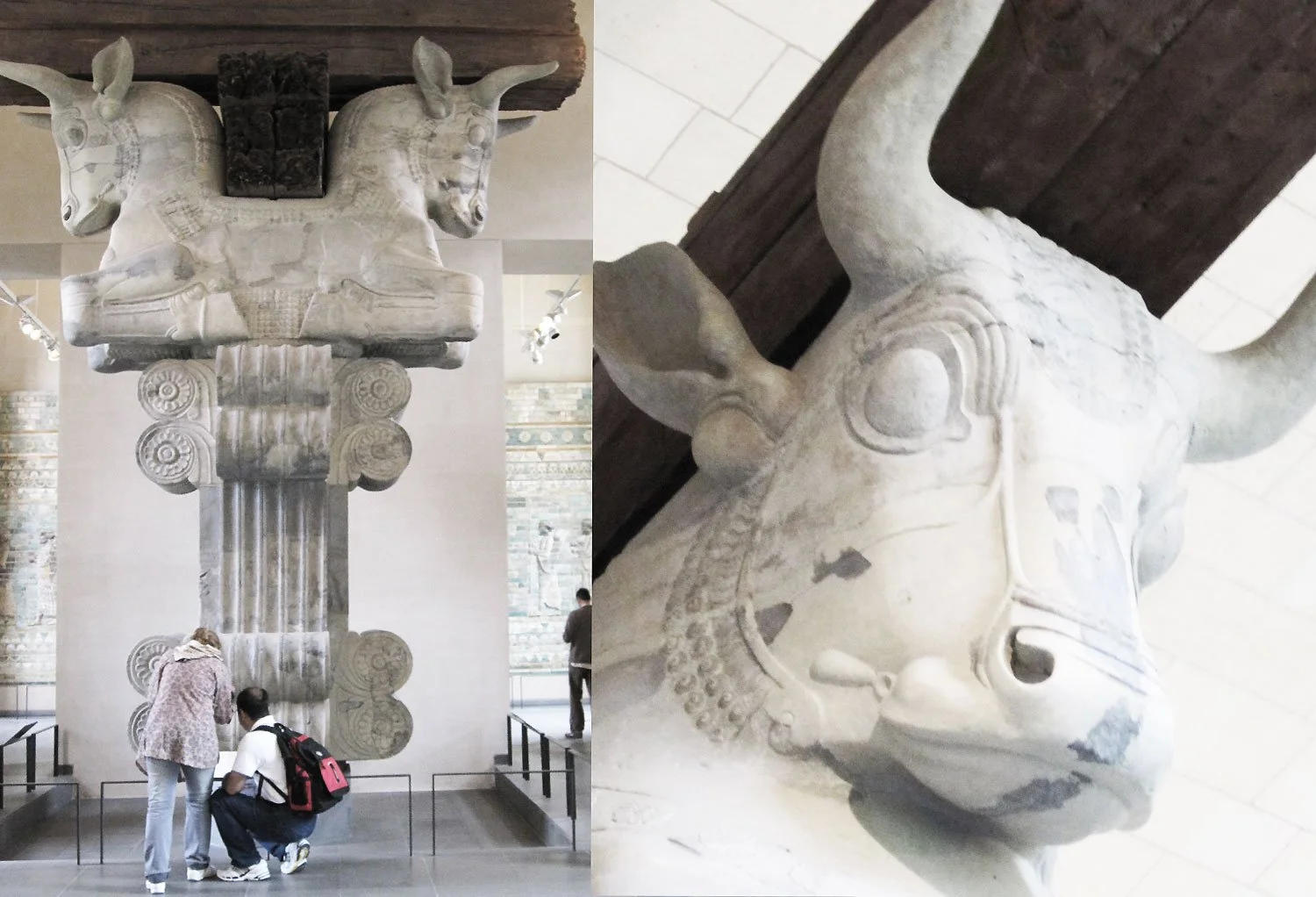
Bull capital from the ancient Achaemenid Empire.
In the near future I will be back at the Louvre and the British Museum, two of my favorite places in the world. With this in mind, I thought I would revisit just a few of the most striking pieces in both of them. At least in my opinion.
Ancient Persian Art in Stone…
I think the most beautiful art in the world is carved in stone. And many examples originated in ancient Persia (modern-day Iran) and are colossal in scale.
This bull capital, for example, is stunning. Both in craftsmanship and scale. Originally, there were 36 such capitals holding up a roof.
The irregular coloring stems from the fact that the column was pieced together from several to show a complete result.
Achaemenid Bull Capital
The monumental bull capital in the Louvre once crowned a column in the Apadana, or royal audience hall, of Darius I’s palace at Susa, constructed around 500 BCE. Carved from limestone, the capital features the forequarters of two powerful bulls placed back-to-back, with the space across their backs designed to support the enormous wooden beams of the palace roof. The complete reconstructed capital rises more than five metres high, offering a sense of the extraordinary scale and splendour of Achaemenid architecture.
The bulls’ calm expressions, muscular bodies and perfect symmetry convey both restrained power and royal authority, while the capital’s combination of sculpture and structural engineering reflects the sophisticated, cosmopolitan style of the Persian Empire. Discovered during excavations at Susa in 1884–1886, it is now one of the Louvre’s most impressive surviving architectural elements from the palace of Darius the Great.
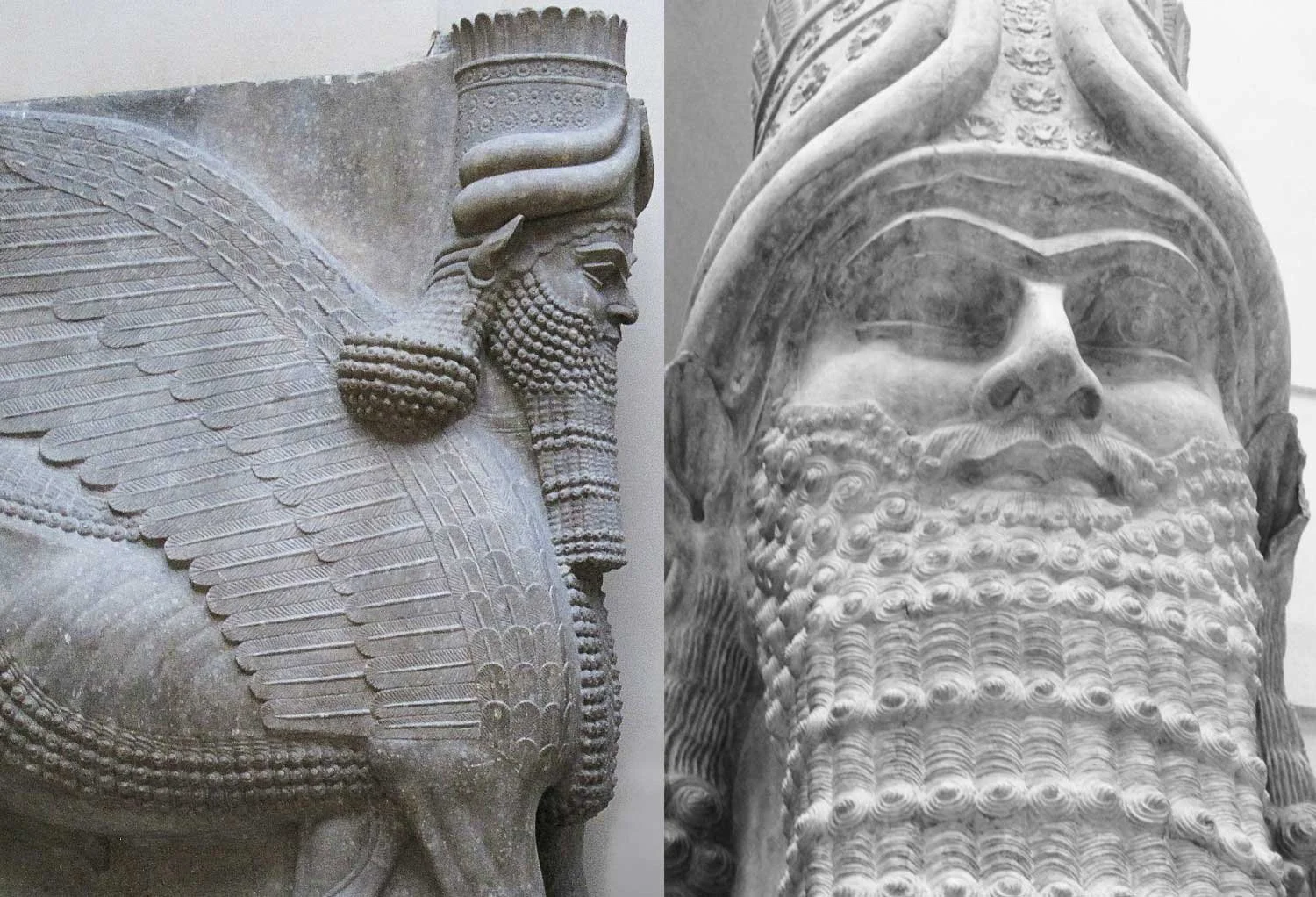
A Lamassu, from the Louvre, with the body and ears of a bull, face of a human and wings of an eagle.
Colossal Lamassu…
Also at the Louvre is The Cour Khorsabad, a gallery which houses pieces from the ancient palace of King Sargon II, ruler of the Assyrian Empire.
These magnificent pieces have such gorgeous carving. Very stylized and precise, almost architectural looking. Note the lips on the close- up of the face to the right. They are very lush and humanistic but still match stylistically with the patterned carving of the beard and other details.
The colossal Lamassu displayed in the Louvre’s Cour Khorsabad once guarded entrances to the palace of the Assyrian king Sargon II at Dur-Sharrukin (modern Khorsabad in northern Iraq) during the late eighth century BC.
These supernatural guardians combine the powerful body and ears of a bull, the wings of an eagle and the crowned head of a man, bringing together physical strength, heavenly authority and human intelligence.
Their horned headdresses signify divinity, while their famously gentle expressions suggest that they were benevolent protectors rather than threatening monsters.
Each lamassu was carved with five legs so that it appears to stand firmly when viewed from the front, yet strides majestically forward when seen from the side. Positioned beside monumental gateways, these imposing beings protected the king, his palace and the city while proclaiming the divine power and grandeur of Assyrian rule.
Lion Hunt of Ashurbanipal
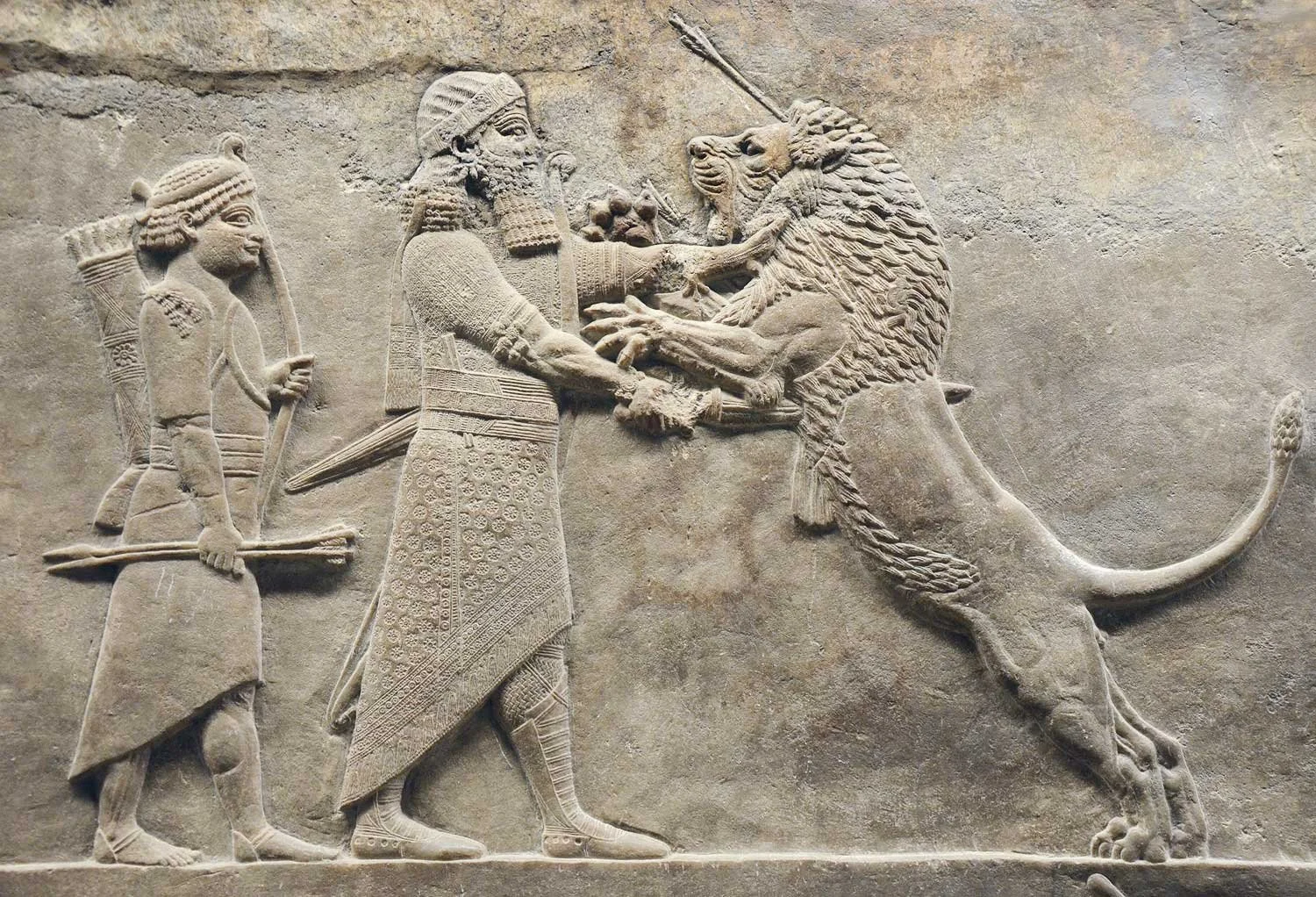
Detail from Lion Hunt of Ashurbanipal at the British Museum. Assyrian, 645–640 BC.
Photo Wikipedia by Carole Raddato.
At the British Museum is a famous ‘hunting scene’ made of gypsum panels, the Lion Hunt of Ashurbanipal. The scenes depicted are not in the wild but in an arena with captive lions and put on for the public spectacle. Not unlike the games at the Roman Colosseum.
These panels are so masterfully created, vivid with emotion and the grandeur of the powerful lions.
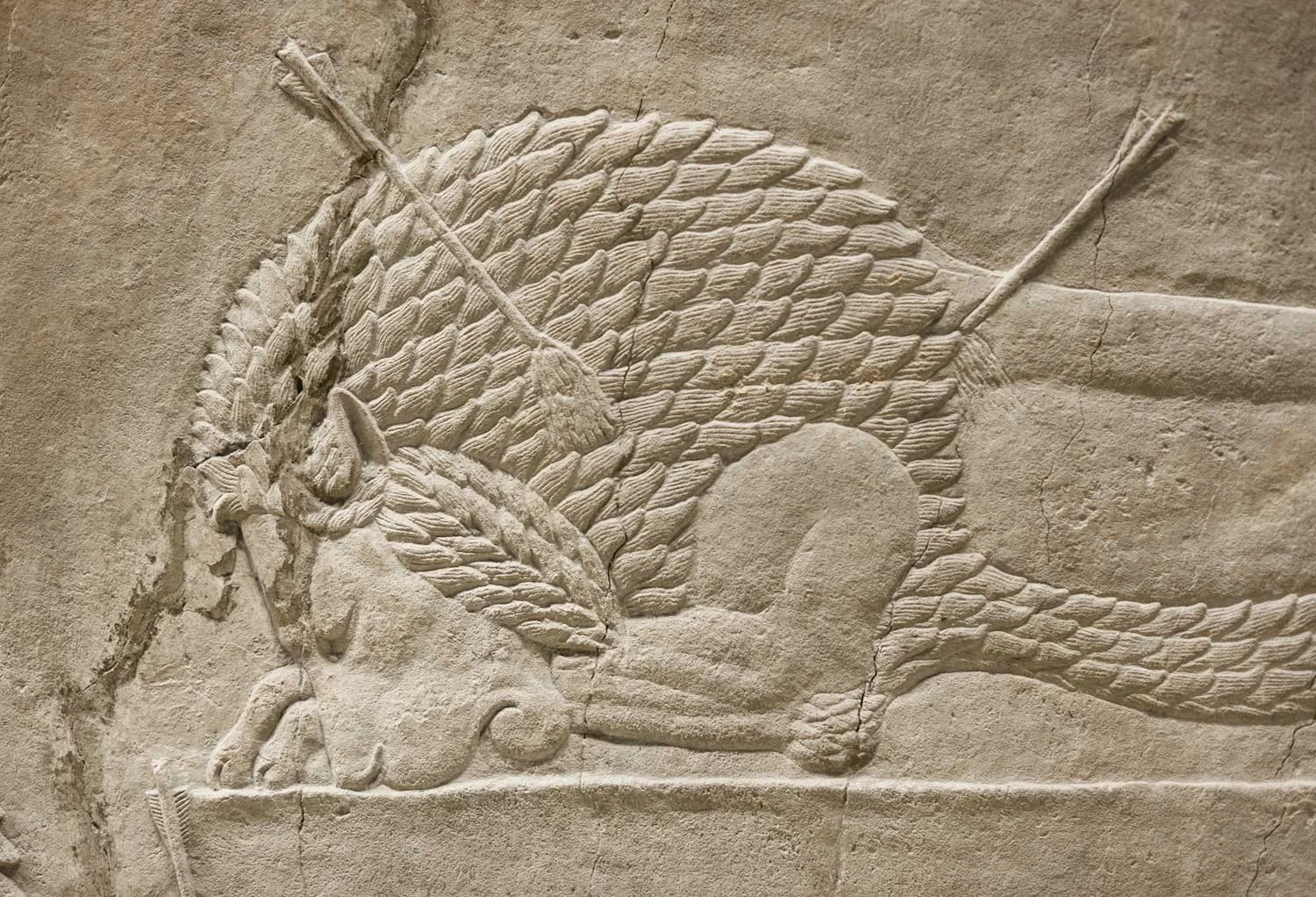
The lion fallen. Photo: Wikipedia, by Paul Hudson.
The Lion Hunt of Ashurbanipal is a celebrated series of carved gypsum reliefs created for the North Palace of the Assyrian king Ashurbanipal at Nineveh, around 645–635 BC. The scenes portray the king hunting lions that had been released into a controlled arena—an event presented not simply as sport, but as a royal ritual in which the ruler triumphs over the dangerous forces of nature and chaos. Ashurbanipal appears composed and powerful as he shoots lions from his chariot or confronts them at close range, while attendants protect the surrounding spectators. Yet the lions themselves are rendered with extraordinary observation and emotional intensity: wounded animals struggle, roar and collapse with a realism that makes them among the most moving creatures in ancient art. The reliefs glorified the king, but it is their tragic and remarkably lifelike portrayal of the lions that has made them unforgettable.
And when I return, new images…
These are just a few of the pieces that I am really looking forward to revisiting in person and updating with new photos. It’s bittersweet in away because I’m reminded of all the places that are not easily travelled to today. Iran, Iraq and other areas of the Near and Middle East have some of the most incredible ancient art and history and to see some of these sites in person would be magical.