
Ramesses II and the Ozymandias Poem
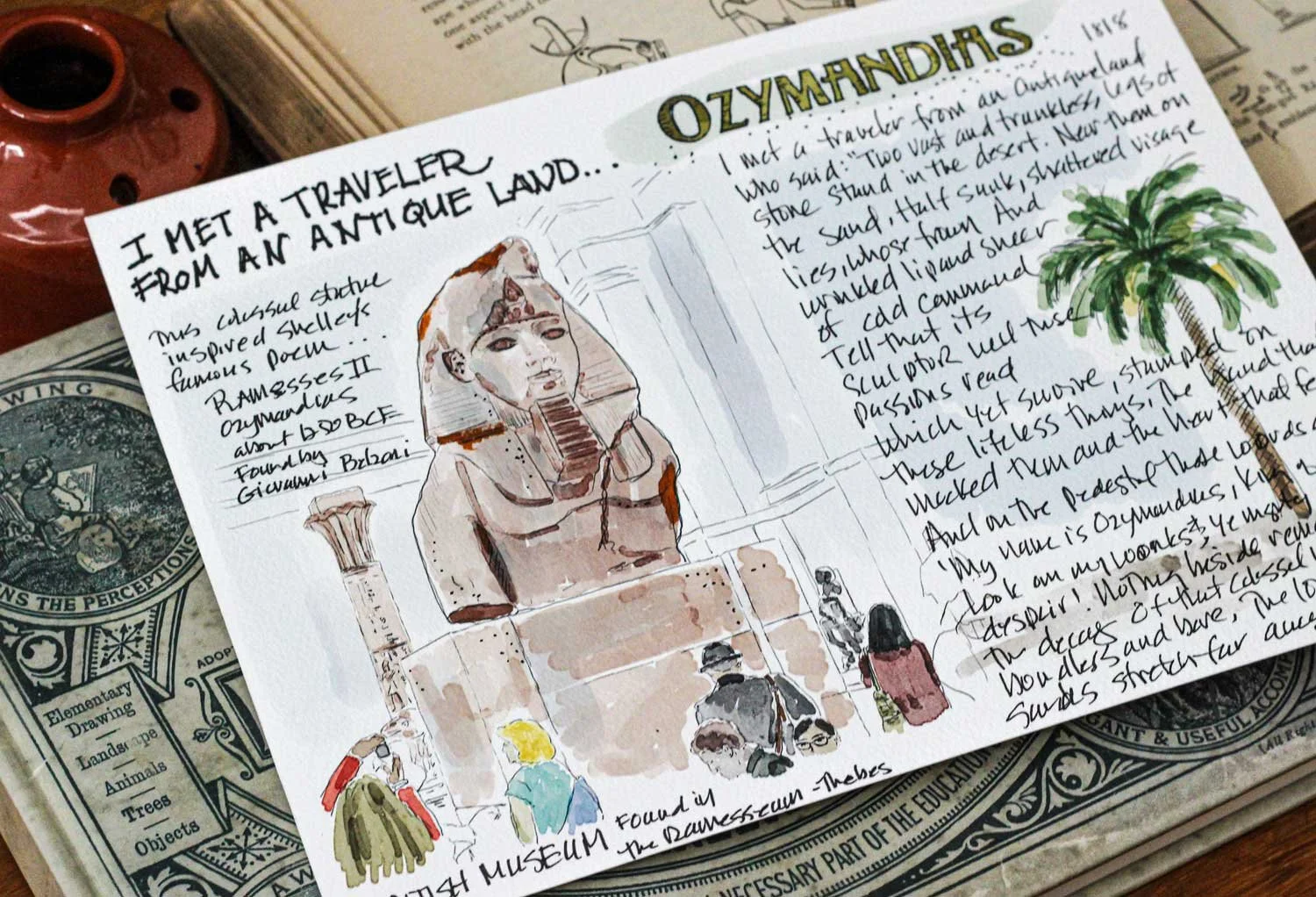
The Shelley version…
I Met a Traveller From an Antique Land…
I’ve not come across many poems that capture the impermanence of earthly greatness as vividly as Percy Bysshe Shelley’s Ozymandias.
I prefer not overly long poems that get to the point, and this poem does that. But I have to admit that what I love most about this poem is the opening line,
“I met a traveller from an antique land”
This poem by Shelley is one of two poems about Ozymandias (aka Ramesses II). The other was written by Horace Smith; the two wrote them in friendly competition, more about this later.
I immediately preferred Shelley’s poem because of that first line. It’s evocative of far-flung places and times long past and the words ‘antique land’ immediately bring to mind, for me, either Ancient Egypt or the Greco Roman world.
The poem is said to be based on the colossal state of Ramesses II at the British Museum. I’ve been there a few times and each visit I’m filled with awe standing beneath it. When I first saw it in person, I wasn’t aware of the poem, but seeing it when I was aware of it, made the connection with it that much deeper.
Poetry by the romantics explored exotic places, travel and a sense of discovery. I think, to those of us who not only love old ruins, historical places and people, but the sense of timelessness and mystery associated with them, these writings are especially appealing.
The Percy Bysshe Shelley Version…
I met a traveller from an antique land
Who said – 'Two vast and trunkless legs of stone
Stand in the desert. Near them, on the sand,
Half-sunk, a shattered visage lies, whose frown,
And wrinkled lip, and sneer of cold command,
Tell that its sculptor well those passions read
Which yet survive (stamped on these lifeless things)
The hand that mocked them, and the heart that fed:
And on the pedestal these words appear:
"My name is Ozymandias, King of Kings:
Look on my Works, ye Mighty, and despair!"
Nothing beside remains. Round the decay
Of that colossal wreck, boundless and bare
The lone and level sands stretch far away.'
The Horace Smith Version…
In Egypt's sandy silence, all alone,
Stands a gigantic Leg, which far off throws
The only shadow that the Desert knows:—
"I am great Ozymandias," saith the stone,
"The King of Kings; this mighty City shows
The wonders of my hand."— The City's gone,—
Naught but the Leg remaining to disclose
The site of this forgotten Babylon.
We wonder — and some Hunter may express
Wonder like ours, when thro' the wilderness
Where London stood, holding the Wolf in chace,
He meets some fragment huge, and stops to guess
What powerful but unrecorded race
Once dwelt in that annihilated place.
A Friendly Literary Competition
The poem grew out of a friendly writing competition between Shelley and his friend Horace Smith. Literary challenges of this kind were popular among the writers associated with poet and editor Leigh Hunt. Shelley and Smith agreed to compose sonnets on the same subject: the ruined monument of the Egyptian pharaoh Ramesses II, known to the Greeks as Ozymandias.
Both poems were published in The Examiner in early 1818, although Shelley’s appeared first. Smith’s sonnet was initially titled On a Stupendous Leg of Granite, Discovered Standing by Itself in the Deserts of Egypt, with the Inscription Inserted Below and was later known simply as Ozymandias. Smith’s version also imagines the disappearance of a once-powerful civilization, but then carries the idea into the distant future, when a traveler may encounter the ruins of London and wonder what forgotten people once lived there.
Who Was Ozymandias?
“Ozymandias” is the Greek form of part of the throne name of Ramesses II, one of ancient Egypt’s most celebrated pharaohs. Ramesses II ruled from approximately 1279 to 1213 BC and commissioned an enormous number of temples, statues and monuments. His long reign and extensive building projects ensured that his image appeared throughout Egypt.
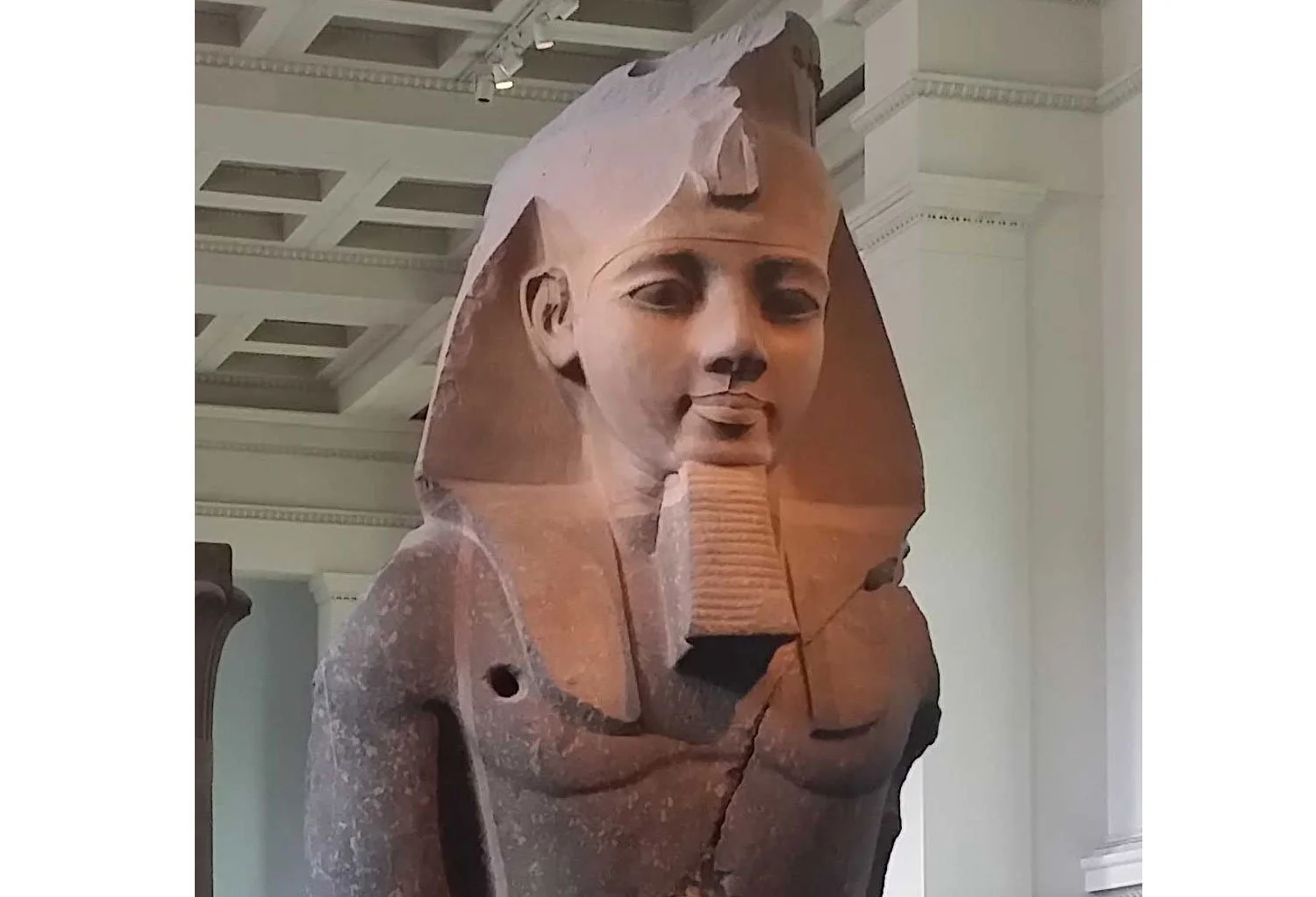
The actual British Museum Ramesses II bust
The British Museum Ramesses Bust
The poem is associated with the colossal bust of Ramesses II known as the “Younger Memnon,” now in the British Museum. The bust originally stood at the Ramesseum and was removed from Egypt by Giovanni Battista Belzoni on behalf of the British consul Henry Salt. It reached England in 1818, the same year Shelley’s poem was published.
However, Shelley probably never saw the sculpture itself. The transport of the monumental head and growing public interest in Egyptian antiquities may have helped create the atmosphere surrounding the poem, but Shelley appears to have relied principally upon written accounts of Ramesses II and his monuments. The British Museum consequently describes the connection between the bust and Shelley’s poem as indirect.
There’s also this line in Shelley’s poem:
Half-sunk, a shattered visage lies, whose frown,
And wrinkled lip, and sneer of cold command,
If you look at the statue above, you can see that the facial expression is actually quite serene and pleasant. No sneer in sight. This makes the idea that Shelley, while basing his poem on the colossal bust, never actually saw it, at least before the publishing of the poem.
Pride and the Passage of Time
At the center of Ozymandias is the ancient idea of hubris: excessive pride that leads a powerful person to forget the limits of human existence. The king calls himself “King of Kings” and expects other rulers to despair when confronted with his achievements. Instead, there are no achievements left to see.
The abrupt sentence “Nothing beside remains” overturns the king’s boast. Around the pedestal there is no palace, temple, army or thriving city only the “lone and level sands.” Nature and time have erased nearly everything Ozymandias considered proof of his greatness.
The poem does not suggest that Ramesses II was an insignificant ruler. Quite the opposite: the statue’s immense scale implies that he possessed extraordinary wealth and authority. The lesson is more unsettling. If even a ruler as powerful as Ozymandias could be reduced to a broken monument in an empty landscape, no human power can be permanent.
Still, I would say that Ramesses the Great is hardly forgotten - his name and title still evoke images of power and grandeur and it’s been over 3,000 years now. And he is hardly surrounded by an empty landscape; tourists abound where his image is carved.