
Geomythology…What is it?
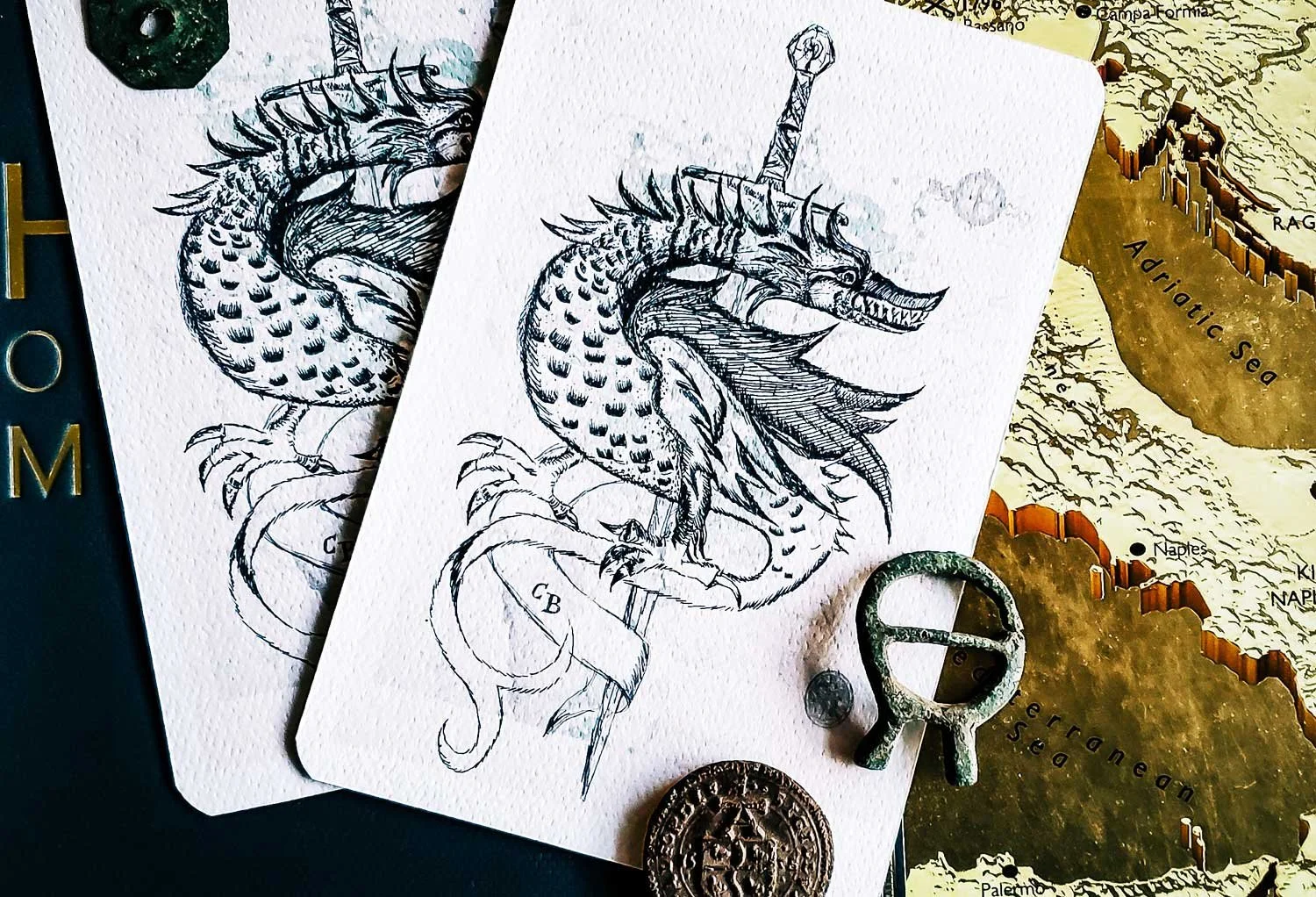
From my sketchbook, a dragon adapted from a medieval manuscript.
From Mythology to Geomythology…
I think I first became interested in mythology when I happened across a copy of Bullfinch’s Mythology at my High School library. The three-volume work was originally published back in the 1800s; since I pulled it from that school shelf many moons ago, it’s been re-published more than a few times. A true classic.
More recently, Edith Hamilton’s 1942, Mythology: Timeless Tales of Gods and Heroes has been added to my bookshelf.
But where did all these mythic people, creatures and places spring from? There’s obviously not just one source, but the idea of Geomythology adds another intriguing possibility to the mix.
As someone who believes much of magic, witchcraft etc. is just undiscovered science, geomythology resonates with me. It just kind of makes sense, it’s logical, at least in my opinion. I’m also quite sure that in a hundred years from, what with the rate technology is moving, there will be many more secrets explained but just as many new ones that appear for future exploration.
Anyway, if you would like a succinct, video explanation, I’ll link a Ted-Ed video that requires only about 5 minutes of your time and will give you the cliff notes version of Geomythology.
If you want more, read on…
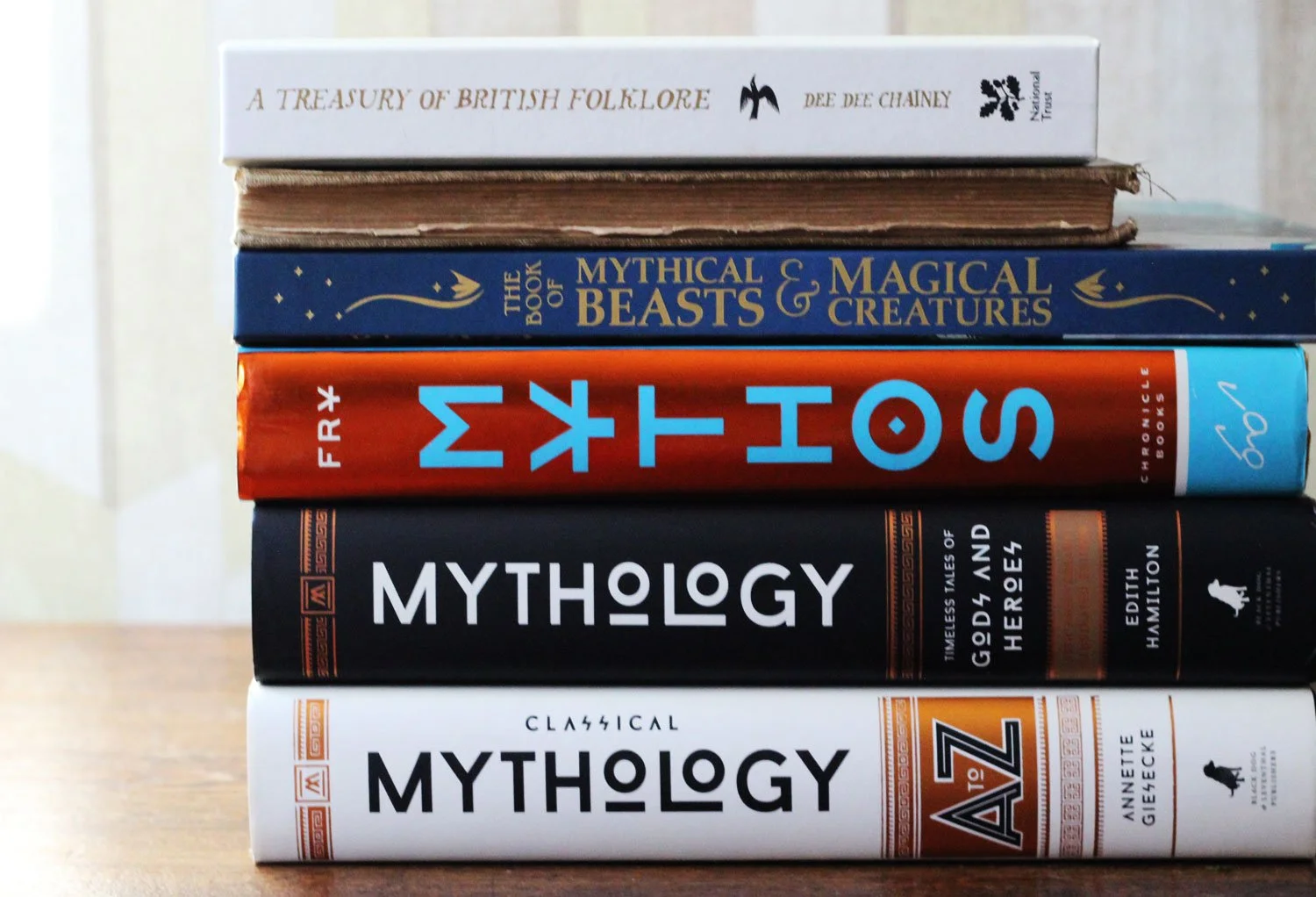
A few from my library…
Geomythology: Where the Stories of the Earth Meet Science
Long before earthquakes were measured, volcanoes monitored, or fossils arranged in museum cases, people explained the restless earth through stories. Mountains were raised in battles between gods, islands vanished beneath the sea, and strange bones belonged to giants or dragons. Geomythology studies these traditions not simply as fantasies, but as possible records of natural events and observations preserved through cultural memory.
The field occupies an intriguing borderland between geology, archaeology, folklore, history, and mythology. It asks whether an ancient tale might contain the memory of an eruption, tsunami, earthquake, meteorite impact, fossil discovery, or dramatic alteration of the landscape. Yet geomythology is not an attempt to “prove” myths scientifically. A myth may carry religious, moral, political, and poetic meanings while also preserving an observation about the physical world.
The Origins of Geomythology
The word geomythology was introduced by the American geologist Dorothy B. Vitaliano in 1968. She developed the idea more fully in her influential 1973 book, Legends of the Earth: Their Geologic Origins. Vitaliano recognized two broad kinds of geological tradition.
The first was the story created to explain a remarkable feature of the landscape: a strangely shaped mountain, a deep lake, a field of enormous stones, or a fissure from which fire or vapor emerged. Without modern geological terminology, people might describe such places as the work of gods, giants, monsters, or ancestral beings.
The second kind was more like a cultural memory—an account of an actual earthquake, eruption, flood, or other catastrophe that had been reshaped through generations of storytelling. Details might change, but the central image of fire falling from the sky, the sea withdrawing, or a mountain collapsing could remain.
Vitaliano gave the field its name, but the instinct behind it was much older. Classical writers attempted to explain fossils and unusual landforms, while nineteenth-century geologists regularly compared local legends with the landscapes they investigated. What changed in the late twentieth century was the development of a more deliberate, interdisciplinary method. In 2004, the International Geological Congress held a session devoted to “Myth and Geology,” followed by an important collection of scholarly studies edited by Luigi Piccardi and W. Bruce Masse.
How a Geomyth Is Investigated
Geomythologists begin with a tradition connected to a particular place or natural phenomenon. They then compare its imagery with geological, archaeological, historical, and environmental evidence.
A story describing the sea suddenly retreating before returning as a great wall of water, for example, resembles the behavior of certain tsunamis. A battle in which supernatural beings hurl fiery stones may recall volcanic bombs, falling meteorites, or an eruption witnessed from a distance. Stories of lands sinking beneath the waves may preserve memories of coastal subsidence, sea-level change, or a destructive landslide.
The strongest cases have several forms of support:
The tradition can be associated with a specific place.
Its important details resemble an identifiable natural process.
Geological evidence shows that such an event occurred.
The date is compatible with human occupation of the region.
Older versions of the story can be traced, reducing the possibility of recent influence.
The interpretation respects the meaning given to the tradition by the community that preserves it.
Even then, caution is essential. Human beings naturally find patterns, and an exciting geological explanation can be imposed upon a story that originally meant something quite different. Geomythology is therefore most convincing when folklore and physical evidence illuminate one another rather than when a myth is treated as a coded scientific report.
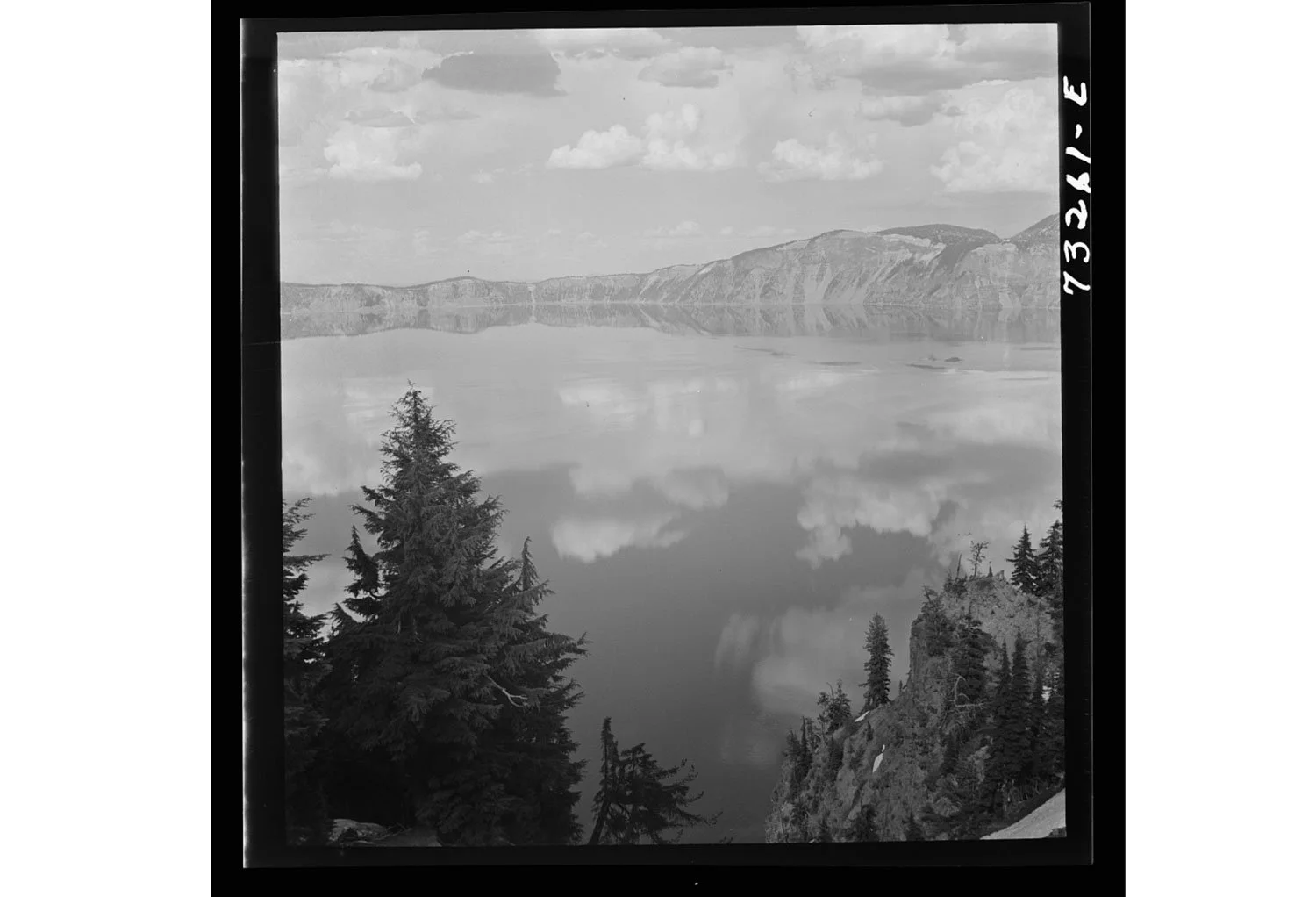
Crater Lake National Park, Oregon. Russell Lee, 1942
Mount Mazama and the Creation of Crater Lake
One of the best-known examples comes from Crater Lake in Oregon. The lake occupies the caldera formed when Mount Mazama underwent an enormous eruption and collapse approximately 7,700 years ago.
Traditions of the Klamath people tell of a conflict between powerful beings associated with the Above World and the Below World. In a commonly published version, Skell and Llao battle with fire and stones until Llao’s mountain collapses, leaving a great depression that eventually fills with water.
The imagery of fire, airborne stones, a destroyed mountaintop, and the formation of the lake bears a striking resemblance to the geological history of Mount Mazama. Because people were living in the region when the eruption occurred, the tradition is often considered a possible cultural memory of the catastrophe. It is also a sacred Indigenous narrative, however, and should not be reduced to a picturesque description of volcanic mechanics. Its spiritual and cultural meanings remain as important as any geological correspondence.
Atlantis and the Eruption of Thera
The story of Atlantis is probably the most famous—and most disputed—example associated with geomythology. In Plato’s dialogues Timaeus and Critias, Atlantis is a wealthy island civilization destroyed by earthquakes and floods before disappearing into the sea.
Some scholars have compared Plato’s story with the Bronze Age eruption of Thera, now Santorini, during the second millennium BCE. The eruption devastated the island, buried the settlement of Akrotiri, and generated tsunamis that affected parts of the Aegean. The great Minoan palaces of Crete were not instantly destroyed by the eruption, but the disaster may have contributed to a longer period of disruption.
Thera offers an appealing geological background for a story about an island overwhelmed by catastrophe, but there is no scholarly consensus that Santorini “was” Atlantis. Plato wrote many centuries after the eruption and may have created Atlantis primarily as a philosophical tale about wealth, power, and moral decline. Geomythology can reveal possible natural influences upon the story without turning speculation into historical certainty.
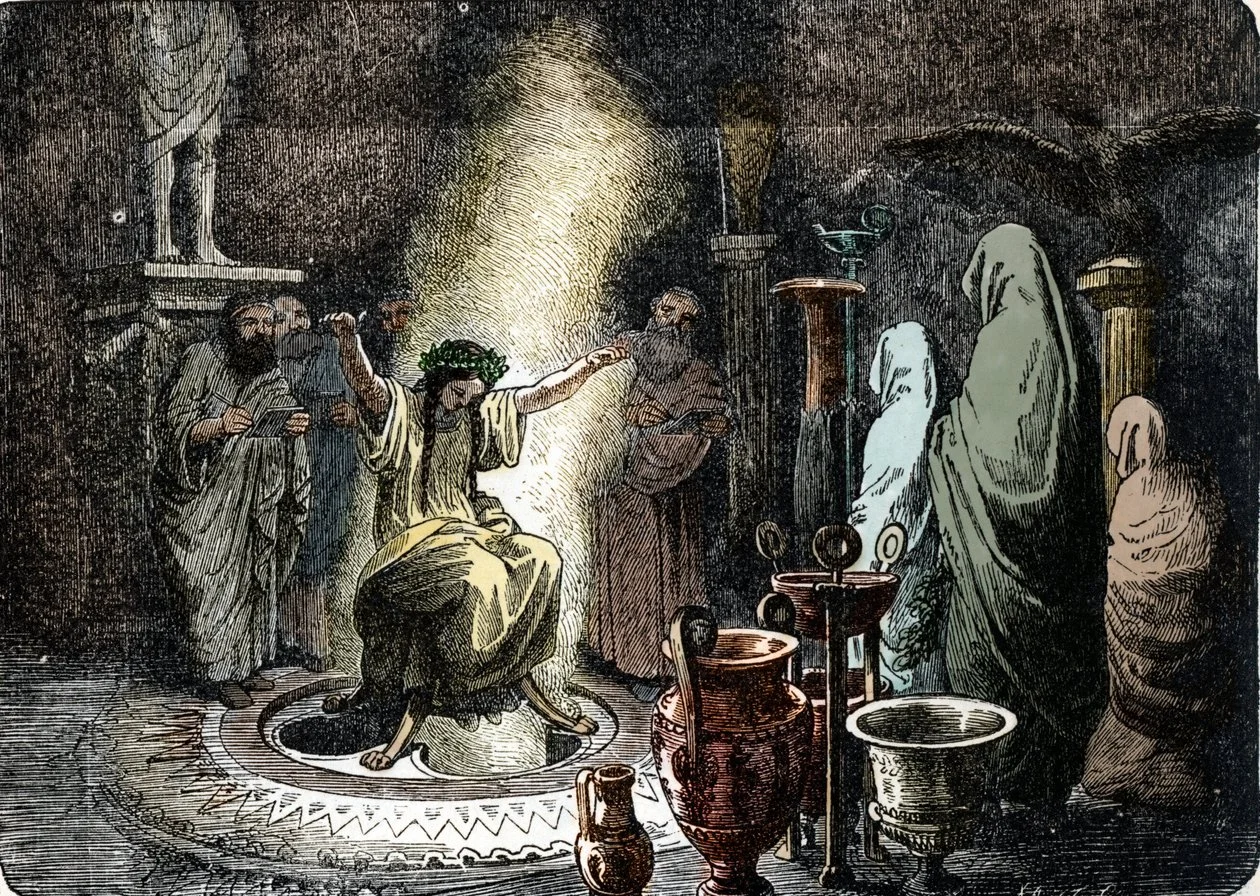
Heinrich Leutemann's The Oracle at Delphi.
The Oracle of Delphi and the Breath of the Earth
Ancient writers described the Pythia, the priestess of Apollo at Delphi, delivering prophecies while seated above a fissure from which a mysterious pneuma, or vapor, arose. For many years, scholars dismissed the idea of geological vapors because no obvious chasm could be found beneath the temple.
Later investigations identified intersecting fault systems in the area and evidence that gases could have traveled through fractured rock. Researchers have proposed that small quantities of hydrocarbon gases may have contributed to the altered state associated with the oracle, although the precise chemistry and its importance remain debated.
Delphi demonstrates that geomythology does not always concern a single ancient catastrophe. It can also examine how geological conditions—faults, springs, caves, gases, and unusual rock formations—helped create the sacred character of a place.
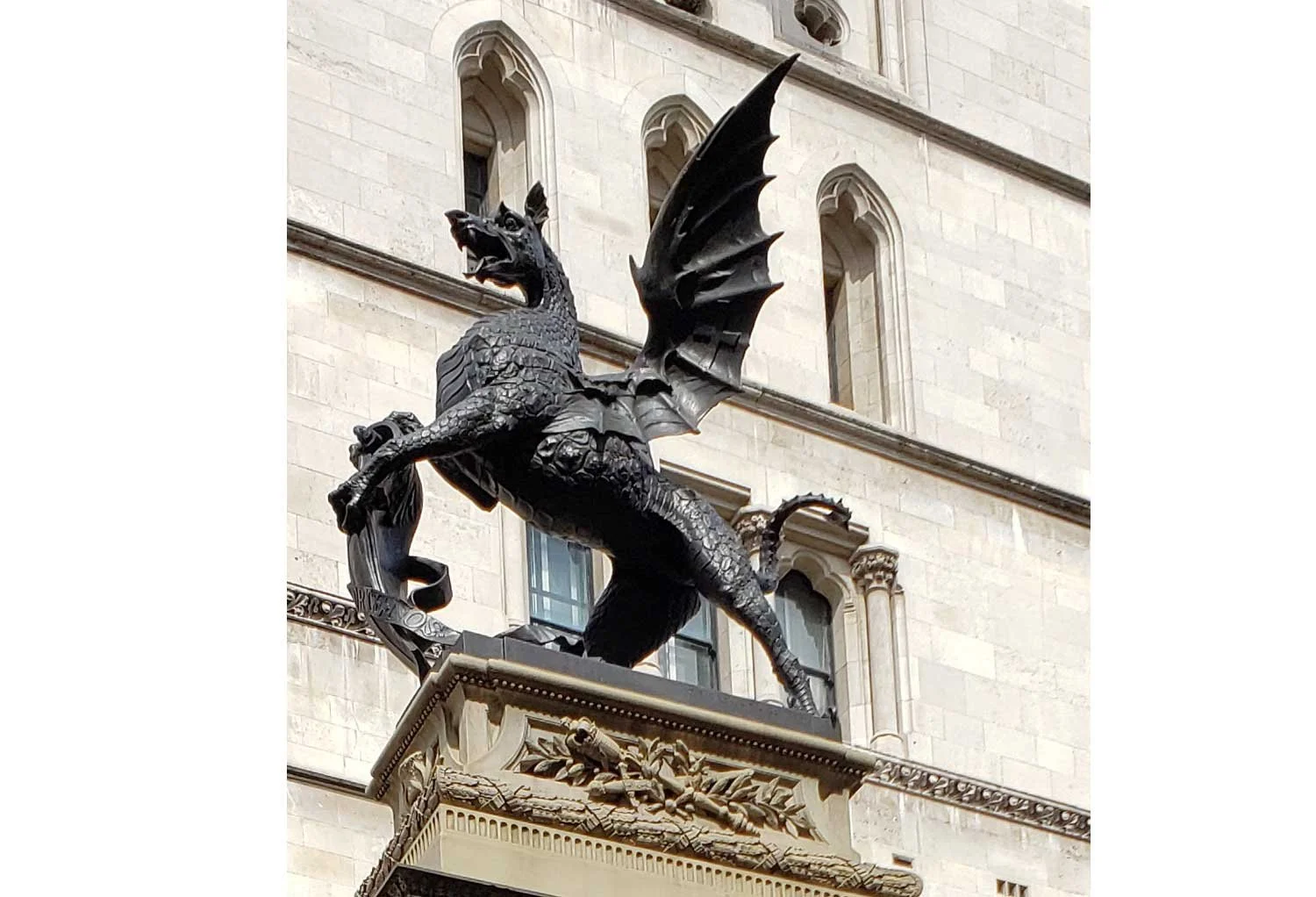
London’s Griffin, which might actually be a Dragon, designed by Sir Horace Jones. Looking very Victorian because it is, indeed, from that era.
Fossils, Griffins, Giants, and Dragons
Fossils form another fascinating branch of geomythology, sometimes called ethnopaleontology (the study of the relationship between human and fossils). Before extinct animals were scientifically reconstructed, their bones invited imaginative explanations. Large fossil remains were identified as those of heroes, giants, monsters, or creatures destroyed in legendary battles.
Classicist Adrienne Mayor has suggested that ancient encounters with fossil remains may have contributed to certain Greek and Central Asian monster traditions. Fossils of beaked dinosaurs found along old travel routes in Central Asia have famously been compared with descriptions of griffins—four-legged creatures with hooked beaks said to guard deposits of gold.
The griffin theory remains debated, but the broader connection between fossils and legendary creatures is well established. In medieval and early modern Europe, ammonites were called “snakestones,” fossil mammoth bones were displayed as the remains of giants, and large teeth were occasionally attributed to dragons. Such identifications reveal how people fitted physical discoveries into the natural and supernatural worlds they already understood.
Floods, Tsunamis, and Drowned Lands
Flood traditions occur throughout the world, but their similarity does not necessarily point to one global event. Rivers overflow, coasts subside, storms produce surges, and tsunamis strike widely separated communities. Different flood stories may therefore contain memories of many local or regional disasters.
One particularly valuable area of research concerns coastal traditions that describe the sea withdrawing before returning violently. In some communities, these stories preserved practical warnings: unusual behavior by the sea meant that people should immediately seek higher ground.
Researchers have also compared Indigenous Australian traditions of drowned coastlines and vanished islands with the rise in sea level that followed the last Ice Age. Some narratives correspond suggestively with landscapes submerged thousands of years ago. These studies remain complex, but they demonstrate that carefully maintained oral traditions can preserve environmental knowledge across periods far longer than was once assumed.
Why Geomythology Matters
Geomythology offers more than dramatic explanations for ancient stories. It can help researchers locate evidence of past natural disasters, understand how communities adapted to hazardous landscapes, and recognize oral tradition as a sophisticated form of knowledge preservation.
Such traditions may encode practical instructions: where floods once reached, which mountains were dangerous, how the sea behaved before a tsunami, or why settlement in a particular place was forbidden. Stories made this information memorable. A warning involving a supernatural being or ancestral event could survive more effectively than a bare list of observations.
The field also reminds us that myth and science do not have to be treated as simple opposites. A sacred story is not merely unsuccessful geology, nor does identifying a natural event explain away its religious meaning. The same narrative can preserve history, shape identity, teach conduct, sanctify a landscape, and contain close observations of nature.
Modern researchers must therefore work collaboratively with Indigenous communities and traditional knowledge holders. Not every story is intended for public circulation, and scientific investigators do not automatically have the right to extract information from living sacred traditions.
Where Can Geomythology Be Studied Today?
Geomythology remains a specialized interdisciplinary field rather than a common stand-alone university degree. A student will rarely find a bachelor’s or master’s program titled simply “Geomythology.” Instead, it is usually approached through one of several related disciplines:
Geology or Earth science, particularly volcanology, paleoseismology, geomorphology, geohazards, and geoarchaeology
Archaeology and anthropology
Folklore, mythology, classics, and religious studies
Historical and cultural geography
Environmental history and the environmental humanities
Indigenous studies and traditional ecological knowledge
Archaeoastronomy and cultural astronomy
Universities in volcanically or seismically active regions—particularly around the Mediterranean, Pacific Northwest, Australia, New Zealand, Japan, and the Pacific Islands—often support research that overlaps with geomythology. Prospective graduate students may have better success searching for individual researchers and supervisors using terms such as “oral tradition and natural hazards,” “Indigenous geoscience,” “myth and landscape,” “cultural memory of disasters,” or “geoarchaeology” rather than searching only for geomythology.
The Geological Society of London and international geological congresses are useful places to follow scholarship on myth, landscape, geoheritage, and natural hazards.
The Earth as Storyteller
Geomythology encourages us to look at both stories and landscapes with greater attention. A lake may be more than water filling a volcanic crater; a mountain may be both a geological structure and the dwelling place of a divine being. Beneath a tale of battling gods may lie the distant memory of fire, darkness, trembling ground, or a sea that suddenly rose.
The purpose of geomythology is not to strip the wonder from such stories. At its best, it does the opposite. It reveals that myth can be a vessel through which human beings remembered the movements of the earth—and that the landscape itself has always been one of humanity’s oldest storytellers.
…
Ted-Ed talk on Geomythology HERE