
Anthropoid Coffins of Ancient Egypt
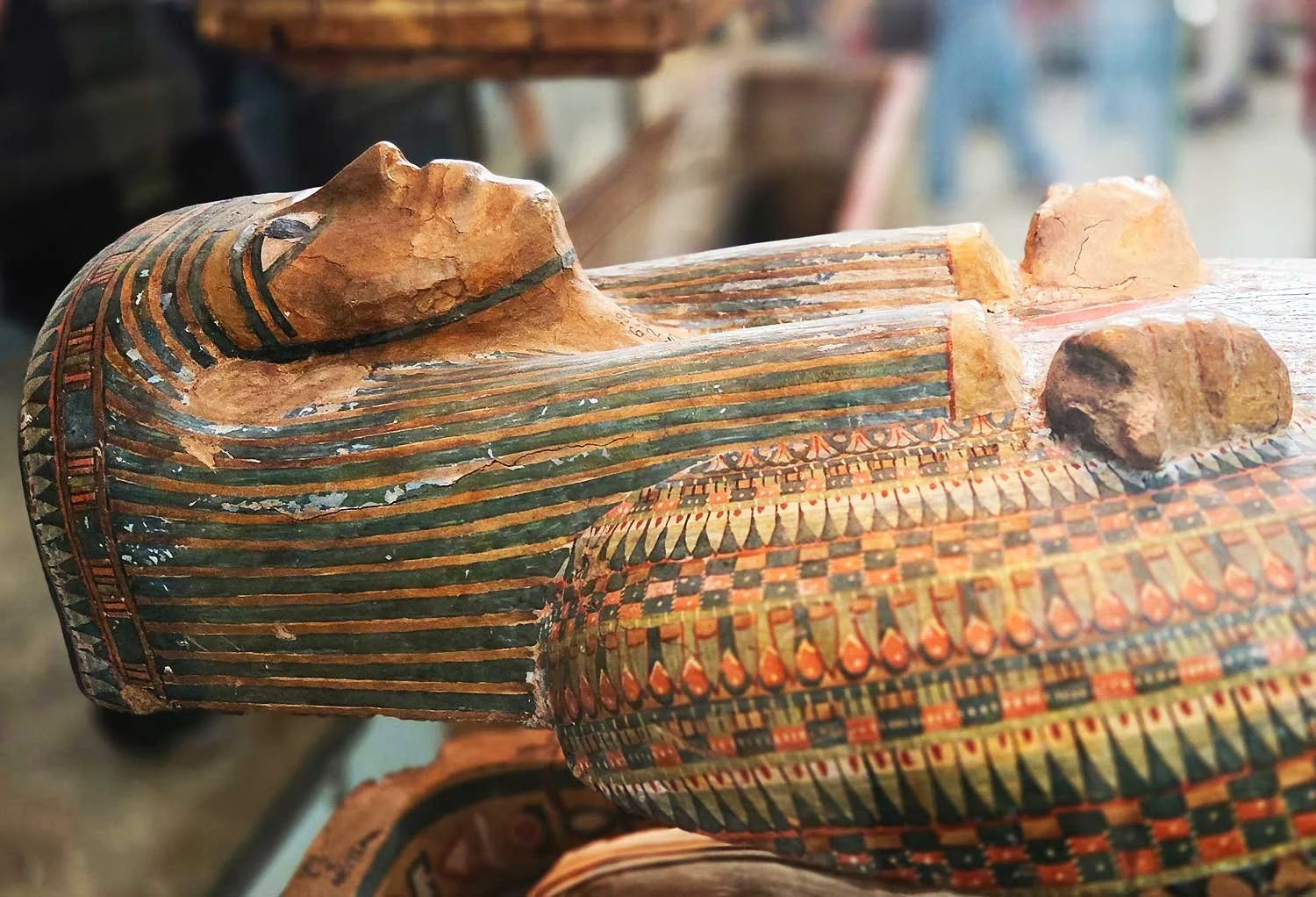
Highly decorated wood coffin at The British Museum.
I was at The British Museum last week and one of the most fascinating galleries was the Egyptian Death and Afterlife: Mummies permanent collection. Aside from cat mummies and canopic jars, they have a large collection of Anthropoid Coffins. These elaborate creations have always captured the imagination and they are just one of the reasons ancient Egypt continues to retain an air of mystery!
Painted for Eternity: The Decorated Anthropoid Coffins of Ancient Egypt
Among the most striking objects in an Egyptian gallery are the anthropoid coffins whose human-shaped forms are almost entirely covered with gods, sacred symbols, hieroglyphs and bands of brilliant color. Their decoration can appear extraordinarily dense: broad collars composed of tiny floral and geometric patterns lie above rows of divine figures, winged goddesses stretch protectively across the chest, and columns of hieroglyphs descend toward the feet. Yet very little of this imagery was intended as ornament alone. An Egyptian coffin was both a protective container and a sacred instrument, designed to preserve the body, identify the deceased and assist in the difficult passage from death to renewed life.
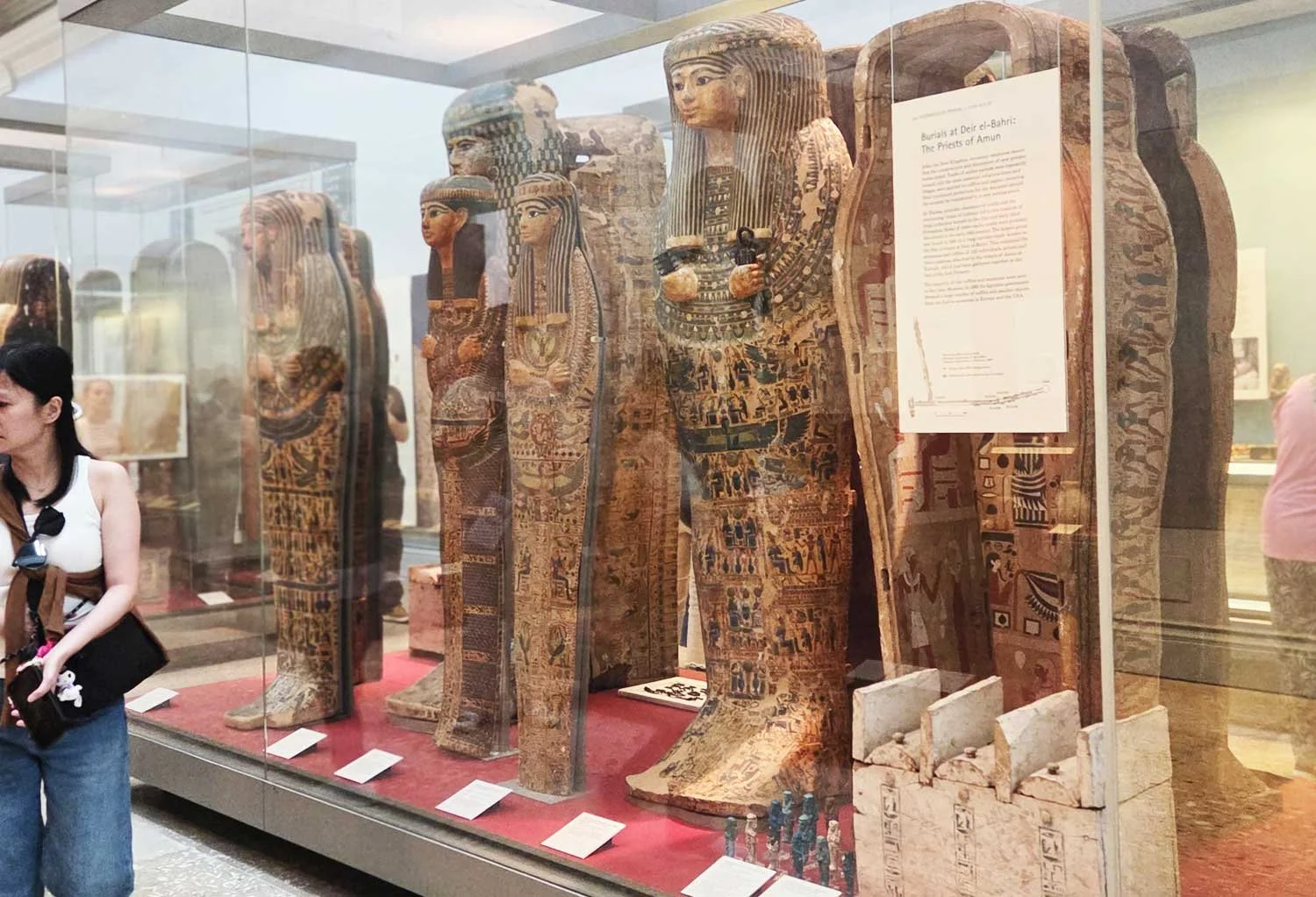
In the galleries at The British Museum.
The word anthropoid simply means “human-shaped.” Although Egyptian coffins changed considerably over thousands of years, anthropoid forms became particularly important from the Middle Kingdom onward and were widely used during the New Kingdom and later periods. The sculpted face, wig, collar and crossed or extended hands transformed the coffin into an idealized, eternal image of its owner. More profoundly, the wrapped and motionless form associated the deceased with Osiris, the god who was murdered, restored to life and made ruler of the afterlife.
During the Third Intermediate Period, particularly the 21st and 22nd Dynasties, painted coffins became extraordinarily elaborate. Tomb decoration was sometimes more limited than it had been during the New Kingdom, and much of the protective imagery formerly painted upon tomb walls was transferred to coffins and funerary papyri. The coffin effectively became a miniature tomb: a carefully ordered sacred world surrounding the mummy.
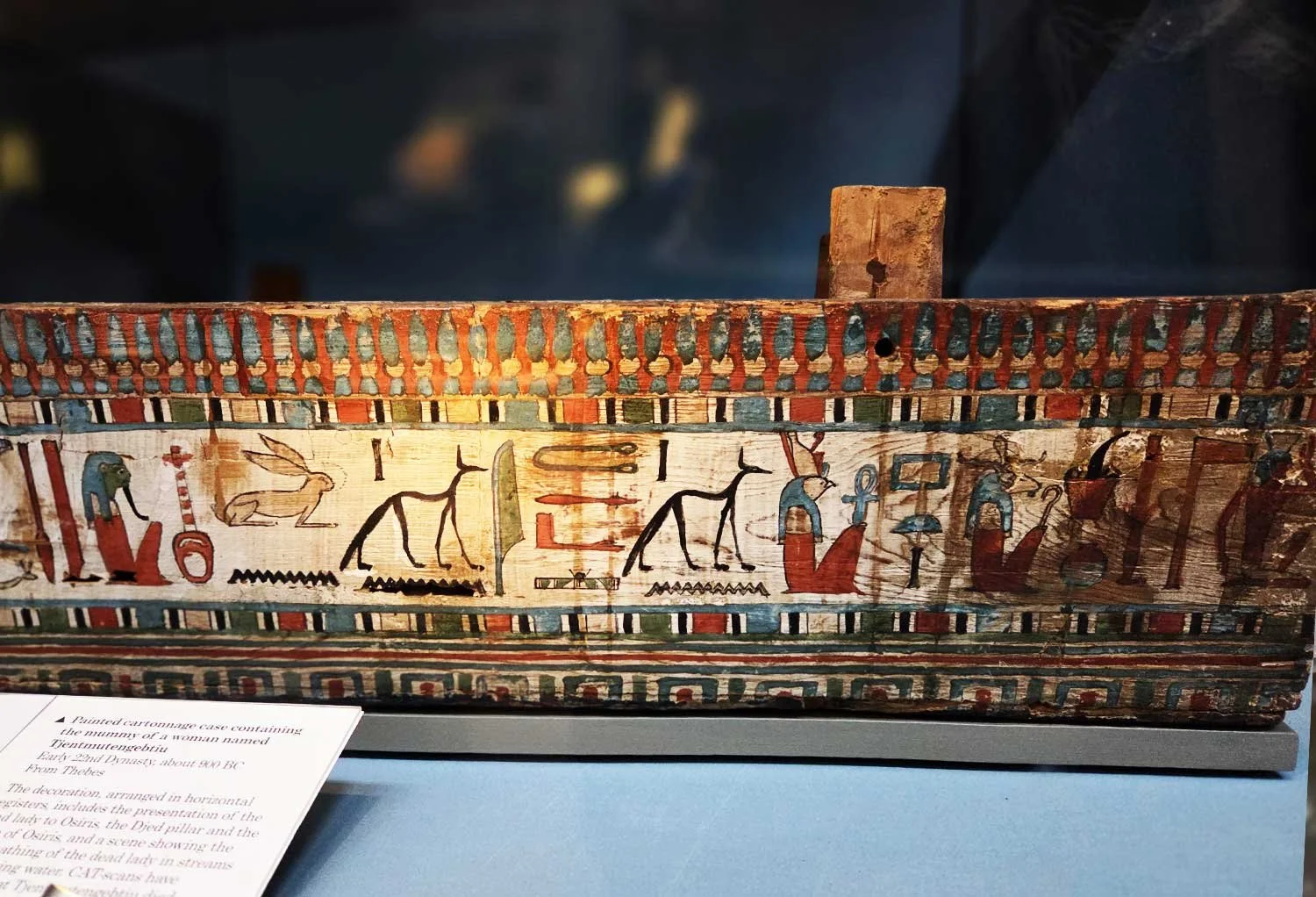
Detail of painted cartonnage case.
Cartonnage is the term for the layers of textile, glue and plaster that were applied wet and then when dried, created the base for the painted designs, or gilding, and hieroglyphics.
A Wooden Body Beneath the Paint
Most anthropoid coffins were assembled from several pieces of wood rather than carved from a single enormous log. Egypt had relatively few large native trees suitable for woodworking, so coffin makers used whatever materials were available. Sycamore fig was especially common, along with tamarisk, acacia and other local woods. Imported cedar from Lebanon was valued for its size, fragrance, durability and natural resistance to insects, but it was expensive and generally reserved for wealthier burials or particularly important components.
Craftsmen joined irregular pieces with wooden pegs, dowels and mortise-and-tenon joints. Knots, gaps and uneven areas could be filled with mud, plaster or small wooden inserts. Linen was sometimes stretched over vulnerable joins to strengthen the surface. The completed wooden shell was then covered with a pale preparation layer—often made from calcite or gypsum mixed with an adhesive—to create a smoother ground for painting.
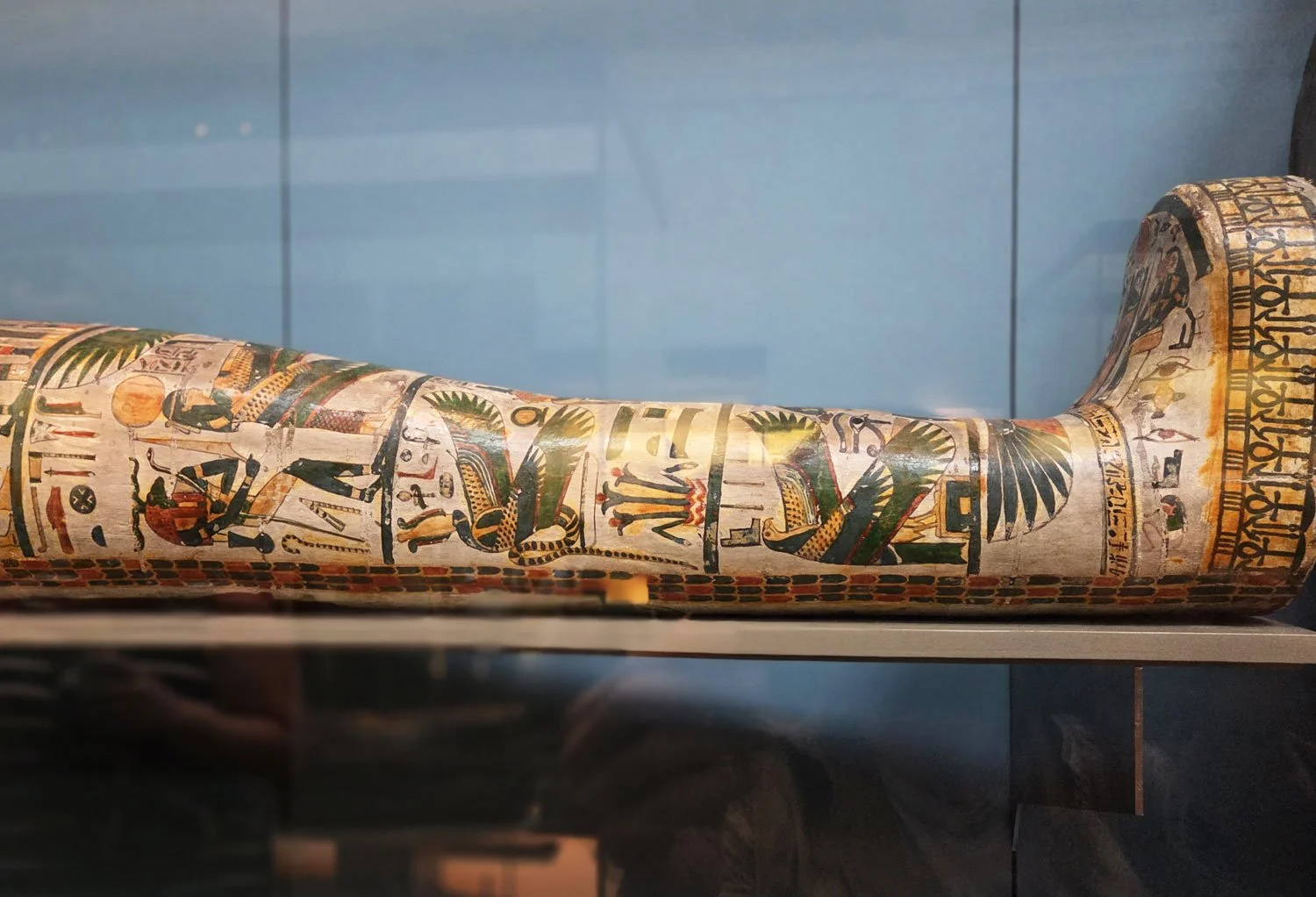
Fantastic imagery painted in beautiful detail.
This white ground concealed the patchwork construction and gave the painters a bright, receptive surface. Outlines could be drawn in red or black before mineral colors were applied with brushes made from reeds or plant fibers. Many paints were mixed with water and a binding material such as plant gum. Scientific examination of ancient coffins has identified palettes containing calcite, gypsum, charcoal black, red and yellow ochres, Egyptian blue, green earth, malachite and, in some periods, brilliant arsenic-based pigments such as orpiment. The precise materials vary from coffin to coffin, so a color visible today cannot always be identified with certainty without scientific analysis. Conservation studies also show that pigments may fade, darken or change in appearance over time.
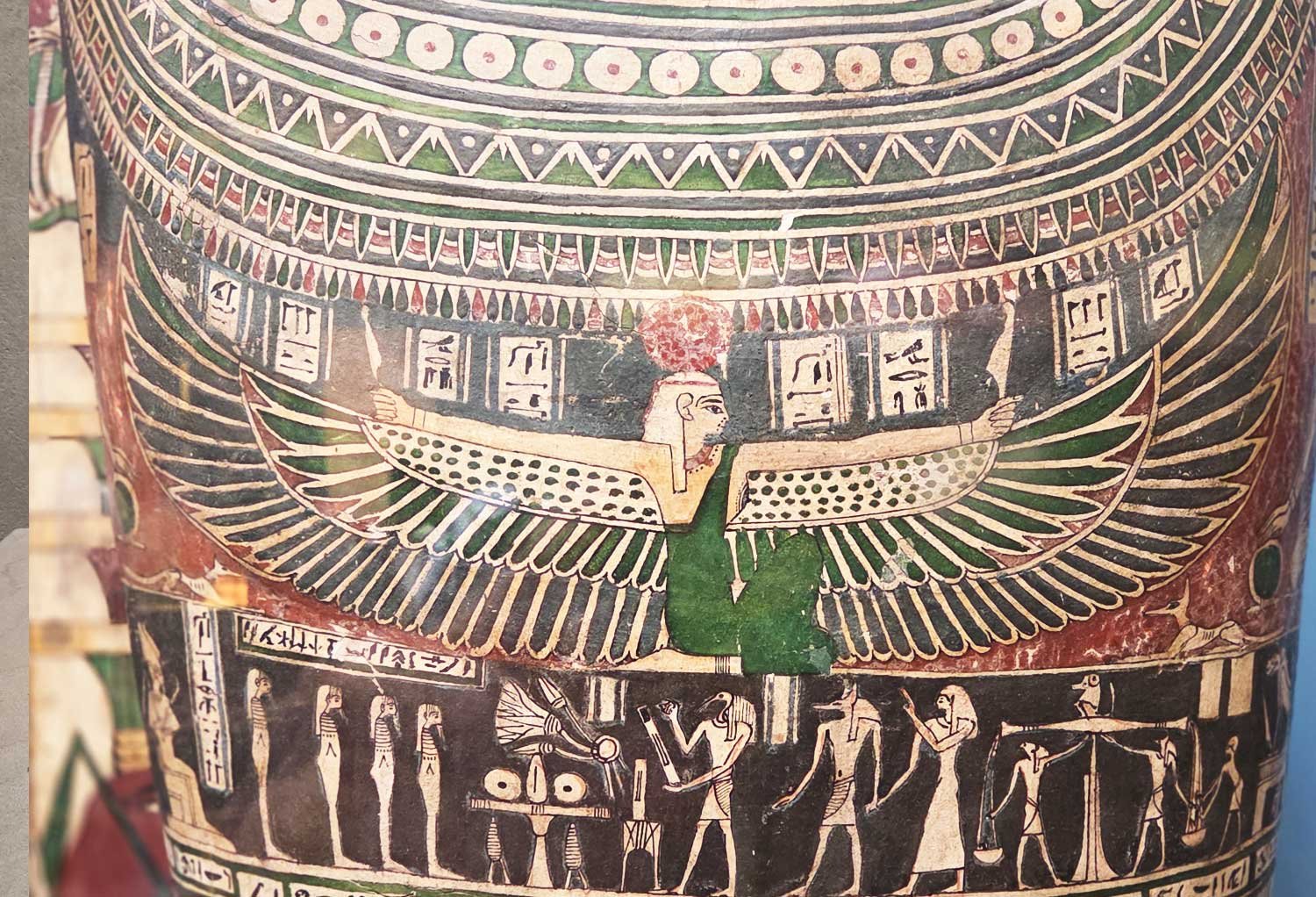
Goddess Nut, a feather in each hand, flanked by goddesses Isis and Nephthys and two jackals.
Colors with Sacred Meaning
The colors used on Egyptian coffins were chosen for their visual beauty, but they also carried religious meaning. To an Egyptian viewer, color could express the essential nature of a god, substance or cosmic force.
Green represented fresh vegetation, health, renewal and regeneration. It was closely associated with Osiris and with the promise that the dead could be restored to life.
Black evoked the rich, dark silt deposited by the Nile and therefore could signify fertility and rebirth. Osiris was sometimes shown with black skin for this reason. Black was generally made from carbon, soot or charcoal.
Blue suggested the heavens, divine waters and the celestial realm. Egyptian blue, one of the earliest manufactured pigments, was produced by heating ingredients including copper, silica and a calcium compound. It could be ground and mixed into paint.
Yellow and gold represented sunlight, permanence and the imperishable flesh of the gods. Yellow ochre provided many painted yellows, while orpiment could produce a particularly luminous golden shade. Actual gold leaf was used on costly coffins and masks.
Red was the color of blood, fire, vitality and powerful energy. It could be protective, but it could also signify danger, anger or the disorder of the desert. Red ochre, rich in iron oxide, was a common source.
White expressed purity, sacredness and ritual cleanliness. Calcite and gypsum were used both as pigments and as preparation layers beneath other colors.
These meanings were not rigid rules; context mattered. Nevertheless, the repeated use of green, blue, yellow, black and red gave the coffin a symbolic life beyond its physical materials.
Hieroglyphs as Protection
The hieroglyphic inscriptions on a coffin were not merely labels or memorial texts. Written words possessed power. They named the deceased, appealed to the gods and supplied prayers, offerings and magical protection. Preserving a person’s name was especially important because the name was considered a fundamental part of individual identity. To erase or forget it threatened the person’s continued existence.
Some inscriptions are offering formulas requesting bread, beer, cattle, fowl, incense, linen and other necessities for the afterlife. Others invoke Osiris, Anubis, Nut or additional deities. Passages derived from funerary compositions could give the deceased knowledge needed to pass divine guardians, avoid dangers and enter the company of the gods.
The arrangement of the writing also mattered. Vertical and horizontal bands of hieroglyphs divide the coffin into ordered compartments, much like the architecture of a temple. Images and texts work together, surrounding the mummy with a structured and eternally active field of protection.
The Gods Upon the Coffin
Osiris naturally occupies a central place in coffin decoration. He may be shown enthroned, wrapped as a mummy and wearing the tall atef crown, sometimes holding the crook and flail. As lord of the dead, he received the deceased into the afterlife and provided the divine model for resurrection.
Several other gods frequently appear:
Nut, goddess of the sky, often spreads her wings or arms across the chest. She could also be painted full-length inside the coffin so that the deceased lay within her protective embrace. Just as Nut received the sun each evening and gave birth to it again each morning, she could receive the dead and bring them into renewed life.
Isis, wife of Osiris, was the great mourner, healer and magician who helped restore her husband. Together with her sister Nephthys, she guarded the dead.
Anubis, the jackal-headed god, protected cemeteries, oversaw embalming and guided the deceased through the realm of the dead. In judgment scenes he may attend the balance upon which the heart is weighed.
Thoth, commonly represented with the head of an ibis, was the god of writing and sacred knowledge. During the judgment of the dead, he recorded the result of the weighing of the heart.
The four Sons of Horus protected the internal organs of the deceased. Imsety, Hapy, Duamutef and Qebehsenuef were associated respectively with the liver, lungs, stomach and intestines and were guarded in turn by particular goddesses.
Winged scarabs, falcons, solar discs, wedjat eyes, djed pillars and knots of Isis could add further layers of protection. The broad floral collar painted around the shoulders recalled the elaborate collars worn by the living, but its repeated petals, beads and sacred forms also helped present the dead in a perfected, ceremonial state.
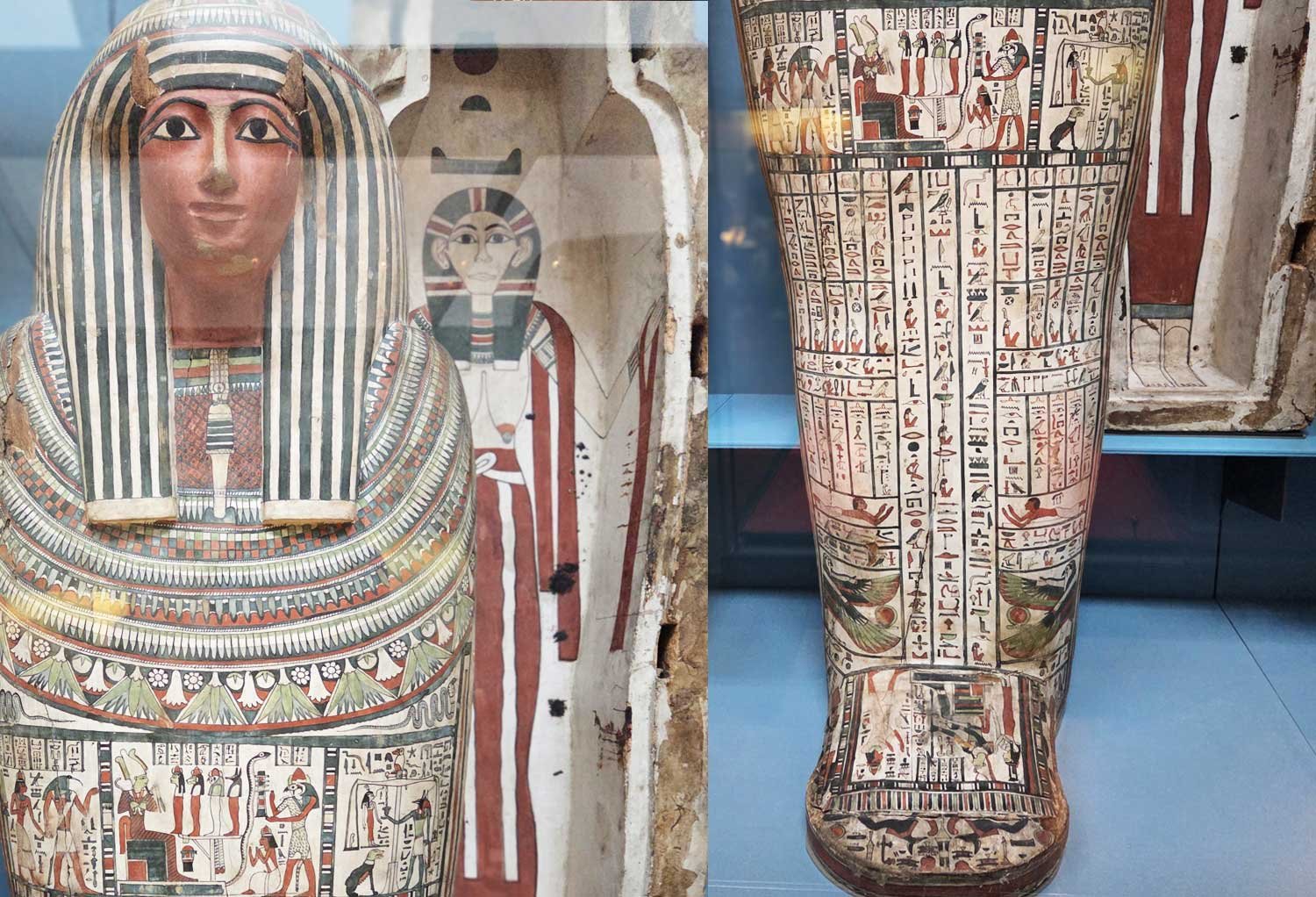
Pensenhor’s coffin, top to the right, lower half to the right.
The Coffin of Pensenhor: British Museum EA24906
A particularly beautiful example is the coffin of Pensenhor, also at The British Museum. Pensenhor was a man of Libyan origin who settled in Egypt and was buried at Thebes during the 22nd Dynasty, broadly dated to about 945–715 BC. His background reflects the close connections between Egypt and families of Libyan descent during this period, when rulers of Libyan ancestry governed much of the country and participated fully in Egyptian religious and artistic traditions.
Pensenhor’s anthropoid wooden coffin consists of a base and lid covered with polychrome painting on a white ground. The face is serene, while the wig, broad collar and intricately arranged registers transform his coffin into an ideal divine body.
The lid contains images of Osiris, Isis, Thoth and the four Sons of Horus, accompanied by a prayer to Osiris. One of its more unusual scenes shows Anubis weighing Pensenhor’s heart. In Egyptian belief, the heart was weighed against the feather of Ma’at—the principle of truth, justice and cosmic order. A heart that proved balanced and righteous allowed its owner to pass into blessed existence.
An emblem of Osiris hangs prominently over the collar, further emphasizing Pensenhor’s hoped-for transformation. Near the feet, he is shown standing before Osiris and Isis, visually presenting him to the divine rulers of the afterlife. Inside the base is a full-length image of the sky goddess Nut with her arms extended. When Pensenhor’s mummy was placed within the coffin, he was symbolically enclosed by the goddess herself.
Every part of the composition therefore served a purpose. Osiris offered resurrection; Isis supplied protection and magical restoration; Anubis guided the dead and supervised judgment; Thoth confirmed the verdict; the Sons of Horus guarded the body; and Nut enveloped Pensenhor within the regenerative cycle of the heavens.
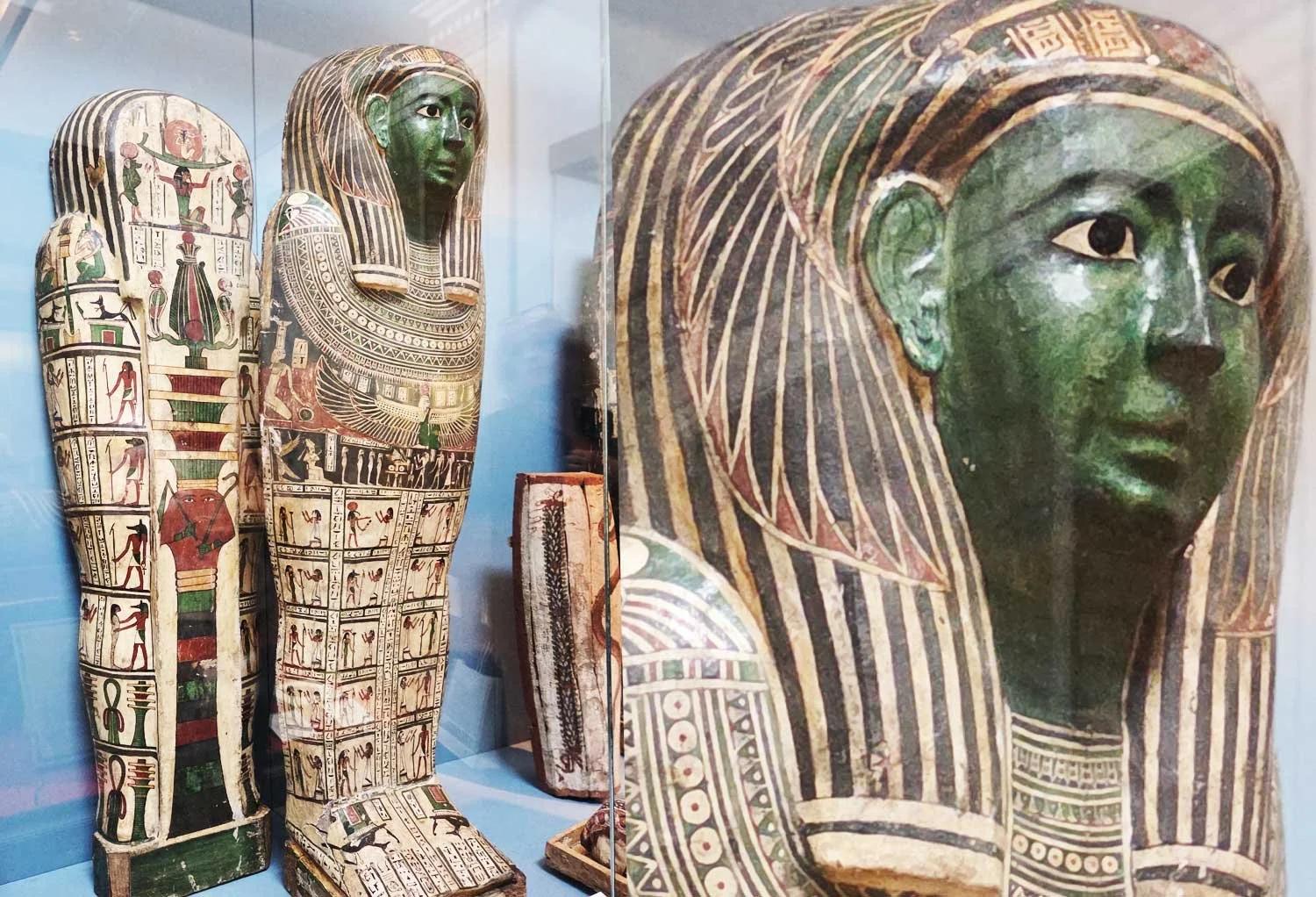
Coffin of Itineb
The coffin of a man named Itineb in The British Museum is a painted anthropoid coffin made from sycamore-fig wood and dating to Egypt’s Late Period, probably the 26th Dynasty or later, after 664 BC. Found at Saqqara, it is covered with painted stucco and has a green face, identifying Itineb with Osiris and the promise of regeneration. Above his striped wig appears the sky goddess Nut, crowned with a solar disc and holding an ankh in each hand. A second image of Nut spreads her wings protectively across the chest, this time with a feather in each hand, accompanied by Isis, Nephthys and two sacred jackals.
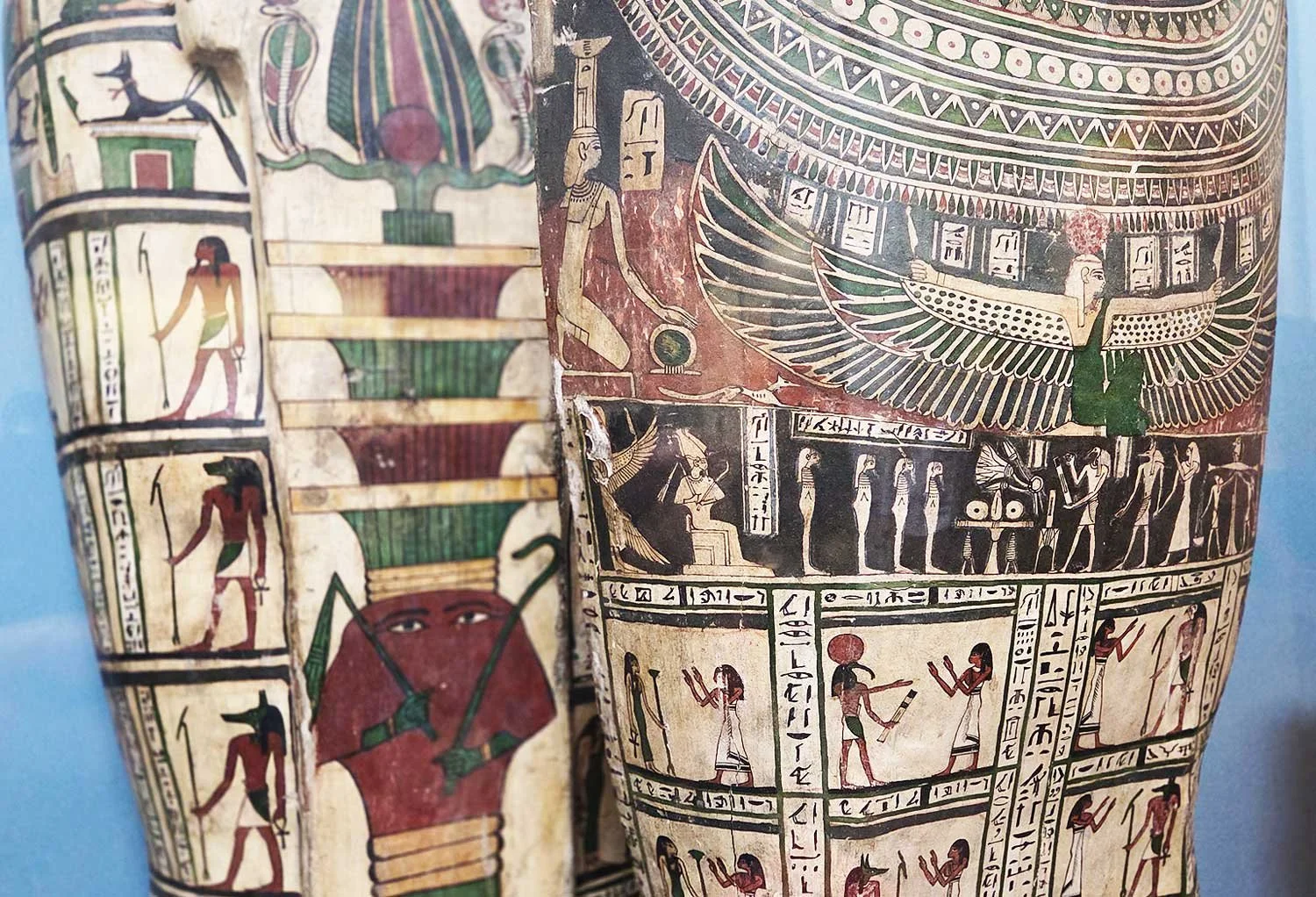
The Goddess Nut, spreading her wings across the chest section. Djed Pillar shown with crook and flail, all in rich earth-based colour.
Below this is a detailed judgment scene in which Itineb’s heart is weighed before he is led by Anubis and Thoth into the presence of the enthroned Osiris. Smaller compartments show Itineb worshipping different deities, while the accompanying texts identify parts of his body with those of the gods, magically transforming and protecting him. On the back, an extraordinary crowned djed pillar—symbolizing the backbone and enduring stability of Osiris—is given human eyes, arms, a torso, crook and flail. Together, these images turned the coffin into far more than a beautiful container: it became a sacred body through which Itineb might be protected, judged and reborn.
Why Do Some Coffins Have Green Faces?
The green faces seen on certain Egyptian coffins were not attempts to reproduce the deceased’s natural appearance. They identified the dead person with the regenerative power of Osiris. Because crops emerged green from the earth, green represented vegetation returning to life. Osiris, whose resurrection stood at the heart of Egyptian funerary belief, was consequently shown with green or sometimes black skin.
Painting the coffin’s face green could therefore express a transformation: the deceased had become an “Osiris,” a justified and renewed being capable of eternal life. The color proclaimed that death was not final. Like seed buried in the earth, the dead person could awaken and flourish again.
Green could be obtained from minerals such as malachite or green earth, or created by combining blue and yellow materials. Because ancient paint layers may have altered over centuries—and because different workshops used different recipes—the pigment responsible for a particular green face can only be confirmed through analysis.
A Painted Universe
The beauty of an Egyptian coffin lies partly in its remarkable combination of art, craftsmanship, theology and written language. What appears at first to be a profusion of patterns is in fact a carefully constructed universe. The collar, wings, feathers, hieroglyphs and divine figures created successive layers of protection around the vulnerable body.
To stand before one of these coffins today, especially when its blues, reds, greens and golden yellows remain vivid, is to see death represented not as emptiness, but as transformation. The coffin was an eternal body, a temple and a map of the afterlife. Its painted surface assured the deceased that the gods knew their name, guarded their journey and would help them rise again with the sun.