
The Turquoise Double-Headed Serpent
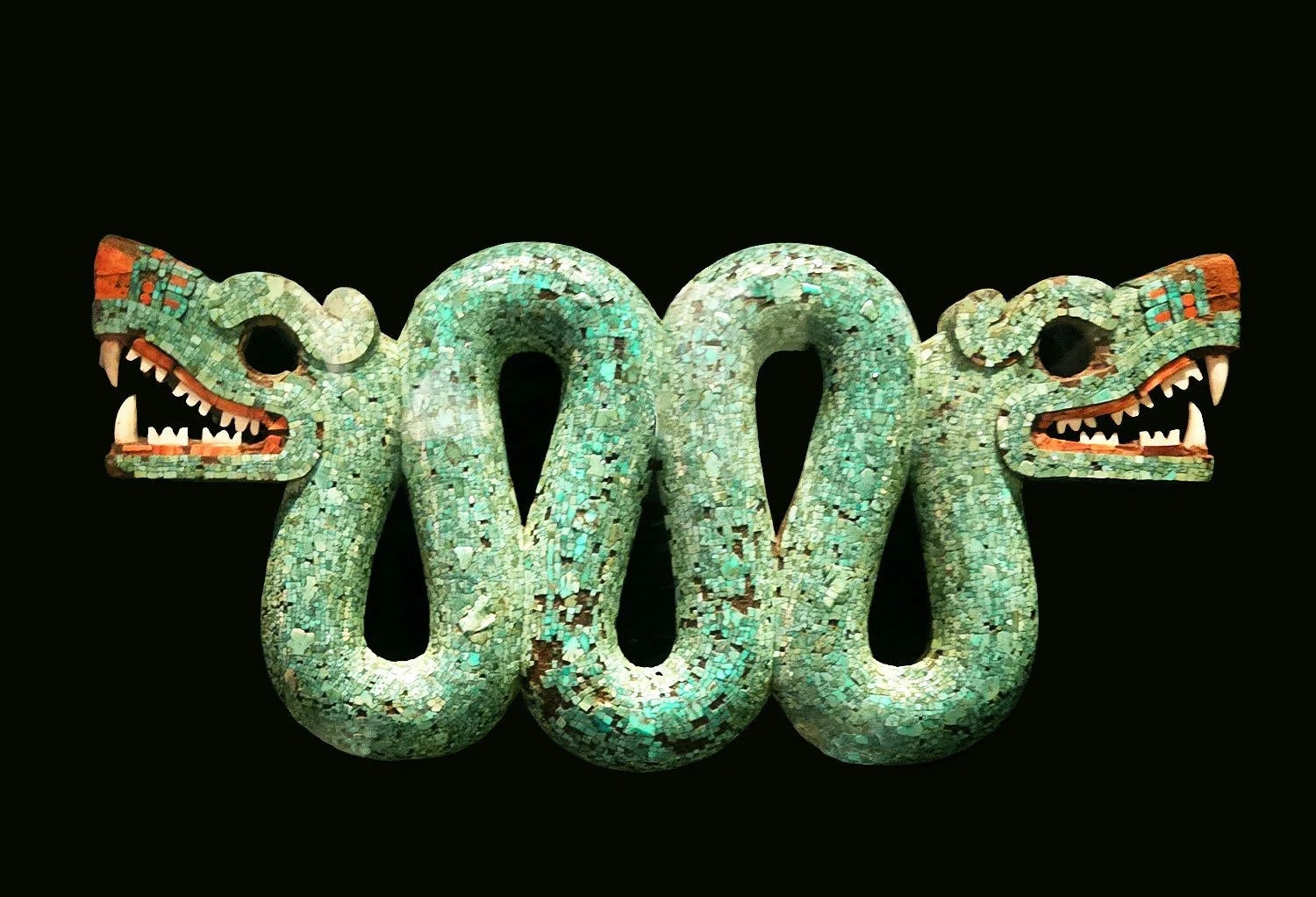
I took this photo on a recent visit to The British Museum in London. Mixtec-Aztec, AD 1400-1521
Last week I had the great pleasure of being back at The British Museum. I particularly love this museum because of its collection of archaeological art vs canvas paintings. I know there’s a lot of conversation around the area of who owns the rights to many of the relics there, but that aside, its collection is breathtaking.
This is one of my favorite pieces, the double-headed serpent clad in brilliant turquoise mosaic pieces, conch shell, oyster shell, hematite on a base of cedrela wood. Pine resin is used as the adhesive and beeswax, I believe, was used to hold orbs where the empty eye sockets are now.
The Double-Headed Serpent: A Turquoise Masterpiece of Ancient Mexico
Among the British Museum’s celebrated group of Mexican turquoise mosaics, few objects are as arresting as the Double-Headed Serpent Pectoral. Created in Mexico between approximately 1400 and 1521, during the final century of the Mexica, or Aztec, Empire, the ornament measures just over seventeen inches wide. Its precise place of manufacture is unknown, and the museum attributes it to the Mexica or Mixtec cultures, both of which produced exceptionally sophisticated luxury objects. With its sinuous body, brilliant blue-green surface and two open, fanged mouths, it was designed to appear both magnificent and formidable.
Although the individual tesserae are flat, their subtle variations create the impression of a shimmering, scaled skin moving across the serpent’s curved body.
The serpent was carved from a single piece of Spanish cedar, or Cedrela odorata. Its wooden body was hollowed from behind, probably to reduce its weight, while two holes along the upper edge suggest that it could be suspended and worn across the chest as a pectoral. It may have formed part of the ceremonial regalia of a ruler, priest, deity impersonator or sacred effigy. The front is covered with thousands of small pieces of turquoise, carefully cut, polished, graded by color and fitted together with pine resin. Although the individual tesserae are flat, their subtle variations create the impression of a shimmering, scaled skin moving across the serpent’s curved body.
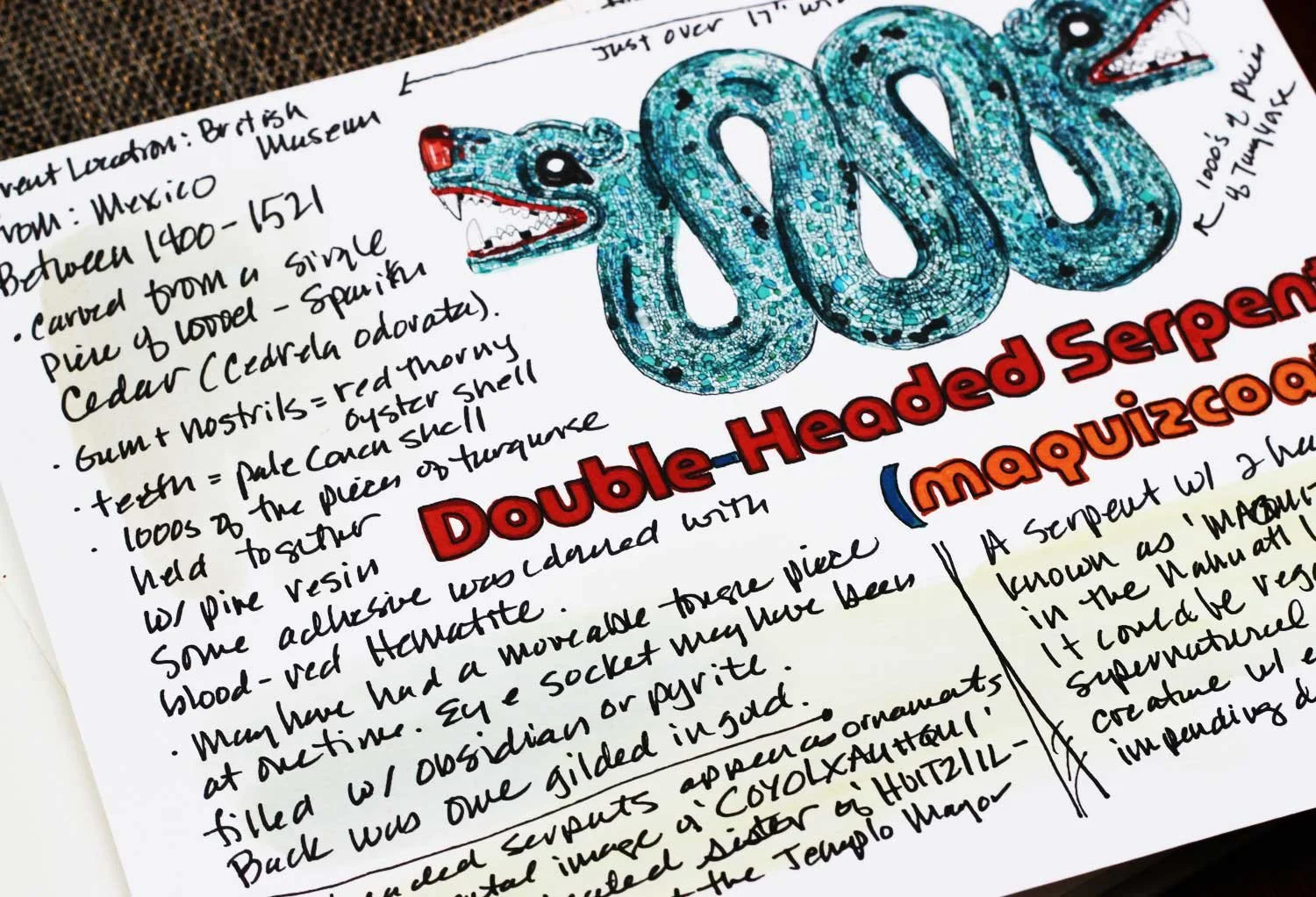
An addition to my sketchbook.
Shells for Teeth, Gums and Nostrils…
Other materials supplied dramatic details. The gums and nostrils were formed from red thorny-oyster shell, or Spondylus princeps, while pale conch shell was used for the teeth. Hematite colors portions of the adhesive a rich blood-red, and traces of copal resin and beeswax remain. The now-empty eye sockets may once have held gleaming pieces of pyrite or obsidian, and holes in the lower jaws suggest that movable tongues might also have been attached. Even the reverse was originally splendid: although largely undecorated today, it appears to have once been gilded. When complete, the combination of turquoise, gold, red shell, white teeth and flashing eyes must have made the creature seem almost alive.
Materials and Their Associations…
These materials carried meanings beyond their beauty. Turquoise was one of the most valued substances in ancient Mesoamerica, associated with preciousness, rulership, fire, water and the brilliant blue-green world of feathers and vegetation. It reached central Mexico through extensive trading and tribute networks, although the exact geological origins of the turquoise used in individual objects remain debated. Red Spondylus, gathered from warm Pacific waters, was likewise an exotic material associated with wealth, water and elite ritual. Thus, the pectoral embodied not only artistic skill but also control over distant resources and trade routes.
Serpents, Associated with the Underworld, the Earth and the Sky…
Serpents occupied a particularly important place in Mexica religion. Because they moved close to the earth yet were associated with water, clouds, fire and celestial forces, they could symbolically cross the different levels of the cosmos—the underworld, earthly realm and sky. Serpent imagery appeared in connection with several deities, including Quetzalcoatl, the Feathered Serpent, and Xiuhcoatl, the Turquoise or Fire Serpent associated with the sun and the god Huitzilopochtli. The undulating form of this pectoral may also have represented a celestial “sky-band,” making it an emblem of sacred authority.
A Double-Headed Serpent and The Supernatural
A serpent with two heads had more particular associations. Known in Nahuatl as a maquizcoatl, it could be regarded as an ominous supernatural creature connected with elite power and impending death. According to Mexica belief, encountering one might foretell misfortune. Double-headed serpents also appear as ornaments on the monumental image of Coyolxauhqui, the defeated sister of Huitzilopochtli, discovered at the Templo Mayor in Mexico City. For this reason, scholars have suggested that the British Museum pectoral may once have belonged to the insignia of Huitzilopochtli, an image of the god or a priest ceremonially impersonating him. Its two heads may additionally evoke the complementary opposites fundamental to Mexica thought—life and death, creation and destruction, earth and sky—although its exact meaning cannot now be known with certainty.
Where Did it Come From?
The pectoral’s journey from Mexico is equally mysterious. It is sometimes suggested that it was among the extraordinary turquoise objects sent to Europe following the arrival of Hernán Cortés in 1519, perhaps even among the diplomatic gifts presented by the Mexica ruler Moctezuma II. No surviving documentation proves this connection, however, and its whereabouts during the following centuries remain unknown. It reappeared in Europe in the late nineteenth century, when a London dealer offered it to the British Museum on behalf of an unidentified owner in Italy. After negotiations involving the Duchessa Massimo and Lord Walsingham, the museum purchased it in 1894 for £100.
Its survival is remarkable. Many Mexican objects made from precious materials were dismantled, melted down or dispersed after the Spanish conquest. This serpent escaped that fate, preserving not only the brilliance of Mexica and Mixtec mosaic work but also something of the commanding presence of ancient ceremonial regalia. Five centuries later, its two heads still seem poised between worlds—beautiful, threatening and charged with sacred power.
See this on The British Museum site HERE. The Curator’s Comments is of special interest.