
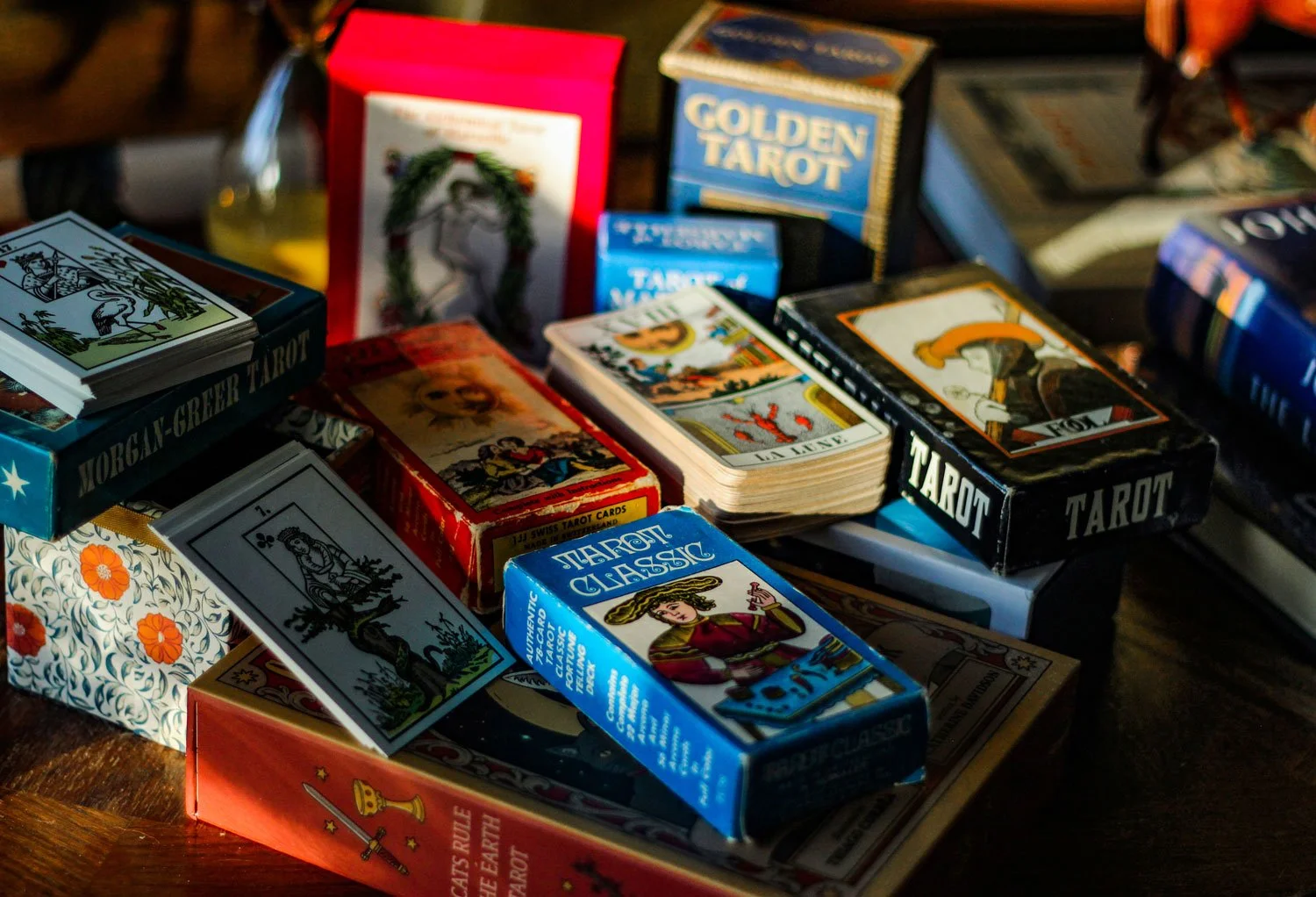
My budding collection of Tarot Cards…
A Life-Long Passion for Tarot Card Art…
I have been under the spell of tarot cards since I first set eyes on them, which was when I was about 10. Not just because they held a sense of mystery and maybe even a little bit of spookiness (to a
10-yr old) but mainly because of the imagery.
And still to this day, it’s the art on the cards that draws me in. Truth be told, I have tried my hand at reading cards. But, I never really believed in the concept as I understood it.
Now, today, my thoughts on this have shifted a bit. I still don’t exactly buy the idea that someone else can answer life’s questions for you with the shuffling and picking of cards, but I do believe that you can read and interpret your own cards.
What I mean is, I believe that you can pull a card - and some people do this daily, pulling just one card every morning- and concentrate on what the idea of that card means to you. In other words, the card is like a prompt for your subconscious. So, while the card isn’t telling you your future, it’s helping you to think about something that may be dancing around in your head that you’re not even aware of yet.
These days, I mostly collect tarot cards. I am especially drawn to vintage cards from the 1970s - I grew up in that era and I still think it’s one of the best in terms of art, design and yes, even fashion.
And now, onto the history of Tarot & Divination Cards…
The Art and Evolution of Tarot
With their gilded emperors, turning wheels, celestial bodies, angels, skeletons and fools, tarot cards can appear to belong to an ancient and mysterious world. They are frequently associated with secret knowledge, astrology and fortune-telling, yet their true history begins not in an Egyptian temple or a medieval sorcerer’s chamber, but at the gaming tables of Renaissance Italy.
Over the course of nearly six centuries, tarot evolved from an aristocratic card game into a system of occult symbolism, a popular tool for divination and self-reflection, and an unusually adaptable form of miniature art. Each generation has redressed its familiar figures, transforming the cards into mirrors of its own beliefs, anxieties and ideals.
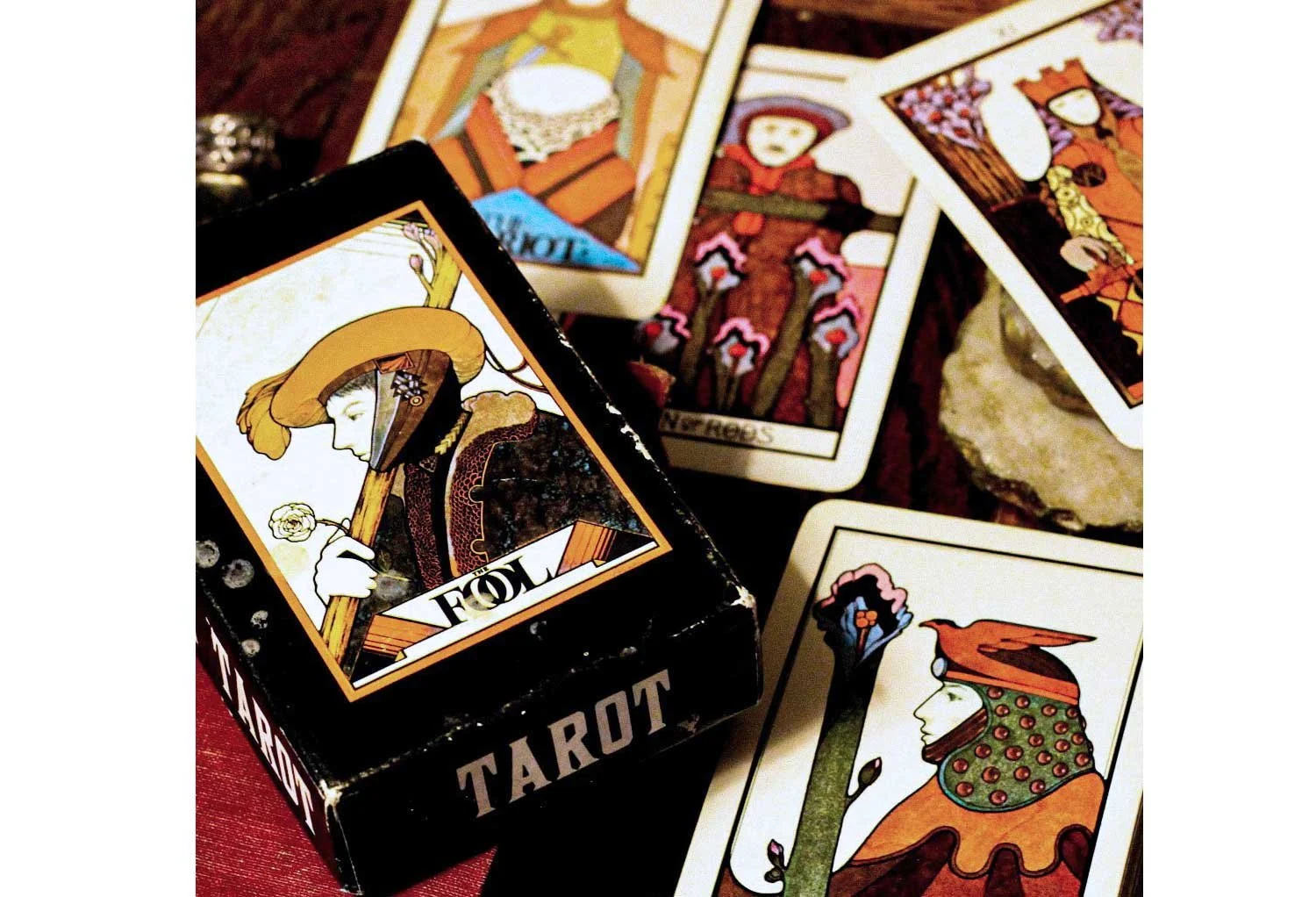
Aquarian Tarot deck, from the 1970s.
The Birth of Tarot in Renaissance Italy
Playing cards were already known in Europe by the late fourteenth century, but tarot emerged as a distinct form during the fifteenth century. The earliest references are associated with the wealthy courts of northern Italy, particularly Milan, Florence, Venice and Ferrara. At first, the cards were called carte da trionfi, “cards of triumphs,” and were used for a trick-taking game in which a special series of picture cards could triumph, or trump, over the ordinary suits.
A traditional tarot deck eventually settled into a structure of 78 cards. Fifty-six of these belonged to four suits - Cups, Swords, Batons and Coins- with numbered cards and the four court figures of King, Queen, Knight and Knave. An additional group consisted of twenty-one illustrated trump cards and the unnumbered Fool, today the number is usually 22 cards with the Fool being numbered as 0. These trump cards included such figures and subjects as the Emperor, the Pope, Justice, the Wheel of Fortune, Death, the Sun, the Moon and the World. The terminology “Major Arcana” and “Minor Arcana” was not used in the Renaissance; these names were introduced much later by nineteenth-century occultists.
The subjects on the earliest trumps were not originally intended as a secret magical alphabet. They drew upon imagery already familiar to Renaissance viewers: Christian teachings, moral virtues, classical mythology, allegorical pageants and the established ranks of earthly society. The Wheel of Fortune warned of the instability of worldly success, Justice represented moral and civic order, and Death reminded the viewer that neither wealth nor rank could prevent mortality. The sequence resembled the allegorical processions known as “triumphs,” in which personifications of Love, Fame, Time, Death or Eternity appeared in literature, paintings and public celebrations.
Tarot was therefore more than a simple game, even before it was used for divination. Its imagery offered a miniature theatre of human existence—from the wandering Fool to rulers, lovers, virtues, disasters and, finally, the celestial realm.
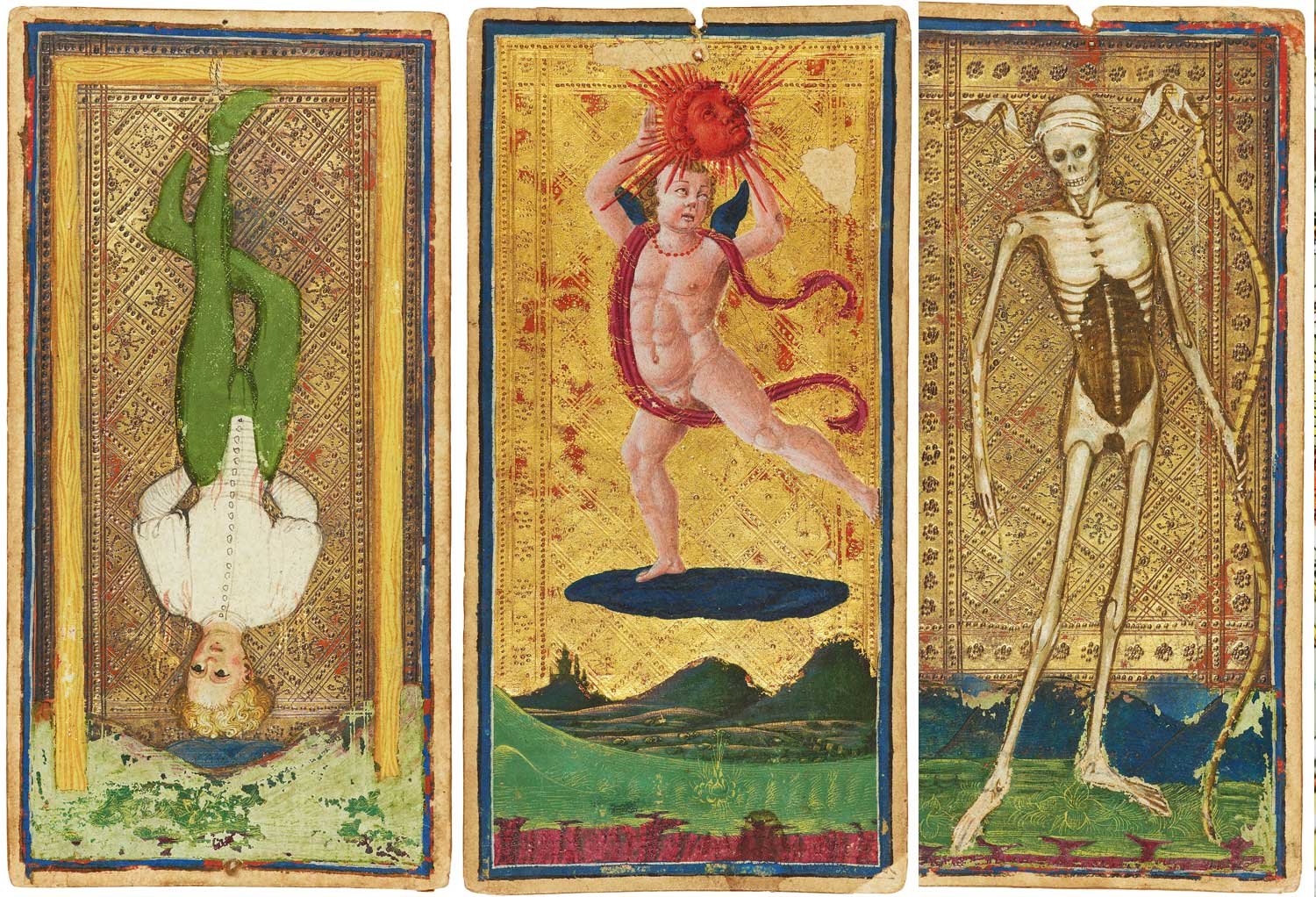
Individual cards from the Visconti-Sforza deck, these from the Morgan Library in NYC
The Painted Cards of the Visconti and Sforza Courts
The most splendid early tarot cards were handmade luxury objects commissioned by members of the Italian nobility. Among the finest surviving examples are the Visconti and Visconti-Sforza decks, produced in Milan during the mid-fifteenth century and associated with the ruling families of Filippo Maria Visconti and Francesco Sforza.
Attributed principally to the workshop of the Milanese court painter Bonifacio Bembo, these cards were painted in opaque colors upon pasteboard and embellished with tooled gold and silver. Flowing robes, heraldic devices and elegantly elongated figures give them the appearance of illuminated manuscript pages small enough to rest in the hand. Many of the figures wear contemporary court dress rather than imaginary ancient costumes, allowing the cards to preserve glimpses of Renaissance textiles, hairstyles, jewelry and ideals of aristocratic beauty.
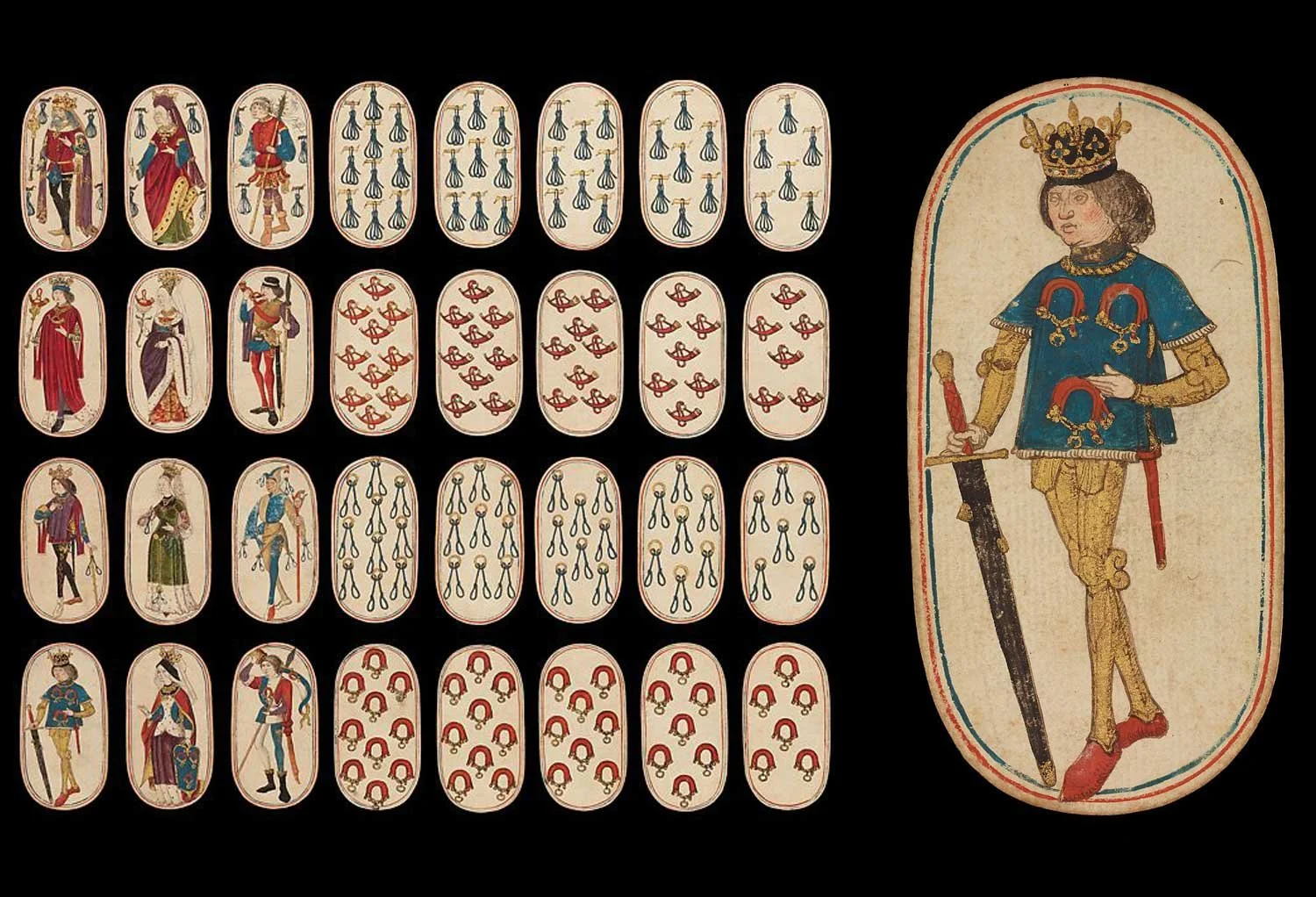
These are not Tarot Cards, but 15th Century playing cards. From the Met Museum Cloisters. Made from layers with 4 layers of pasteboard, paints, glazes and applied silver and gold.
Family emblems were sometimes incorporated into the decoration, suggesting that the cards could commemorate alliances, marriages or courtly occasions as well as provide entertainment. Seventy-four cards from one Visconti-Sforza deck survive, divided among the Morgan Library & Museum, the Accademia Carrara in Bergamo and a private collection. Other early groups include the Visconti Tarot and the Brambilla deck. Together, these rare cards reveal tarot at its beginnings: not as cheaply printed ephemera, but as a form of personalized court art. The Met Museum and the Morgan Library, in NYC, preserve extensive information about these remarkable early decks.
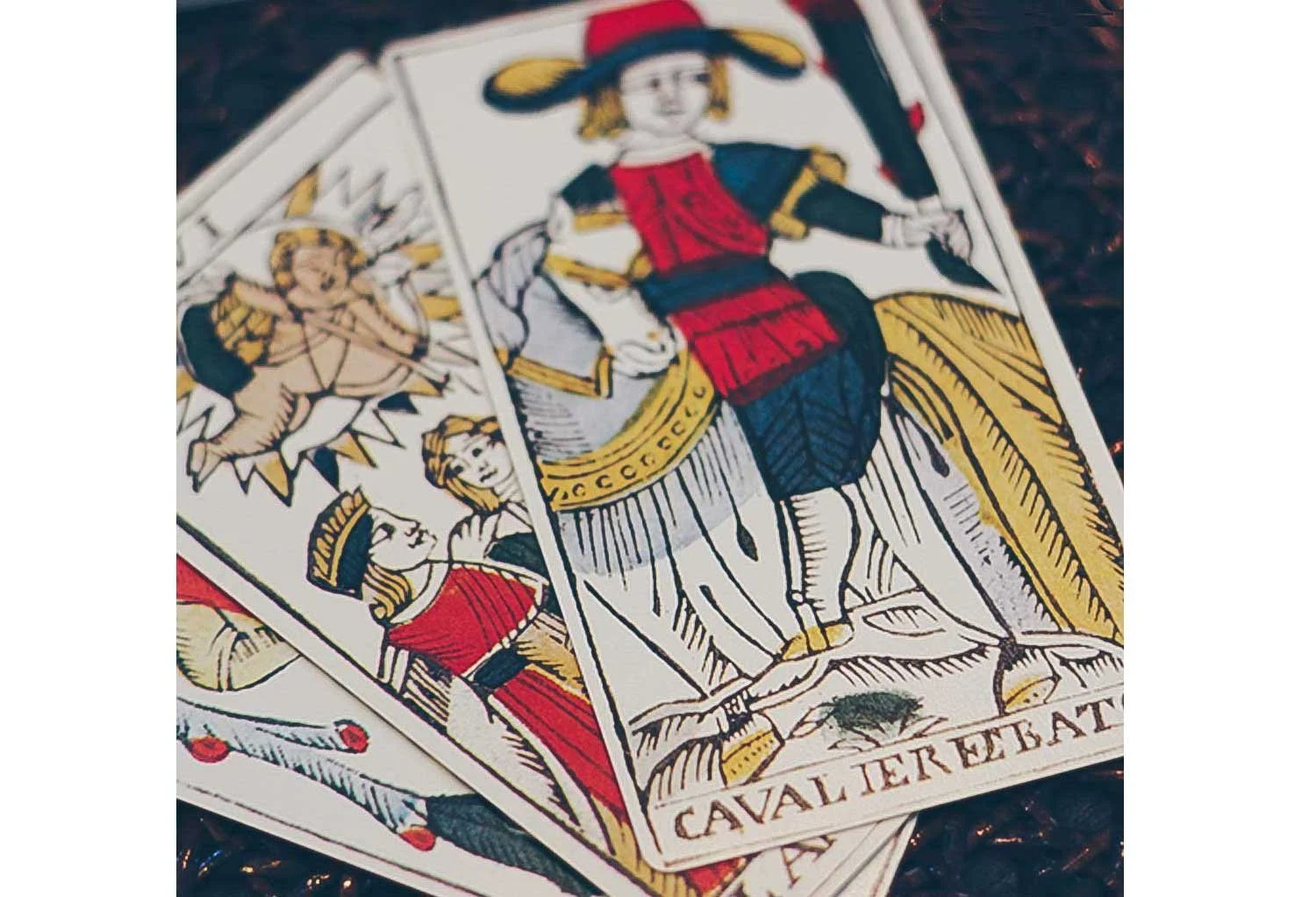
Cards from the Tarot de Marseille deck.
From Courtly Treasure to Printed Folk Art
Hand-painted cards were costly, but the development of woodcut printing allowed tarot decks to reach a much wider public. Cardmakers carved the principal lines of a design into wooden blocks, printed the images onto sheets of paper and added color by hand or through stencils. The cards were then pasted onto thicker paper, cut apart and sold for play.
This change in production transformed their appearance. The soft modeling and lavish gold grounds of the Visconti cards gave way to stronger outlines, flatter colors and simpler, more easily repeated compositions. Yet this was not merely a decline from luxury art to inexpensive printing. The practical limits of the woodcut created a new and highly recognizable visual language. One that was bold, direct and symbolic.
The best-known expression of this tradition is the Tarot de Marseille. Despite its name, this was not the creation of one artist or a single workshop, but a family of related designs produced in France, Switzerland and parts of Italy. Its familiar images the Magician standing before his table, the skeletal figure of Death, the lightning-struck Tower and the woman gently opening a lion’s jaws—were repeated and adapted by generations of printers.
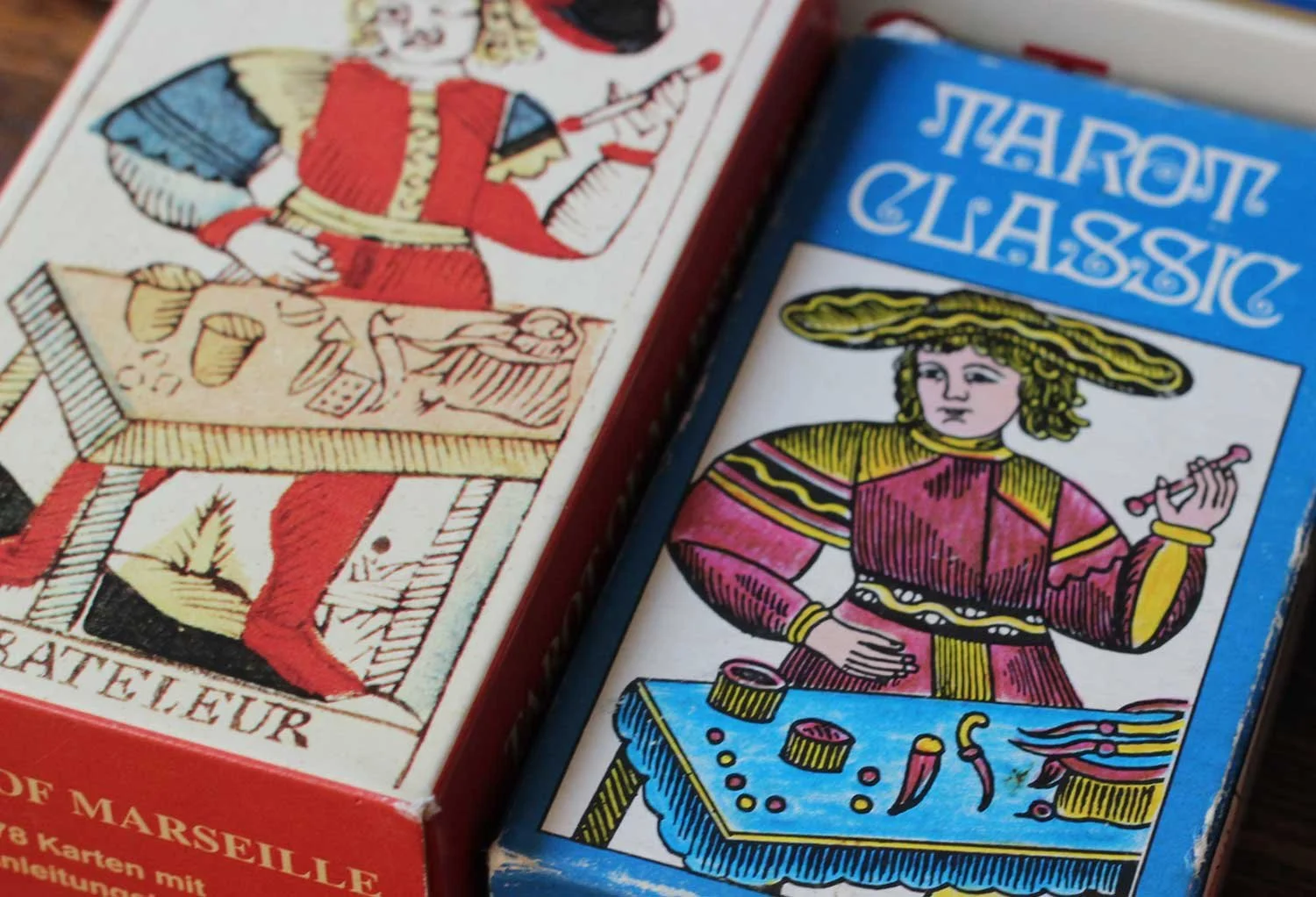
Two Marseille decks, both showing the Magician on the front of the card box.
The Marseille cards generally featured fully illustrated trump and court cards, while the numbered suit cards displayed arrangements of cups, swords, batons or coins rather than narrative scenes. Their limited palette of red, blue, yellow, green and black, applied within heavy outlines, gave them the appearance of small folk prints. Examples of eighteenth-century woodcut and stencil-colored tarot cards demonstrate how closely the design of the deck was tied to the technology used to reproduce it.
Regional variations also flourished. The Florentine game of Minchiate, developed alongside tarot, expanded the pack to 97 cards by adding theological virtues, the four elements and the signs of the zodiac. Elsewhere, cardmakers altered names, numbering and imagery to suit local customs or political sensitivities.
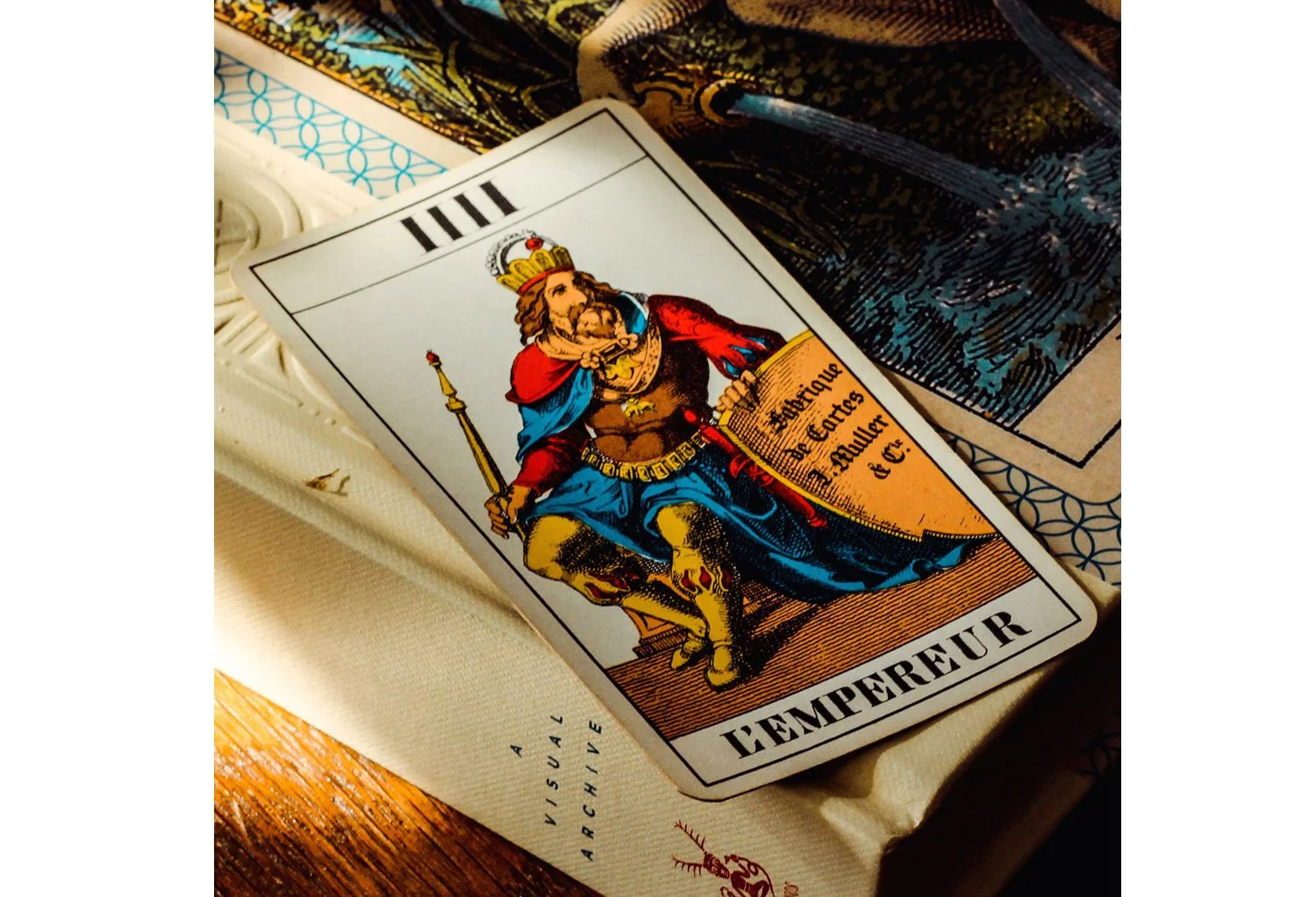
One of the Major Arcana, L’Empereur - the Emperor.
When Tarot Became Occult
Tarot’s connection with fortune-telling arose centuries after the cards were invented. Cartomancy, the practice of interpreting cards to uncover hidden information or predict events, became increasingly fashionable in eighteenth-century Europe. Ordinary playing cards could be used for this purpose, but tarot’s imagery made them especially attractive and added to the supernatural sense of drama.
During the 1780s, French writers began claiming that tarot preserved fragments of ancient Egyptian wisdom. These theories were imaginative rather than historically supported, but they permanently changed the way the cards were perceived. Jean-Baptiste Alliette, who wrote under the reversed form of his surname, Etteilla, became one of the first professional cartomancers to develop and publish a deck specifically intended for divination.
In the nineteenth century, occultists connected tarot with astrology, alchemy, numerology, ceremonial magic and the Kabbalah. Éliphas Lévi was particularly influential in presenting tarot as a key to a larger esoteric system. It was during this period that the trump and suit cards came to be called the Major and Minor Arcana- arcana meaning mysteries or secrets.
These occult interpretations did not uncover tarot’s original meaning so much as create an important new chapter in its history. Symbols that had once expressed Renaissance social and religious ideas were rearranged into a system intended to describe spiritual initiation, cosmic forces and the inner life of the individual.
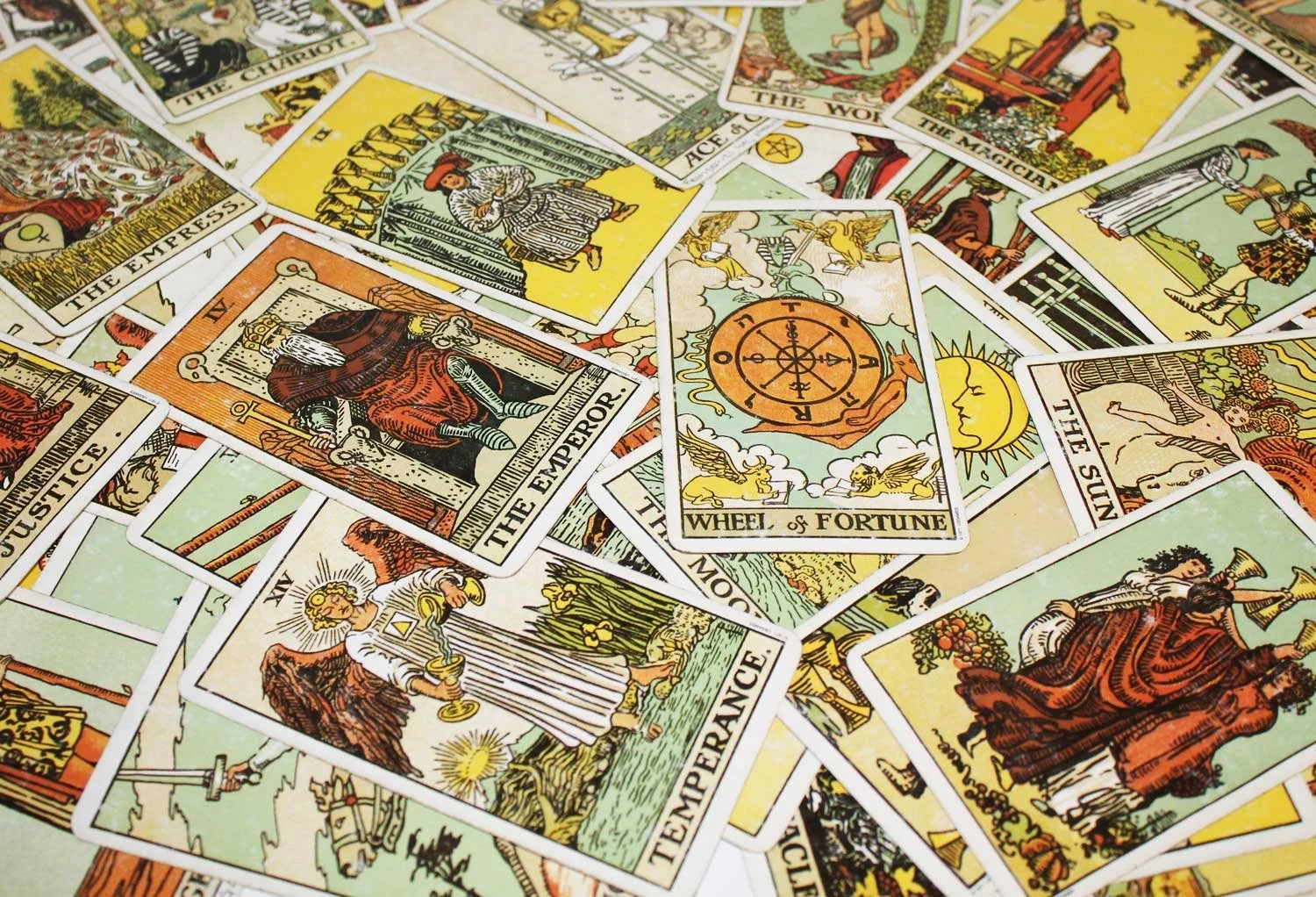
Rider Waite Smith Tarot Cards…
Pamela Colman Smith and the Modern Tarot Image
The most influential modern deck was created through the collaboration of British occultist Arthur Edward Waite and artist Pamela Colman Smith. First published by Rider in 1909, it is now commonly called the Rider-Waite-Smith deck—a name that properly acknowledges Smith’s essential artistic contribution.
Earlier European decks usually treated the numbered suit cards as decorative “pips”: seven cups, for example, or eight carefully arranged swords. Smith transformed these cards into fully illustrated scenes. Her Three of Swords depicts a heart pierced by three blades; the Five of Pentacles shows two struggling figures passing through the snow beneath an illuminated window; and the Eight of Cups presents a solitary traveler walking away beneath an eclipsed moon.
This innovation made the Minor Arcana far easier to interpret through imagery alone. Instead of memorizing a fixed meaning, a reader could study the figures, expressions, weather, landscape, colors and relationships within the scene.
Smith’s style combines influences from medieval and Renaissance art, theatrical costume, book illustration, folklore and the Arts and Crafts movement. Her forms are often simplified and outlined, but the scenes possess a remarkable emotional clarity. A gesture, turned head or distant mountain can suggest an entire story. Waite supplied detailed direction for many of the Major Arcana, while Smith had greater freedom in illustrating the Minor Arcana. Her designs became so influential that countless later decks have reinterpreted their compositions, sometimes without viewers realizing how much they owe to her imagination.
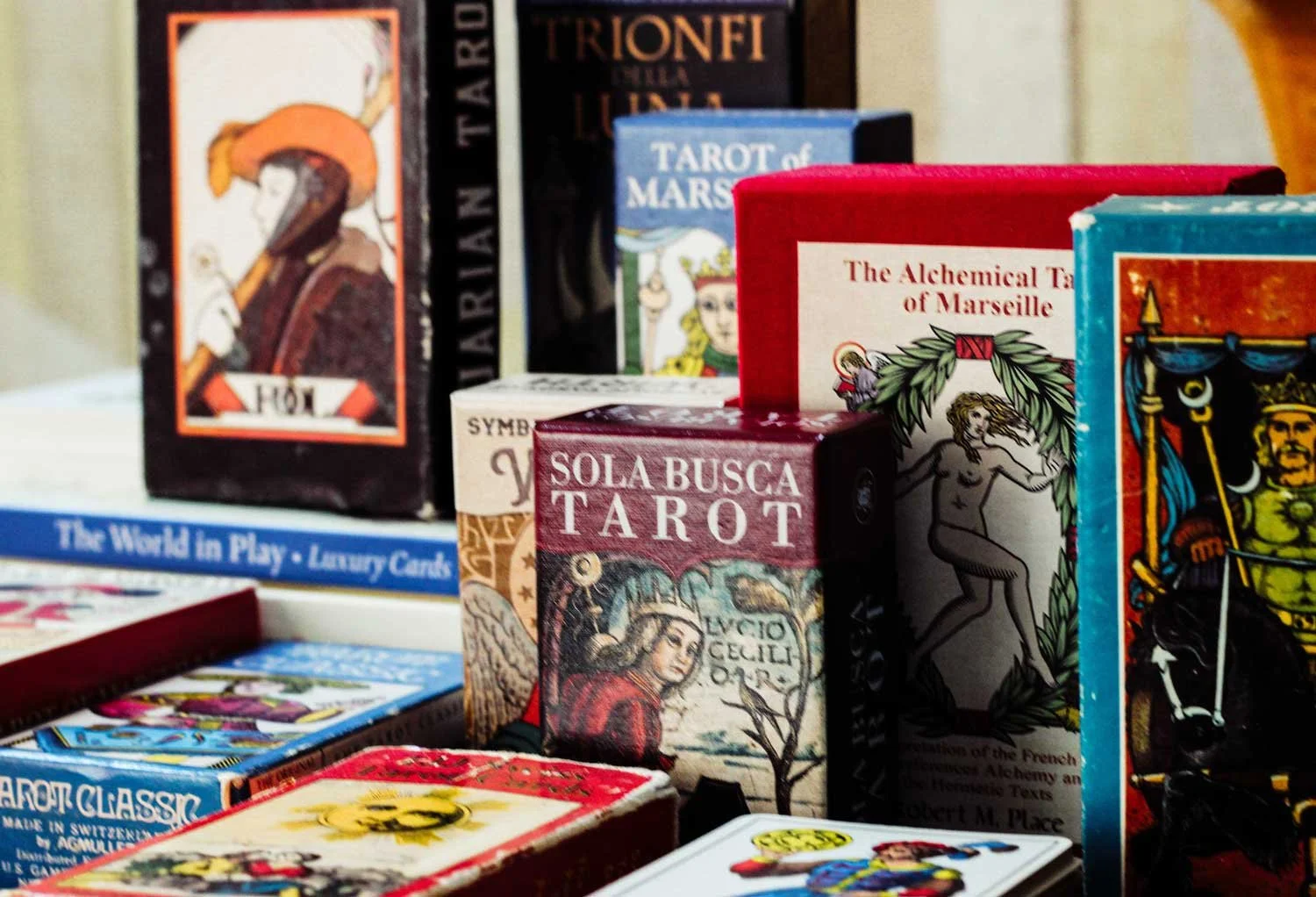
More from my collection…
Tarot as a Living Art Form
20th and 21st century artists have treated the tarot deck as a portable gallery: a sequence of interconnected works that can be viewed individually or arranged into changing combinations. Some decks preserve Renaissance dress and Marseille-style woodcuts; others draw upon Art Nouveau, Surrealism, botanical illustration, folklore, photography, collage or contemporary graphic design.
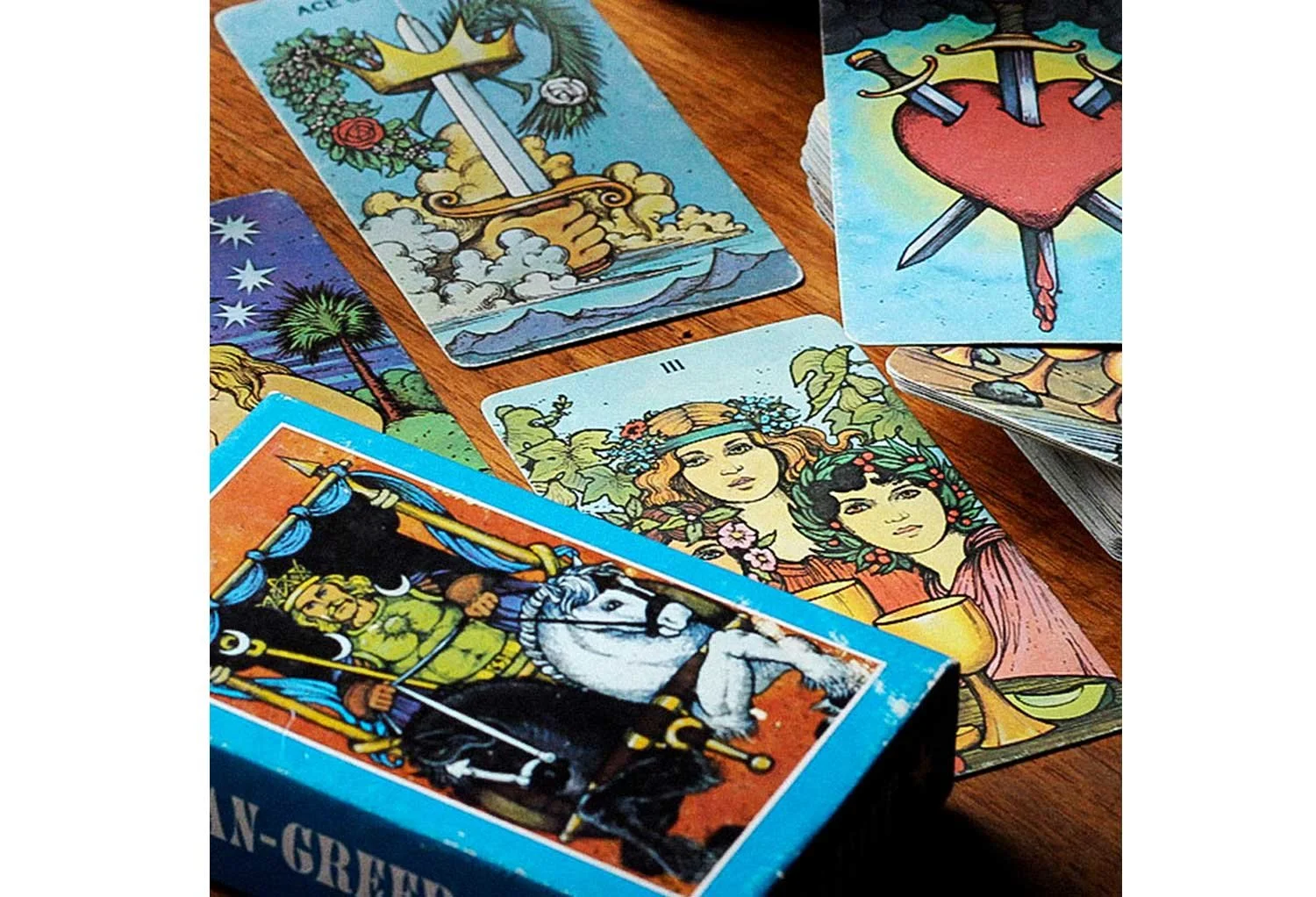
Original 1970s Morgan Greer deck, flower child meets King Arthur. This deck has recently been reprinted, but I love my vintage deck.
Because tarot provides artists with an existing framework, it invites both continuity and reinvention. A deck may retain the recognizable figure of the Hermit while depicting that figure as a medieval scholar, a forest mystic, an astronaut or an ordinary person seeking solitude. The structure remains familiar, but its visual world can be transformed.
Modern decks also represent cultures, spiritual traditions, bodies and identities that were largely absent from older European cards. For many users, tarot is no longer primarily a method of predicting the future. It may instead serve as a prompt for meditation, journaling, storytelling or the examination of choices and emotions. Its images remain powerful precisely because they do not possess only one interpretation.
Tarot, Oracle and Other Types of Cards
Although the terms are sometimes used interchangeably, not every illustrated divination deck is a tarot deck.
Tarot Cards
A standard tarot deck contains 78 cards and follows a recognizable inherited structure:
22 Major Arcana cards, consisting of 21 numbered trumps and the Fool
56 Minor Arcana cards divided into four suits
Numbered cards from Ace through Ten
Four court cards in each suit, usually Page, Knight, Queen and King
The titles, order and artwork may vary, but a deck that calls itself tarot will normally retain most of this structure.
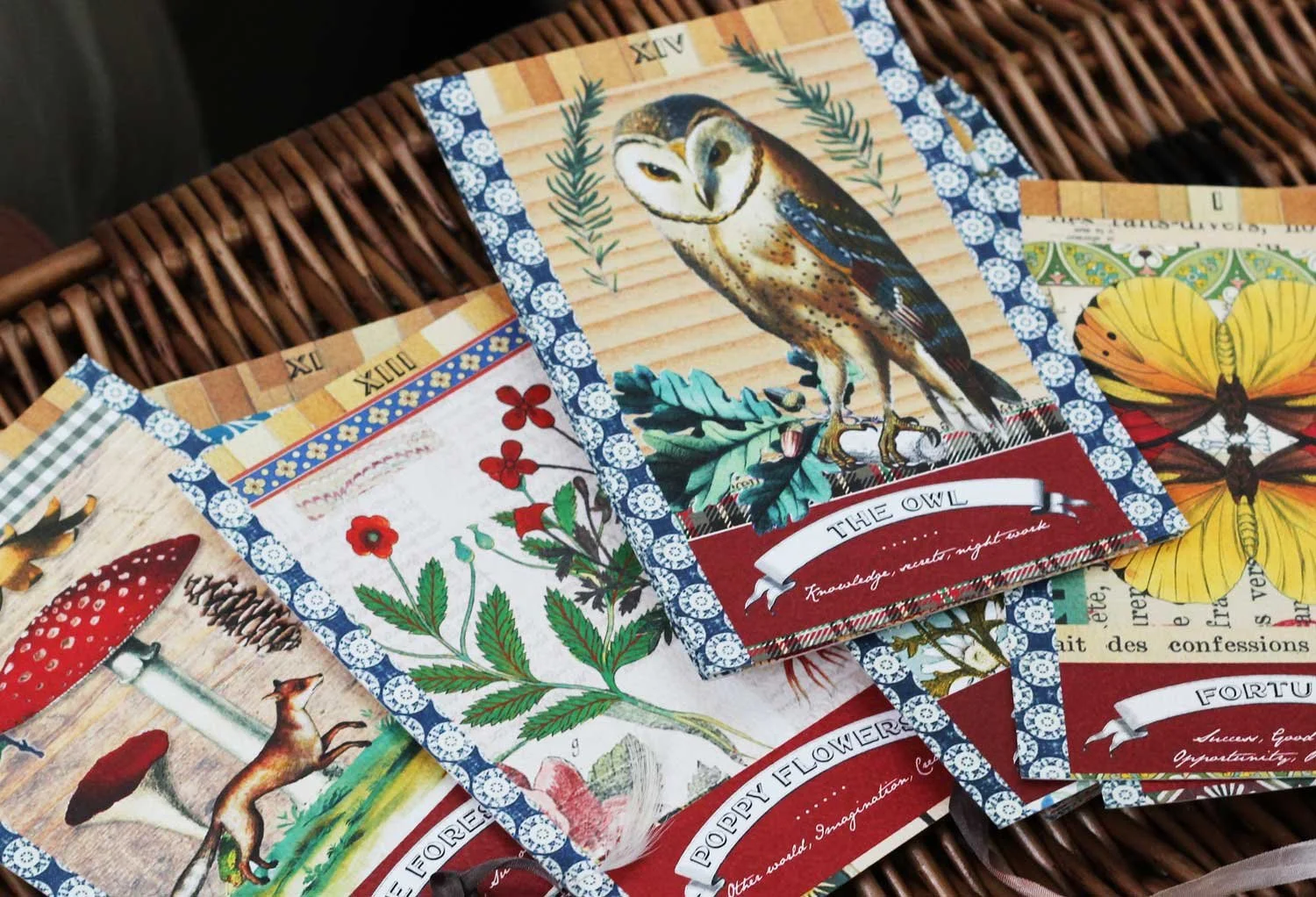
Assorted Oracle Cards…
Oracle Cards
Oracle decks have no required number of cards, suits or established sequence. Their creator determines the subject, organization and meanings. One oracle might contain 30 botanical cards, another 52 goddesses, and another 44 animals, angels or affirmations.
This freedom allows oracle decks to be especially varied in their art and design. They may resemble tarot cards, but they do not need to contain figures such as the Fool, the Magician or the Wheel of Fortune. Oracle cards also tend to offer more direct messages, sometimes printing a word or sentence such as “Renewal,” “Patience” or “Trust Your Instincts” upon the card itself.
In short, tarot is a particular historic system; “oracle” is a broad modern category for decks with creator-defined systems.
Lenormand Cards
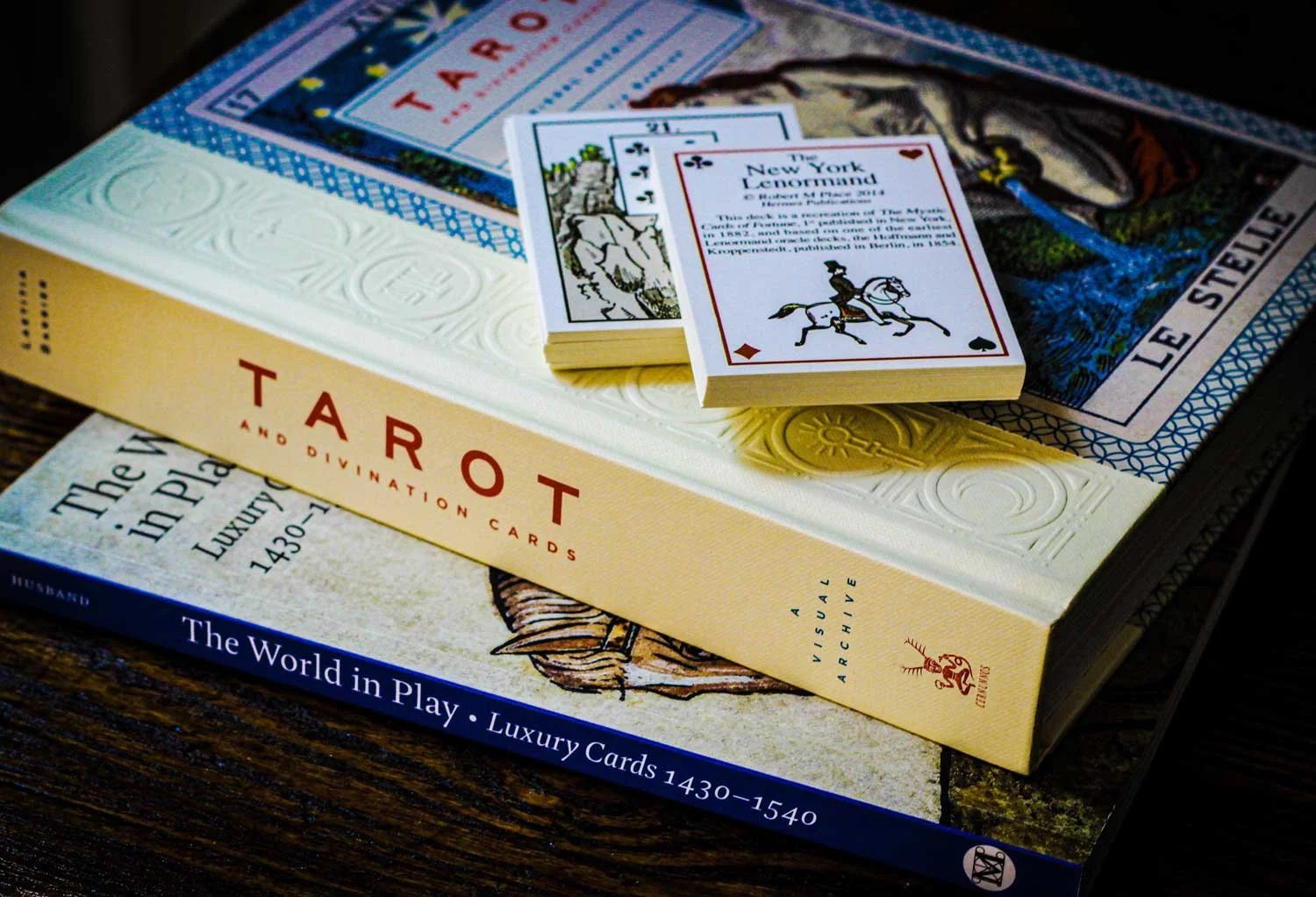
Books on the history of playing cards and Tarot and a Lenormand deck.
Lenormand is a separate cartomantic tradition rather than a form of tarot. The most familiar Petit Lenormand deck contains 36 cards bearing concise images such as the Rider, Clover, Ship, House, Tree, Key, Moon and Cross.
The system takes its name from the celebrated French fortune-teller Marie-Anne Lenormand, although the small deck associated with her was derived from a German parlor game called Das Spiel der Hoffnung, or The Game of Hope. Lenormand readings usually depend heavily upon combinations: one image modifies the card beside it, creating phrases almost like a visual language. Tarot, by comparison, tends to place greater emphasis on the layered symbolism and individual character of each card.
Ordinary Playing Cards
A standard 52-card deck can also be used for cartomancy. Hearts, Diamonds, Clubs and Spades may be assigned meanings, as can the numbered and court cards. This practice predates some specifically designed oracle decks and was central to the eighteenth-century rise of professional fortune-telling.
Playing cards and tarot share common ancestors, but a modern playing-card deck lacks tarot’s separate series of 22 archetypal trumps.
Affirmation and Guidance Cards
These are usually considered a form of oracle deck, though they may not be intended for divination at all. Their cards contain encouraging statements, questions or prompts for reflection. Rather than predicting events, they are designed to focus attention, inspire creative thought or support a daily practice.
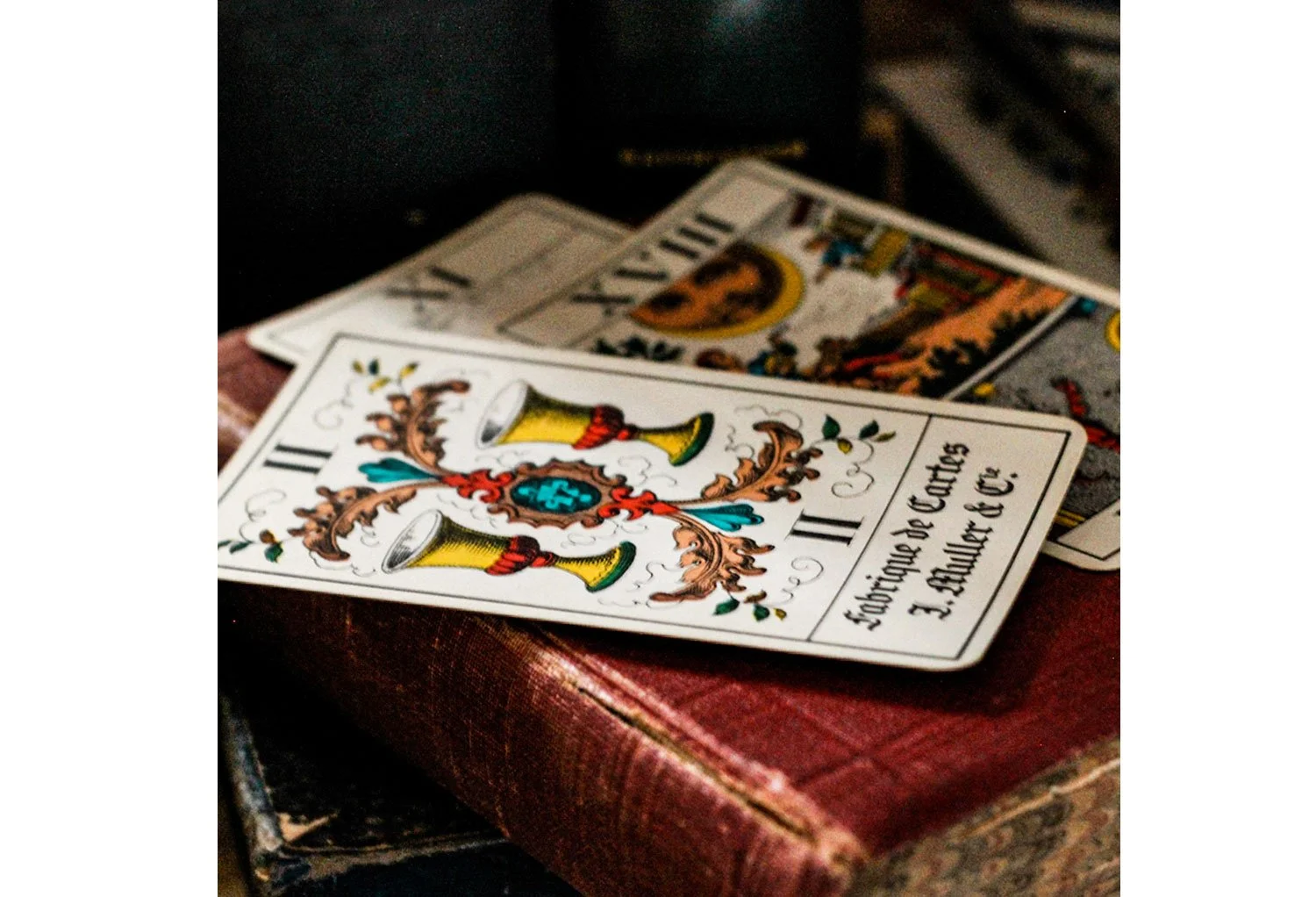
From a French Tarot deck…
A Mirror in Miniature
Tarot’s long history is a history of changing purposes. It began as a Renaissance game, became a vehicle for allegorical art, entered popular culture through woodcut printing and was recast by 18th and 19th century occultists as a book of hidden wisdom. Pamela Colman Smith then gave its minor cards a new narrative life, while modern artists continue to reshape the deck for their own cultures and imaginations.
Whether regarded as a game, an oracle, an aid to reflection or simply a collection of beautiful images, tarot remains one of the most enduring forms of narrative art. Its cards are small enough to be shuffled in the hand, yet broad enough in subject to contain rulers and wanderers, virtues and temptations, love and ruin, the turning heavens and nearly every uncertainty of human life.
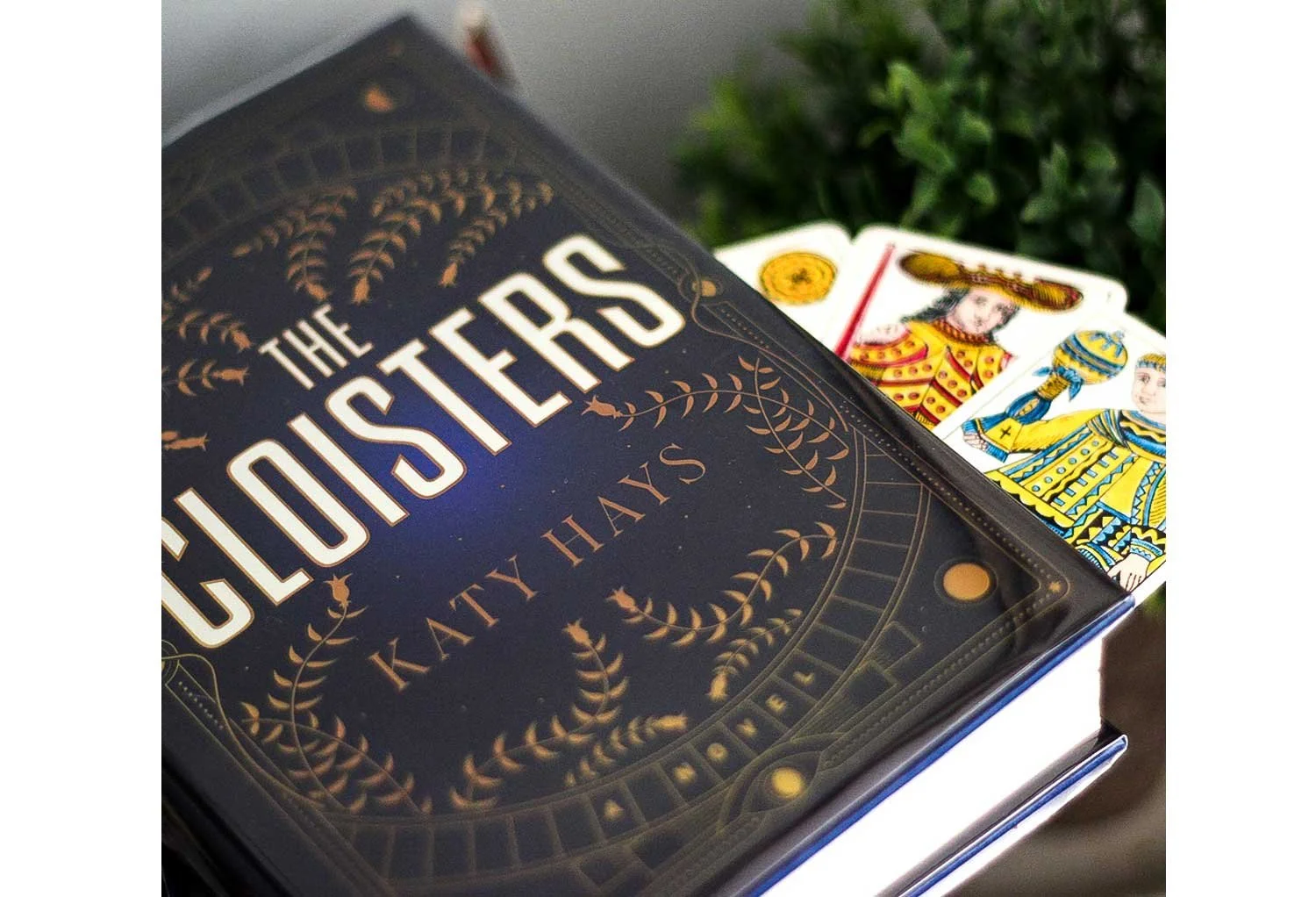
The Cloisters by Katy Hays
Lastly…
And just for fun…if you’re a suspense fan, a medieval art fan and a tarot card fan, you might want to check out ‘The Cloisters,’ by Katy Hays.
I listened to this as an audio book on a road trip and I really enjoyed it. Atmosphere, suspense, a little art history mystery! The setting is The Met Museuem’s Cloisters in NYC (hence the title) and it’s a novel built around a set of ancient tarot cards.
Links of interest:
The V & Museum video on Tarot Card history